Double Maths First Thing didn’t know the letters went that big.
Hello! My name is Colin and I am a mathematician on a mission to share the joy and delight I take in figuring stuff out and solving puzzles. This weekend just gone, I went to the not-yet-open MathsWorld venue in Southwark to hang out with my geeks and practise calculating pi by hand. Young Bill was thrilled that Matt Parker signed his calculator, and I’ve spent the last couple of days reading up on ways that might improve the method. Turns out Leonhard Euler was pretty clever, who knew?
I also got to meet the co-author of the maths/art crossover short stories I’ve been working on for ages – we’re getting closer and closer to a first draft, and I’m really excited about it.
Waiting for the optician the other day, Bill asked to play Wordle as if we were still in 2021. I think Mastermind is a better game, and Erik Göransson Gaspar has a lovely article about optimal play.
Another good strategy game: Paper soccer, which I recall stealing a great deal of time from me back in the day.
On one hand, I loathe headlines that start with the word “This”, a symptom of the Buzzfeedification of everything, but I’ll make an exception here: a chap in New York state has built a scale model of NYC. Maths? Sometimes it’s ok just to share something cool.
Another cool thing: an investigation into the physics of badminton. It’s not a sport I play, and if it was, I don’t think the sport I would play would be the same sport as people who use a spin serve play
There’s a Finite Group livestream with scicomm legend Hana Ayoob on the maths of colour tomorrow, September 25th at 12 noon UK time. (I’ll be watching it on catch-up, which is one of the many perks of being a member of the Group.)
Early bird tickets for Big MathsJam are only available until the end of September – if you’re going to hang out with us and do maths (with cakes, music, craft, games, etc. all available) in Milton Keynes in November, now would be an excellent time to buy your tickets. Next week, they’ll be about 11% more expensive.
I’ve never been to MathsConf, but the next one is on October 11th-12th: several friends of mine are speaking or running workshops, including Tom Briggs, Rob Eastaway and Karen Hancock.
Lastly, the annual tradition that is Mathober is almost upon us; Fractal Kitty has, as always, come up with a set of daily prompts for all of us to use as inspiration for… whatever we like, really. At least one PRE song has been written as a result.
That’s all I’ve got for this week. If you have friends and/or colleagues who would enjoy Double Maths First Thing, do send them the link to sign up – they’ll be very welcome here.
Meanwhile, if there’s something I should know about, you can find me on Mathstodon as @icecolbeveridge, or at my personal website. You can also just reply to this email if there’s something you want to tell me.
In a dimly-lit tavern on the South Bank of the Thames, Philip Henslowe — builder and owner of the Rose Theatre — is celebrating the success of Shakespeare’s latest blockbuster, Henry VI Part I, among the cutthroats, actors and other lowlife of London. He spreads thirteen playing cards on a table in a circle. “Pick a card,” he grins. “Any card.”
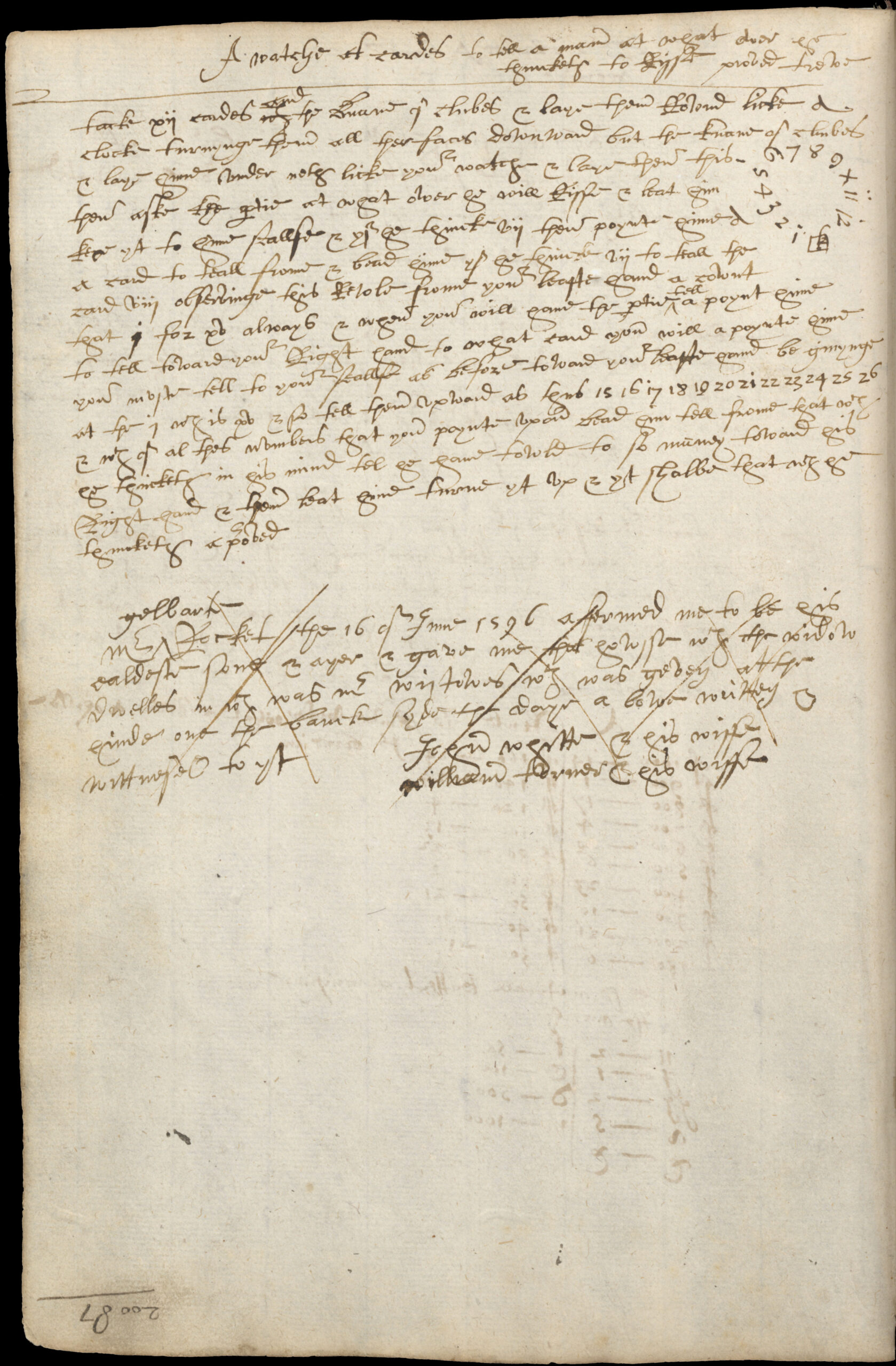
Henslowe, one of Elizabethan theatre’s most important figures, kept a diary. It’s mainly the accounts of the theatre and records of loans, but among the administrivia are some gems — including the following card trick:
Dulwich College Archive MS VII f18v — with kind permission of the Governors of Dulwich College
My dogged team of researchers is looking into it, but there are very few documented card tricks from this era — and most of them are sleight-of-hand or forces. Tiago says this might be related to something written by Pacioli in 1478, and I understand there are Italian deck-stacking tricks from the first half of the 16th century. While it’s relatively unremarkable now, it seems quite sophisticated for its time.
Luckily, the trick was transcribed by W. W. Greg barely 300 years after having been scrawled out by Henslowe:
Now, I don’t know about you, but I’m not fluent in shorthand-infused streams-of-consciousness written in Early Modern English. Maths communication has evidently come a long way in the last 400 years. Here’s the best I can do as a more-or-less faithful translation:
Take 12 cards and the jack of clubs and lay them in a circle like a clock, all face down except for the jack. Put the jack at the bottom like on your watch [ed: I have never owned a watch with the jack of clubs at the bottom of it, but let’s roll with it], laid out like [the picture]. Then ask the volunteer what time they will get up and to keep it to themself.
Tell them to pick a card to count from [ed: It’s unclear to me whether the trickster or the volunteer picks the card — it doesn’t make a difference, so I’d let the volunteer do it]. Starting from this card and moving clockwise, they should count from their card up to 15 — so if they picked 7, they should count on eight cards.
Going around the circle, you count aloud clockwise while pointing at the cards, saying “15” on the first card clockwise from the jack, “16” on the second and so on up to 26. Tell the volunteer that whichever number you said when you pointed at their current card, they should count anticlockwise from their secret number up to that number.
When they flip the card they land on, it will be the number they first thought of.
I presume “a proved” is Early Middle English for “and everyone said WOW! That’s amazing.”
But it doesn’t work.
If you follow the instructions — which, like a game of Telephone that started centuries before the telephone was invented, have been written down from Henslowe’s memory, transcribed by an expert from unclear manuscript, and then translated into modern-day English by someone unqualified to do so. Hi! — you’ll find your “tada!” falls flat, because it’s not their secret number.
Let’s try it: I get up when I want, except on Wednesdays when I’m rudely awakened by the dustmen at 6am. And, rolling a 13-sided die¹ to decide where to start, I get card #3. I need to count on 9 clockwise from there (to make it up to 15), so I end up on card #12. That’s been given the number 26, so I need to count counterclockwise from my number (6) up to 26 — that is, 20 cards backwards. That takes me to 5.
¹ Yes, I do own a 13-sided die. Why do you ask?
Close, but no not-yet-introduced-to-England cigar.
It turns out that, whatever card you start from, and whichever number you pick, you’ll end up on the card immediately before your secret number. This suggests an easy fix: start your counting-aloud from 14 at card #1.
In case you want to do the trick yourself correctly, here are instructions for my version:
Tell your volunteer to think of a secret number from 1 to 12 (don’t let me control your mind!).
Tell them to pick a card (any card! don’t tell me what it is) and count clockwise from their chosen card, starting from their secret number and ending at 15. Have them tell you the card they land on.
Now tell them the numbers attached to the card: whatever “time” their card is on the clock face, give them a number 13 higher.
They must now move anticlockwise from their chosen card, starting from their secret number, ending on the number attached to the card.
Turn over the card they ended up on and say “abracadabra!”.
My glamorous assistant Bill goes through the trick with me. Better magicians than me — which is pretty much everyone — will have ideas about improving the patter and performance.
NOW it works. But why?
You know what else, apart from the later Shakespeare plays, telephones, and cigars, hadn’t arrived in Elizabethan London? I’ll tell you: modular arithmetic. At least, modular arithmetic as we know it — working with remainders goes back to at least Sun Zi in the third century CE, but Euler and Gauss’s formalisations of it were still 150 years away.
I don’t know what Henslowe’s mathematical background was — he was certainly competent at regular arithmetic — so I don’t know whether he understood why the trick worked, whether he came up with it himself, or anything about the history of it. All the same, I’m certain he wouldn’t have used the modulo function.
(In case you’re one of today’s lucky 10,000: modular arithmetic uses the remainder left over when you divide by a given number, like on a clock: 16:00 is the same as 4pm, and we’d say we were working “modulo 12” or “mod 12”, because we are lazy and modulo is far too long a word. The numbers 4 and 16 have the same remainder when you divide them by 12. In this problem, we’ll be working modulo 13.)
Let’s say you’ve picked secret number \(s\) and you decide to start from card #\(c\). You’re going to count on \( 15-s \) cards from there, so you end up at card #\( (c + 15 – s ) \). (We can think of card 14 as the same as card 1 and so on.)
The number I assign to it is 13 more than the card number. Modulo 13, that’s just the card number — but doing it this way ensures we don’t have to deal with negative numbers. (Negative numbers had probably reached England by this point, but I don’t imagine they were the kind of thing you’d want to have in a card trick.)
In any case, the volunteer is currently at card #\( (c +15 – s ) \) and has been given the target # \( (c +28 – s )\) to count to, starting at their secret number \( s \). That means they’re going to move \( (c +28 – 2s) \) cards back the way they came, starting at card #\( (c + 15 -s ) \). Moving backwards makes it a subtraction, so we work out \( (c + 15 – s ) – (c +28 – 2s ) \) to see that we end up on card #\( (s – 13)\).
And, because there are 13 cards, that’s the same as card #\(s\), which has the volunteer’s secret number written on it.
Boom.
One more twist, though
When I talked to young Bill about it, he asked a tremendous mathematical question: “would it work with a number other than 15?” The kid is ten years old, and already making me mutter “good GRIEF, where did that come from?” about three times a month.
The answer is… you don’t need it to be 15. In fact, the first half of the trick is mathematically irrelevant². You could ask them to spell out their secret number in a language of their choice, you could ask them to add their age to their best Parkrun time in minutes, you could ask them to spin a coin and pick the card it lands closest to. It doesn’t matter in the slightest, as long as they pick a card.
² That doesn’t mean it’s not an important part of the trick! I think it’s helpful to demonstrate how you want the final bit counted, and it misdirects the volunteer/audience into thinking there must be something clever going on.
If that’s card #\( C \), then they subtract \( (C + 13) – s \) from it — which again leaves you on card #\( (s – 13) \), which is card #\( s \).
Even knowing the maths behind it, I think this is still a pretty impressive trick. To someone frequenting a smoky Elizabethan tavern, it must have looked like, well, magic.
Thanks to Rob Eastaway for sending me the trick. His book on the maths of Shakespeare, Much Ado About Numbers, is available wherever good books etc.Thanks also to Paul O’Malley and Tiago Hirth for historical help, and to Calista Lucy and the Governors of Dulwich College for permission to reproduce the manuscript page.
Long-time Aperiodical muse David Cushing has made a bet with us that he can give us an interesting post every Friday for the next ten weeks. Every week that he sends a post, we buy him a bar of chocolate. Every week that he doesn’t send us a post, he buys us a bar of chocolate. For his first trick, David is going to do some unnatural things with the natural numbers.
The greatest common divisor (gcd) of two or more integers is the greatest integer that evenly divides those integers. For example, the gcd of $8$ and $12$ is $4$ (usually written as $\gcd(8,12)=4$). Two integers are called coprime (or “relatively prime”) if their gcd is equal to $1$.
A reasonable question to ask is,
Given two randomly chosen integers $a$ and $b$, what is the probability that $\gcd(a,b)=1$?
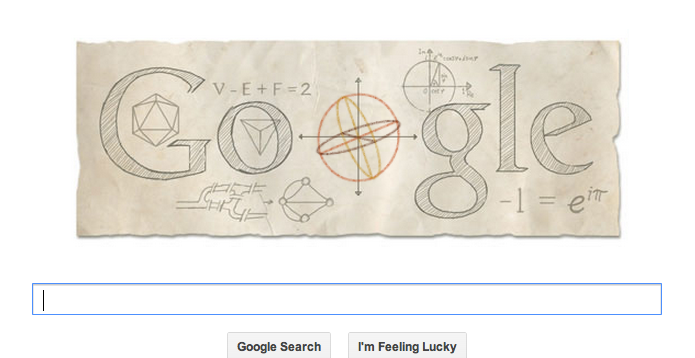
Today is Euler’s $-306 \times e^{i \pi}$th birthday, and Google have chosen to celebrate (despite ignoring several other prominent mathematical birthdays, including Erdős’s centenary – see the @MathsHistory twitter feed for a full list) by creating a Google doodle on their homepage.
For anyone who isn’t aware, this is when Google changes the image above the search box on the homepage at Google.com, so it still says ‘Google’ but using an appropriate image, which sometimes has built-in interactive elements. I thought it was worth pointing out some of the fantastic maths they’ve included in today’s doodle.
In this short series of articles, I’m writing about mathematical questions we don’t know the answer to – which haven’t yet been proven or disproven. This is the second article in the series, and considers a less well-known variant on an extremely well-known problem.
Ask anyone to name a theorem, and they’ll probably come up with one of the really famous ones, like Pythagoras’ theorem. This super-handy hypotenuse fact states that for a triangle with sides A, B and C, where the angle between A and B is a right angle, we have $C^2 = A^2 + B^2$. This leads us on to a nice bit of stamp-collecting – there are infinitely many triples of integers, A, B and C, which fit this equation, called Pythagorean Triples.
One well-known generalisation of this is to change the value $2$ to larger values, and go looking for triples satisfying $C^n = A^n + B^n$. But don’t – Andrew Wiles spent a good chunk of his life on proving that you can’t, for any value of $n>2$, find any such triples. The statement was originally made by Pierre De Fermat, and while Fermat famously didn’t write down a proof, it was the last of his mathematical statements to be gifted one – hence the name ‘Fermat’s Last Theorem’ – and proving it took over 350 years.

![Screenshot of a PDF of the transcription. Text reads: "A watche at cardes to tell a man at what ower he thincketh to Risse proved trewe"; then a horizontal line; then "tacke xij cardes [w^th (and)] the knaue of clubes & laye them Round licke a clocke turnynge them all ther faces downward but the knave of clubes & laye hime vnder neth licke you^r watche & laye them this- then aske the ptie at what ower he will Risse & leat him kepe yt to hime seallfe & yf he thincke vij then poynte hime a a card to teall frome & bead hime yf he thincke vij to teall the card viij observinge this Rewle frome your leafte hand a cownt; that j for xv always & when you will have the ptie ^tell a poynt hime to tell toward you^r Right hand to what card you will a poynte hime you muste tell to your sealfe as before toward you leafte hand be ginynge at the j wch is xv & so tell them vpward as thus 15 16 17 18 19 20 21 22 23 24 & w^ch of al thes nvmbers that you poynte vpon bead him tell frome that w^ch he thinketh in his mind tel he haue towld to so maney toward his Right hand & then leat hime turn yt vp & yt shalbe that w^ch he thincketh a proved." To the right is a diagram of the numbers 1-12 arranged in a circle, with an X in place of 10.](https://aperiodical.com/wp-content/uploads/2024/09/image-2.png)