
Puzzlebomb – Issue 25 – January 2014
The solutions to Issue 25 can be found here:
Puzzlebomb – Issue 25 – January 2014 – Solutions
Previous issues of Puzzlebomb, and their solutions, can be found here.
Puzzlebomb – Issue 25 – January 2014
The solutions to Issue 25 can be found here:
Puzzlebomb – Issue 25 – January 2014 – Solutions
Previous issues of Puzzlebomb, and their solutions, can be found here.
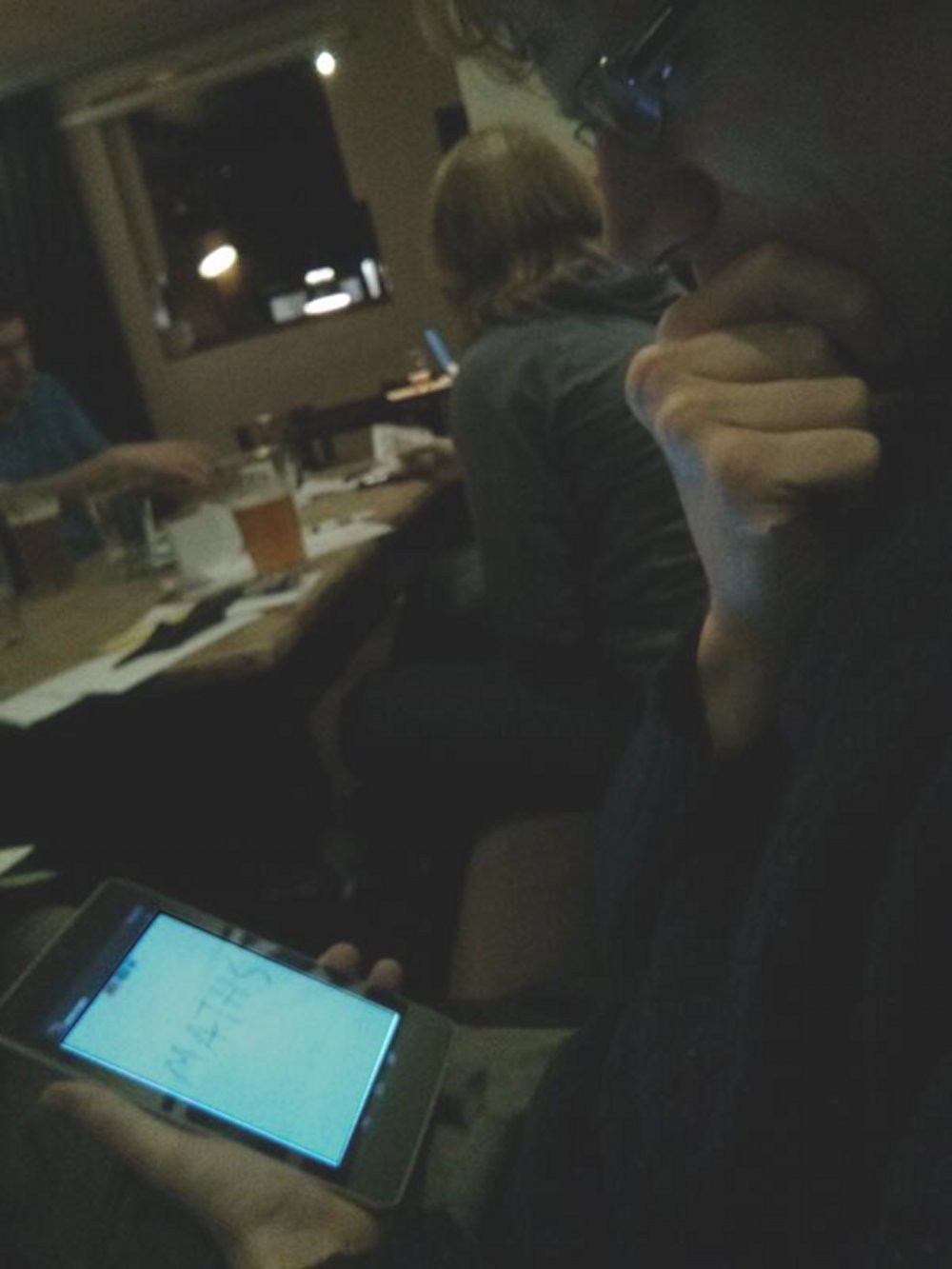 Since I haven’t written a MathsJam recap for a few months, due to extreme busyness, this post will recap things which happened at December’s MathsJam as well as some other things I found in the pile of scrap paper when I went to tidy it all away over New Year.
 Puzzlebomb is a monthly puzzle compendium. Issue 23 of Puzzlebomb, for November 2013, can be found here:
Puzzlebomb – Issue 23 – November 2013
The solutions to Issue 23 can be found here:
Puzzlebomb – Issue 23 – November 2013 – Solutions
Previous issues of Puzzlebomb, and their solutions, can be found here.
Inspired by our Open Season post on the Perfect Cuboid earlier this year, Aperiodical reader Jos Schouten wrote to us describing his work on the problem over the past 20 years. He’s looking for someone to help take his work further. Are you up to the challenge?
This article is about my search for the Perfect Cuboid (PC), which started exactly on Wednesday April 15, 1987. At that time I was a young engineer with feelings for mathematics, and employed to write C-language programs on a UNIX platform. Since then I’ve written software and explored ideas to find the cuboid, at work and at home. I still haven’t found one!
This article is also hoping to find someone in the world community as sparring partner, who likes the subject, wants to propose additional solution methods, and can help to implement such a method. The attempt will be to find a perfect cuboid with an odd side less than a googol.
The problem is easy to state, extremely difficult to solve, but a solution, once found, would be easy to verify.
The problem in words:
Find a cuboid whose sides are integer lengths, whose face diagonals are integers and whose space diagonal (from corner to opposite corner) is integral too.
Radio 4 maths police More or Less took time off from calling out journalists and deputy prime ministers for their misuse of statistics this series to sneak a hidden maths puzzle into their show. The first five episodes were “brought to us by” the numbers, respectively, 1, 49, 100, 784 and 1444. Listeners were invited to work out what number would bring us the final episode.
Puzzlebomb is a monthly puzzle compendium. Issue 22 of Puzzlebomb, for October 2013, can be found here:
Puzzlebomb – Issue 22 – October 2013
The solutions to Issue 22 can be found here:
Puzzlebomb – Issue 22 – October 2013 – Solutions
Previous issues of Puzzlebomb, and their solutions, can be found here.
More or Less, the BBC’s maths and statistics radio show, has been sneakily doing a puzzle on us for the last few weeks. The episodes in the series so far have each been ‘brought to you’, Sesame Street-style, by a different number. But what will the final episode be? Can you crack the integer code and solve the puzzle?
The puzzle was announced in the programme broadcast on the 27th of September; you can listen to it on the Radio 4 site or as a podcast (the puzzle bit is at 27:05). If you think you’ve solved the riddle, email More or Less through their website.
The episodes so far have been brought to you by the numbers 1, 49, 100, 784 and 1444. (It’s not in the OEIS; we’ve checked). You can find out if you’re right when the final episode in the series goes out, on BBC Radio 4 at 4.30pm on Friday 4th October.