The number one component of music that really gets my attention is Brian May plays guitar, but a very close second is clever lyrics. The first morning of 2025’s Talking Maths in Public (TMiP) conference, from waking up, through carving myself a slice of scrambled egg at the breakfast buffet, up until the blessed relief of Jon Chase’s fabulous keynote talk, was soundtracked by a repeating refrain that only I could hear:
‘I like the Pope / The Pope’s got notes on polytopes’.
Double Maths First Thing is not quite mathematically relegated yet
Hello! My name is Colin and I am a mathematician on a mission to spread the love and joy in maths.
My personal maths highlight of the week was well-actually-ing a Guardian Knowledge article, which claims that Man City were mathematically unable to stay on top of the 1972 Football League immediately after their final game. HOWEVER, had remaining results gone their way — specifically, a 17-17 draw between Liverpool and Derby County, and a 2-0 defeat for Liverpool in the other match — it was absolutely possible for the title to go to Maine Road (at least mathematically).
Two PDFs to begin with? A strong start. And this one is over a kilopage — given that it’s an Infinite Napkin, though, that shows some restraint. It’s an overview of an awful lot of pure maths, the sort of thing I skipped lectures about back in the day, but now find quite interesting.
I enjoyed this story of how to represent numbers in a calculator.
Given last night’s destruction of the kids’ Monopoly dreams (only one of them ended up in tears, I’m not completely heartless), it’s not as though I need help defeating the children at card games. In case you do, though, here is a card game and strategy. See if you can make more children cry! (It strikes me that you could also use it as a terrible way to approximate pi.)
In less mean news, Sam has a new game, in which you talk about maths with just short words. It sounds like great fun!
Currently
I understand DMFT was mentioned in a recent MathsGear newsletter. I’m a fan of the enterprise, and as far as I can tell, all of the dice I have ever bought from them are perfectly random.
I’m hosting the Carnival of Mathematics for early March — follow that link if you’ve got any maths links you’d like to share. Or email me, I’m always happy to hear of things!
That’s all I’ve got for this week. If you have friends and/or colleagues who would enjoy Double Maths First Thing, do send them the link to sign up — they’ll be very welcome here.
Meanwhile, if there’s something I should know about, you can find me on Mathstodon as @icecolbeveridge, or at my personal website. You can also just reply to this email if there’s something you want to tell me.
Alexandre Muñiz has just put out Carnival of Mathematics #236; if you enjoy DMFT, you’re likely to get a lot out of the Carnival posts. Incidentally, I’ll be hosting the next one in early March at my blog, and you can submit posts here. Or you can leave a comment here, I’m always interested to see cool maths things.
I’ve also spotted that Katie Steckles, who is generally always everywhere, is specifically going to be talking in Norwich on Monday February 17th about maths in games. That’s during our half-term, but it’s unfortunately a long way from Weymouth.
That’s all I’ve got for this week. If you have friends and/or colleagues who would enjoy Double Maths First Thing, do send them the link to sign up — they’ll be very welcome here.
Meanwhile, if there’s something I should know about, you can find me on Mathstodon as @icecolbeveridge, or at my personal website. You can also just reply to this email if there’s something you want to tell me.
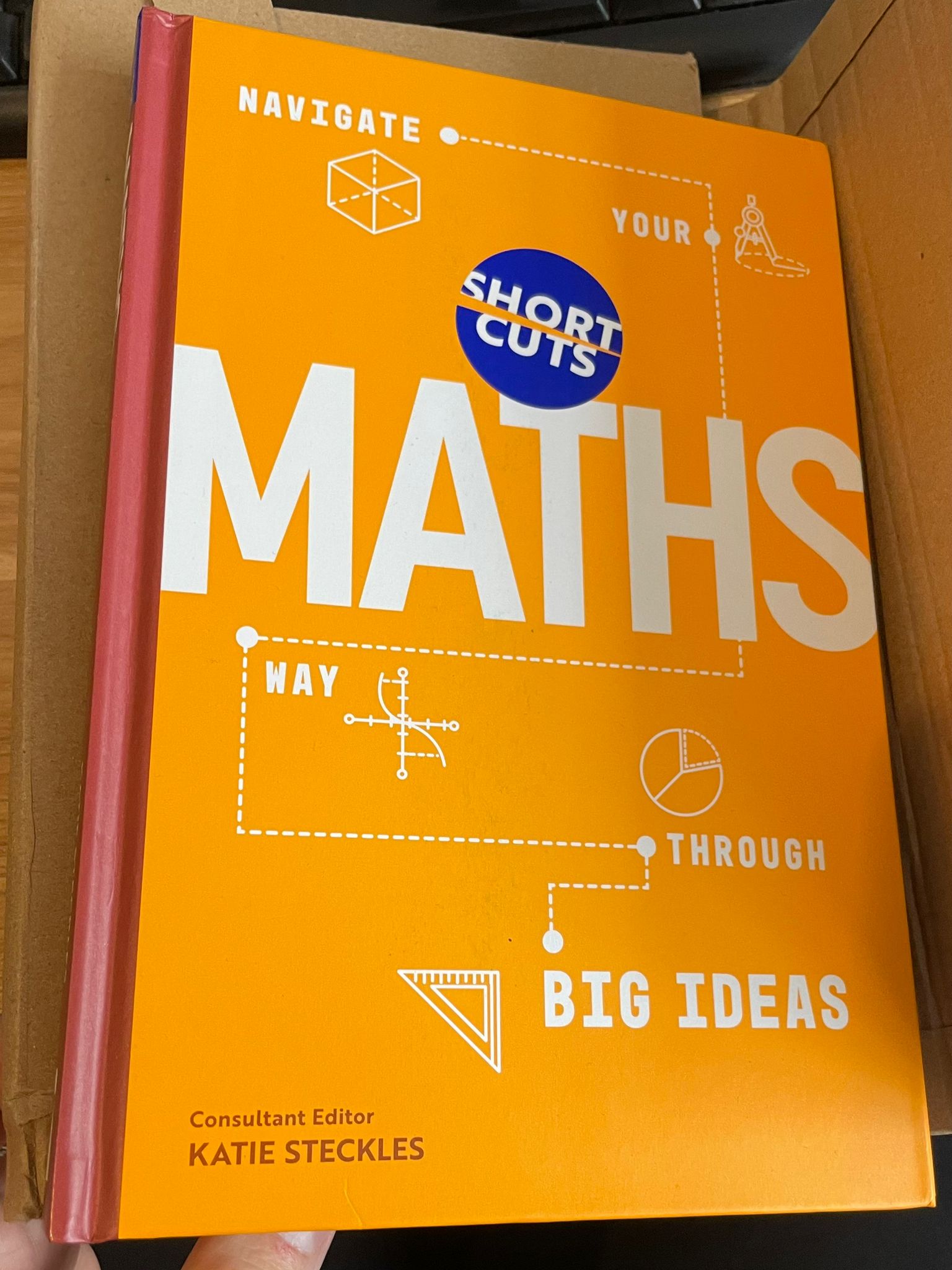
Our own Katie and Peter have collaborated on a new popular maths book, along with friends of the site Alison Kiddle and Sam Hartburn, which is out today. Short Cuts: Maths is an “expert guide to mastering the numbers behind the mysteries of modern mathematics,” and includes a range of topics from infinity and imaginary numbers to mathematical modelling, logic and abstract structures. We spoke to the four authors to see how they found it writing the book and what readers can expect.
How did this project come to be?
Peter: From my point of view, Katie approached me to ask if I’d like to be involved, which was very exciting! She’d worked on a couple of books with the same publisher and was asked to commission authors for this one.
Katie: The publishers wanted to make this book – one of a ‘Short Cuts’ series which needed a maths title – and asked me to be commissioning editor, which meant I could write some of it and ask others to write the rest. I chose some people I’ve worked with before who I thought would have something interesting to say about some topics in maths (in particular, the topics I know less about, so they could help me with those bits!)
Alison: As I was the last of the four of us to come on board, I think everyone had already expressed a preference for their favourite bits to write about, but luckily that left me with the two best topics, logic and probability.
Do any of you have previous experience of working on a project like this?
Alison: I’ve been involved in writing a book before but that one was about maths education, for an audience of mainly teachers, so this was a different sort of challenge, writing for a general audience with different levels of maths prior knowledge and enthusiasm.
Sam: I’ve worked on many books in the same genre as a copyeditor and proofreader, but this was my first time as an author. I enjoyed seeing how the publishing process works from the author’s point of view – it’s definitely had an impact on my editorial work!
Peter: My first time in popular book form, though I felt it used a bunch of skills I’ve developed in other work. And Katie is so great at organising projects that it went really smoothly.
What’s the book like?
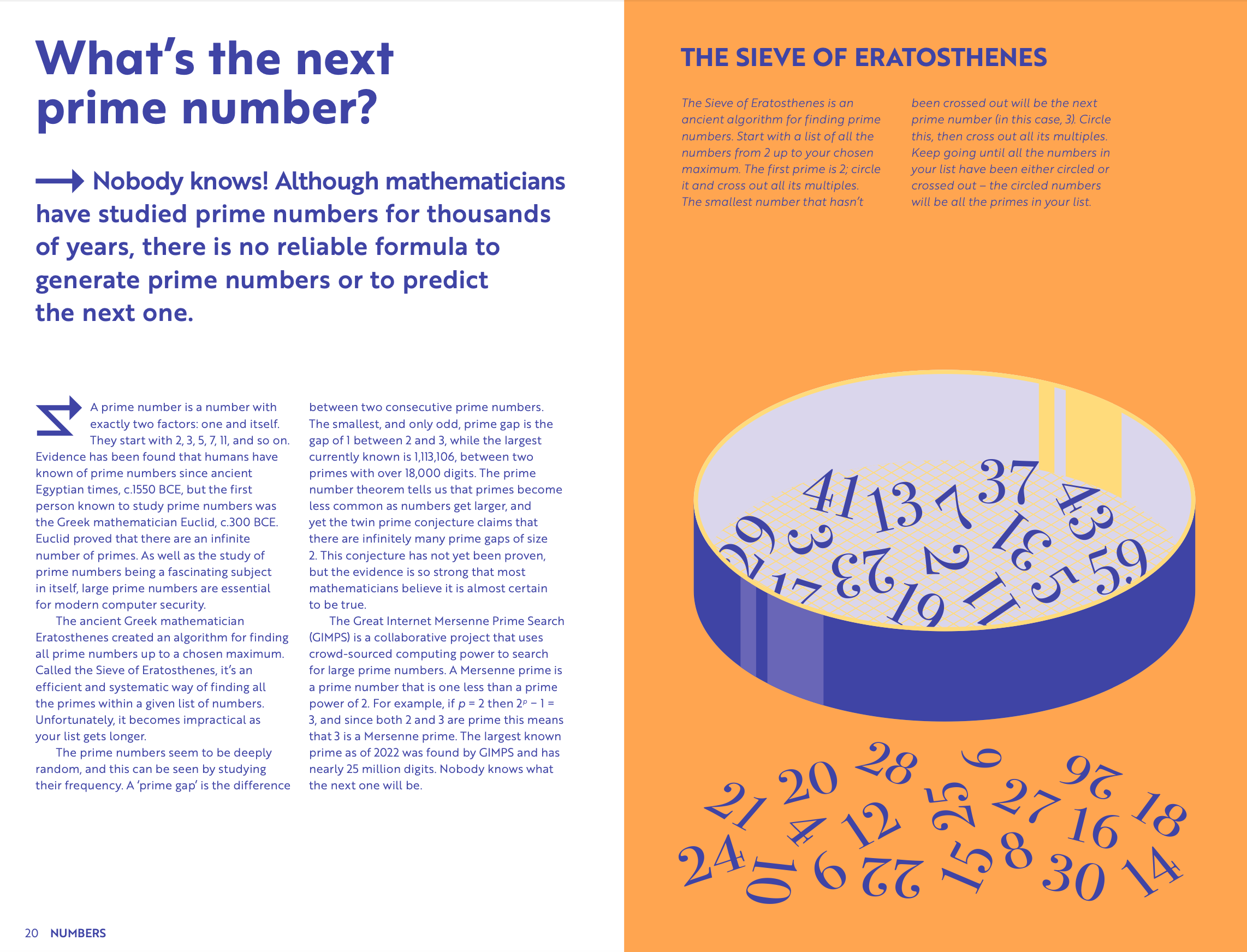
Sam: It’s a book you can dip into – you don’t need to read it from front to back. Each page is self-contained and answers a question, and we tried to make the questions as interesting as possible (two of my particular favourites are ‘Is a mountain the same as a molehill?’ and ‘Do Nicholas Cage films cause drownings?’).
Alison: We had quite a strict word limit to write to, which was a bit hard to get used to at first as I have a tendency to use ten words when two will do – but this turned out to be a blessing because it focussed us all on what the really important concepts were, and we found ways to express those concepts in a concise manner.
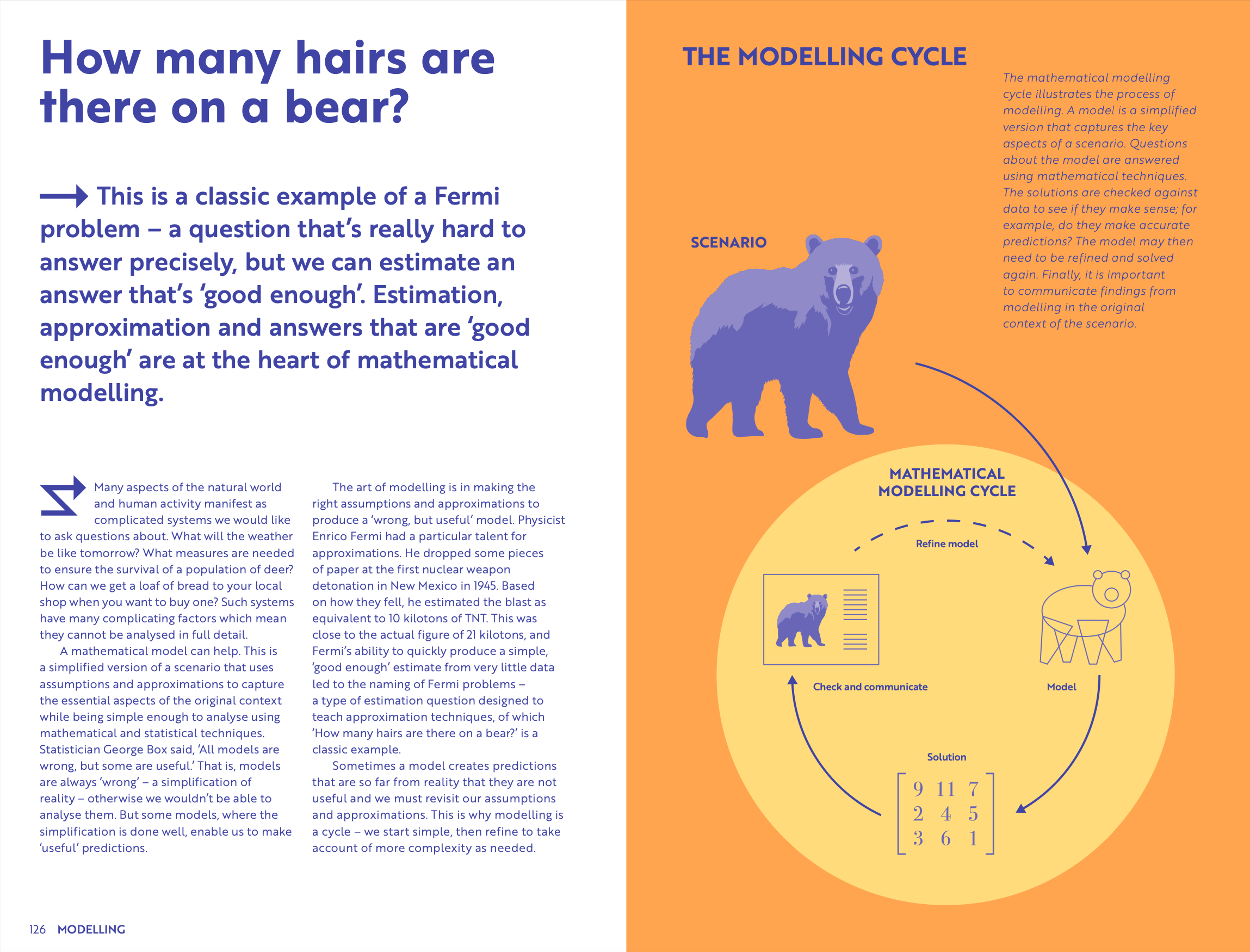
Katie: I love how the style of the book builds in these gorgeous illustrations – we worked with the illustrator to make sure they fit with the text, but also bring out fun aspects of the ideas we’re talking about.
Who do you think would enjoy reading this book?
Sam: I’d like to think that anyone who has a vague interest in maths would get something out of it. Even though it delves into some deep mathematical topics, we’ve (hopefully!) written it in such a way that it’s understandable to anybody with school-level maths. But I’d hope that experienced mathematicians would also be able to find something new, or at least fun, in there.
Alison: I’m definitely going to be recommending it to the students I work with. The bite-size dipping in and out model is great for them to skim read so they can find out a little bit about the mathematical ideas that appeal to them. Particularly useful for people preparing for university interviews where they want to show off that they know some maths beyond the usual curriculum!
Katie: My mum’s definitely getting a copy for Christmas – and not just because I was involved in writing it: she’s not from a mathematical background but I think she’d enjoy the straightforward explanations and discovering new ideas.
What’s your favourite bit?
Sam: The publisher did commission some lovely illustrations. The bear in the modelling cycle is a particular delight!
Katie: Yes! We love the modelling bear. I also liked being able to share ideas people might not otherwise encounter if they read about mathematics, like how mathematical modelling works, or what topology is, or some of the nitty-gritty of mathematical logic.
Peter: There are loads of quick summaries of areas of maths I know less about, which is really nice to have. The illustrations are great — the baby failing to manage a crocodile always makes me chuckle, and I can’t wait to show my son the game theory dinosaurs!
Short Cuts: Maths is available to buy today from all good bookshops.
The next issue of the Carnival of Mathematics, rounding up blog posts from the month of February 2023 is now online at SamHartburn.co.uk.
The Carnival rounds up maths blog posts from all over the internet, including some from our own Aperiodical. See our Carnival of Mathematics page for more information.
The dust is settling on the ninth Big MathsJam, and before I get too sad that it’s nearly a year until the next one, I put down some thoughts about what was so good about this one.