[vimeo url=https://vimeo.com/70587267]
Time tilings by Pablo Valbuena
via NotCot.org
[vimeo url=https://vimeo.com/70587267]
Time tilings by Pablo Valbuena
via NotCot.org
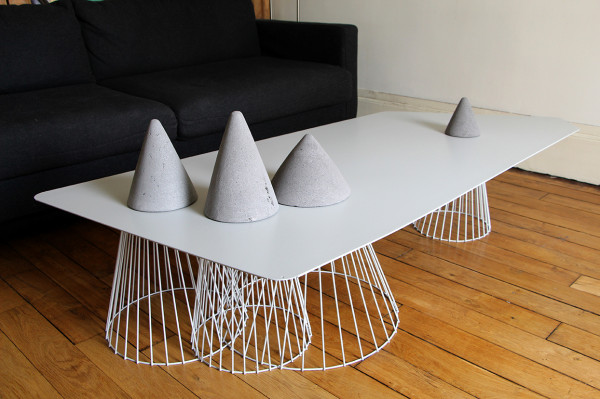 Vuoristo coffee table by Fabien Barrero+Carsenat. Nice conic sections!
In this short series of articles, I’m writing about mathematical questions we don’t know the answer to – which haven’t yet been proven or disproven. This is the third article in the series, and across two parts will discuss various open conjectures relating to prime numbers. This follows on from Open Season: Prime numbers (part 1).
So, we have a pretty good handle on how prime numbers are defined, how many of them there are, and how to check whether a number is prime. But what don’t we know? It turns out, quite a lot.
The Royal Statistical Society have announced ‘Show me the data’ events at the Conservative and Labour party conferences this autumn. Each conference will host three meetings relating to “the importance of interpreting and understanding statistics”, run by the RSS with the Alliance for Useful Evidence and Ipsos Mori.
I asked in the previous post for suggestions of iPad apps that I could use to help with my job as a university lecturer in mathematics. I asked specifically about annotating PDF files I had made using LaTeX and recording such activity. More generally, I asked what other apps might be useful to my job and for other uses I should be thinking about. People made suggestions via comments on that post, Twitter and Google+. Thanks to all who responded. Here is a summary of the recommendations I received.
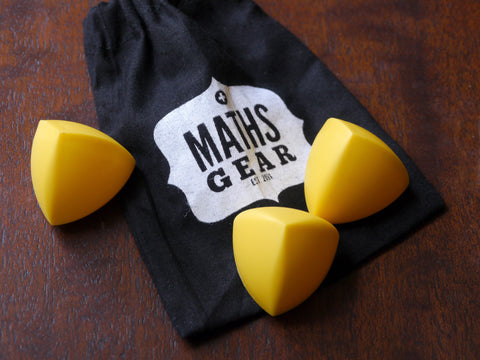
If you like your shapes to be of constant width, friends of the Aperiodical Matt Parker and Steve Mould, who run Maths Gear, have long been the market leader in selling you flat 2D shapes which have the same diameter no matter which direction you measure in (well, them and the Royal Mint). But if you prefer your shapes to be of constant width in three dimensions, you can now satisfy those urges too at MathsGear.co.uk.
They’ve just launched a new product, which is a handsome set of yellow solids of constant width (for those interested, they’re not the standard Reuleaux triangle-based solid of revolution commonly sold – they’re Meissner Tetrahedra). A set of three, which allows you to test the constant width property by rolling them between a table and a book, is yours for £15, with free delivery in the UK. Tables and books sold separately.
Buy: Maths Gear website.
In this short series of articles, I’m writing about mathematical questions we don’t know the answer to – which haven’t yet been proven or disproven. This is the third article in the series, and across two parts will discuss various open conjectures relating to prime numbers.
I don’t think it’s too much of an overstatement to say that prime numbers are the building blocks of numbers. They’re the atoms of maths. They are the beginning of all number theory. I’ll stop there, before I turn into Marcus Du Sautoy, but I do think they’re pretty cool numbers. They crop up in a lot of places in maths, they’re used for all kinds of cool spy-type things including RSA encryption, and even cicadas have got in on the act (depending on who you believe).