
This is a story about a particularly awful bit of science reporting. It’s taken me a while to sort out what’s going on. First I thought it was bad maths, then I thought it was bad science, and now I think it might be bad journalism. But it might be none, all, some, or a superset of those. I didn’t really want to write this post because crowing about other people’s apparent failures isn’t great, but we took a team decision to cover it because of entertainment reasons. ((Unlike the BBC, we are not funded in a unique way, so we have no public service remit. I think that’s right.)) I’m going to make an attempt to tell you what I’ve found, a little bit of what I think, and then we can rejoin Team Positive Mental Attitude when it’s all over.
You're reading: Yearly Archives: 2013
The invariant subspace problem is solved for Hilbert spaces?
Update 05/02/2013: Cowen and Gallardo say that a problem has been found in their proof and they no longer claim an answer to the invariant subspace problem.
At the congress of la Real Sociedad Matemática Española yesterday, Eva Gallarda and Carl Cowen presented an affirmative answer to the invariant subspace problem on separable Hilbert spaces. While it isn’t a Millennium Prize problem, it’s one of the big open problems in maths. As far as I can tell, it hasn’t been through any formal peer review yet, but they’re serious people and you’ve got to be quite sure about this kind of thing before announcing it at such a high-profile event.
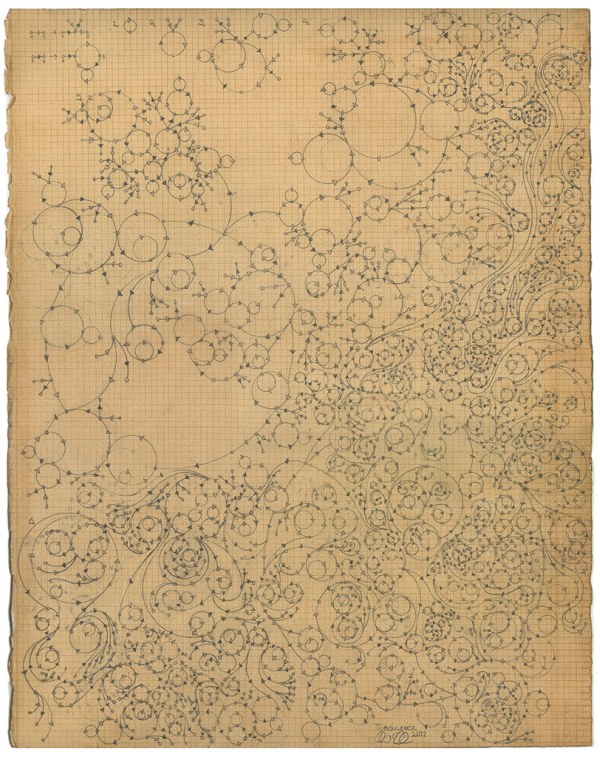
Submergence01 by Squidsoup
[vimeo url=http://vimeo.com/57412634]
Submergence01, by Squidsoup.
via NotCot.org
Student placement with the Numerical Algorithms Group
Mathematical and statistical software specialists The Numerical Algorithms Group (NAG) are advertising a twelve month student placement in Oxford as a software engineer.
We are looking for somebody who has completed the equivalent of two years of a three-year degree course. A strong computing component in the course is important and some mathematical background or experience using software to solve scientific or engineering problems would be a big advantage. The ideal candidate should have experience of programming in a Windows, Unix or Linux environment. Some knowledge of C or Fortran would be useful, but is not essential.
The deadline is 31st January 2013.
Further details: Student Placement: Software Engineer.
Chrome now supports MathML

Update 07/02/2013: Google giveth, and it taketh away. MathML support in Chrome has been disabled until it’s “production-ready”.
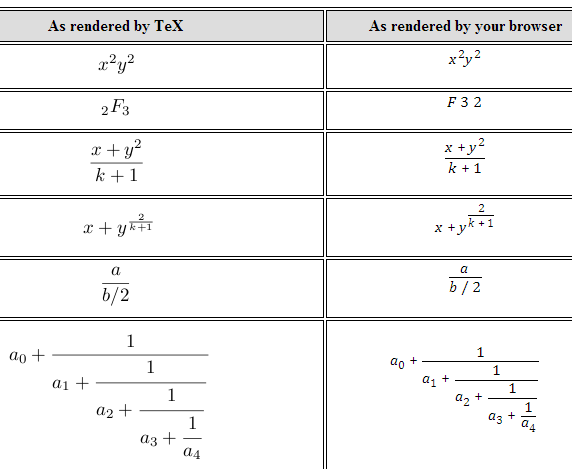
Putting maths on the web has always been a tricky proposition. Typesetting notation is a highly complicated procedure, so for years people have got by either by compromising on aesthetics and writing equations in plain, unadorned text, or by using off-line LaTeX compilers to make blurry images of what they’re trying to say.
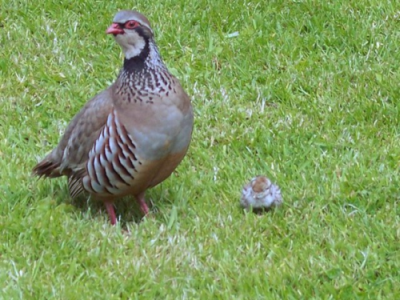
This is an ex-parrot. ‘Is plumage has dimension 1
A paper by Lorenzo Pérez-Rodríguez, Roger Jovani and François Mougeot in Proceedings B, “Fractal geometry of a complex plumage trait reveals bird’s quality“, claims that the measurement of the fractal dimension of a red-legged partridge’s chest plumage is a good indicator of its health.
I know what you’re thinking: another ‘non-mathematicians pick trendy term to describe something rather different’ story, but actually the authors do quite a good job of explaining and justifying their method. I’m convinced!
Plumage patterns are the product of reaction-diffusion systems which probably don’t really produce fractal dimension, but the researchers needed a fairly easy and consistent way of measuring the complexity of patterns. A healthy bird can produce more melanin, which can produce more complicated patterns. For the level of detail needed, the researchers say that the box-counting method of computing fractal dimension is a quick way of measuring the effect they’re looking for.
Paper: Fractal geometry of a complex plumage trait reveals bird’s quality, by Lorenzo Pérez-Rodríguez, Roger Jovani and François Mougeot, in Proceedings of the Royal Society B.
via Slashdot