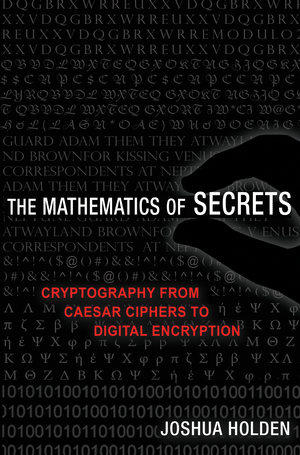
 Ten days ago we posted a cryptogram puzzle, set by mathematician and author Josh Holden. We’ve had a number of entries, some which were so enthusiastic they ignored that we’d said to email them in and tried to post in the comments. However, from the correctly submitted entries, we had one stand-out winner – a quick reply, with a detailed description of the solution and a worthy recipient of a copy of The Mathematics of Secrets. Here’s Josh’s explanation of the puzzle, for anyone who hasn’t cracked it yet.
You're reading: Yearly Archives: 2018
- a writeup of Robert Langlands’ work that won him this year’s Abel prize
- a post expanding on the recent chromatic number result by Aubrey de Grey
Carnival of Mathematics 158
 This is the 158th Carnival of Mathematics, a monthly round-up of interesting maths bits from across the internet. Convention dictates that I now therefore specify some interesting facts about the number 158. Unfortunately I am writing this on a train with no internet access, which will make fulfilling this obligation more than usually challenging.
Competition: Cryptogram Puzzle
Author and mathematician Josh Holden has come up with a nice puzzle — so we’re posting it as a competition. If you think you can decrypt the message below, send in the decrypted message and a one- or two-sentence description of the mathematical principle behind the encryption key to root@aperiodical.com. The first correct entry received will win a copy of Josh’s book, The Mathematics of Secrets.
The technical name for the “cryptograms” found in many newspapers and magazines is monoalphabetic monographic substitution ciphers — monographic meaning that they make substitutions one letter at a time and monoalphabetic meaning that the substitution rule is the same every time a given letter appears in the message.
Most often the easiest way to start solving these is to look at one-letter words which are usually “I” or “a”, then two-letter words, etc. If the breaks between the words are removed, then you might use the fact that in a typical English text the letter “e” will occur about 13% of the time, followed by “t” and “a” at 7-8% and others farther behind.
What then should we make of the following cryptogram?
YOFQX RGLQT GCQPB FFGQJ IQOFT SYVQH FSFQV FTYFC QJGQY OFRSQ YOSJG FQHOF GQYOF NQTSS REFCQ HRYOQ TQLSF TYQZS JHCQT VVFDW AFCQT WJBYQ YOFDQ TAAQV JSYVQ JIQAR YYAFQ WRSCV QTGCQ WFTVY VQTVQ HFAAQ TVQYO FQHOJ AFQMT ZXQJI QZTSC VQYOF QXGTE FQHTV QVYTG CRGLQ WFIJS FQYOF DQRGQ ZOTRG VQHRY OQTQV JACRF SQJGQ FTZOQ VRCFQ YJQLB TSCQO RDQTG CQGFT SQYOF QXRGL QHTVQ YOFQH ORYFQ STWWR YQHRY OQTQY SBDMF YQRGQ JGFQO TGCQT GCQTQ VZSJA AQJIQ MTSZO DFGYQ RGQYO FQJYO FS
The letter “Q” appears almost 20% of the time, followed by “F” at about 10%, and “Y” and “T” at about 8%. The original text is English (in fact it’s from a famous work of children’s literature) and it doesn’t have a particularly odd distribution of letters. Can you decrypt the message? For bonus points, can you figure out what is mathematically interesting about the encryption key?
Carnival of Mathematics 157
The next issue of the Carnival of Mathematics, rounding up blog posts from the month of April, and compiled by Becky, is now online at Lines, Curves, Spirals.
The Carnival rounds up maths blog posts from all over the internet, including some from our own Aperiodical. See our Carnival of Mathematics page for more information.
How to join in with our distributed Wiki edit day
 You may have seen our post last month about our remote Wiki Editing Day, this coming Saturday 12th May. We’re hoping to get a bunch of people in different locations editing pages on Wikiquote and other Wikimedia sites, to improve the visibility of female mathematicians. Here’s how you can get involved.
I’ve written some stuff for the HLF Spektrum blog
Since blogging for the Heidelberg Laureate Forum last September, I’ve now started writing regular posts for their all-year-round blog, which is hosted at Spektrum SciLogs.
My first two posts are:
Keep an eye on the Spektrum blog, and the Aperiodical Twitter feed for news of further posts!
The incredible palindromic hat-trick
I’ve made another one of my interactive online maths doodads. You should have a go at it right now. It doesn’t require any effort on your part, other than coming up with a positive integer.