The next issue of the Carnival of Mathematics, rounding up blog posts from the month of October 2023, is now online at Beauty of Mathematics.
The Carnival rounds up maths blog posts from all over the internet, including some from our own Aperiodical. See our Carnival of Mathematics page for more information.
In this series of posts, we’ll be featuring mathematical video and streaming channels from all over the internet, by speaking to the creators of the channel and asking them about what they do.
We spoke to Kat Phillips, who’s been running regular mathematical livestreams on Twitch through her channel KatDoesMaths since 2020, and has over 3,000 followers.
As we wrote about recently, we (Katie and Peter, along with our friends Sophie Maclean and Matthew Scroggs) are involved in an exciting new initiative – an online maths community that gets together via online chat and monthly video events. The first event happened yesterday evening, and will be available to watch for free on YouTube for the next couple of months.
This is a taster – if you’d like to join the online community and attend next month’s event, you need to join the Finite Group (starting from £4/month).
In this series of posts, we’ll be featuring mathematical video and streaming channels from all over the internet, by speaking to the creators of the channel and asking them about what they do.
We spoke to Toby Hendy, author of the YouTube channel Tibees, which has over a million subscribers.
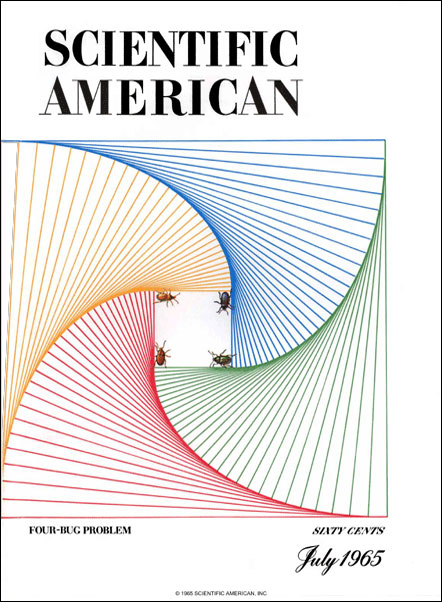
Reminder: I’m occasionally working to (sort of) recreate Martin Gardner’s cover images from Scientific American, the so-called Gardner’s Dozen.
This time I’m looking at the cover image from the July 1965 issue, accompanying the column on ‘op art’ (which became chapter 24 in Martin Gardner’s Sixth Book of Mathematical Diversions from Scientific American).
In this guest post, David Benjamin shares a cornucopia of concepts and stories relating to Pythagoras and his famous theorem.
I admit to mild irritation when I’m told that Pythagoras’ theorem is $a^2+b^2=c^2$. The theorem is based on area – in particular, that of squares. There are many proofs of the theorem and in this post we present a miscellany of Pythagorean Theorem curiosities, including some of my favourite proofs, the theorem’s links to algebra, geometry and number theory, an assassination of a president of the USA, an alleged murder in Greece, an infinite spiral of surds, Gauss and coordinate geometry – plus another connection between Pascal and Fibonacci.
The theorem
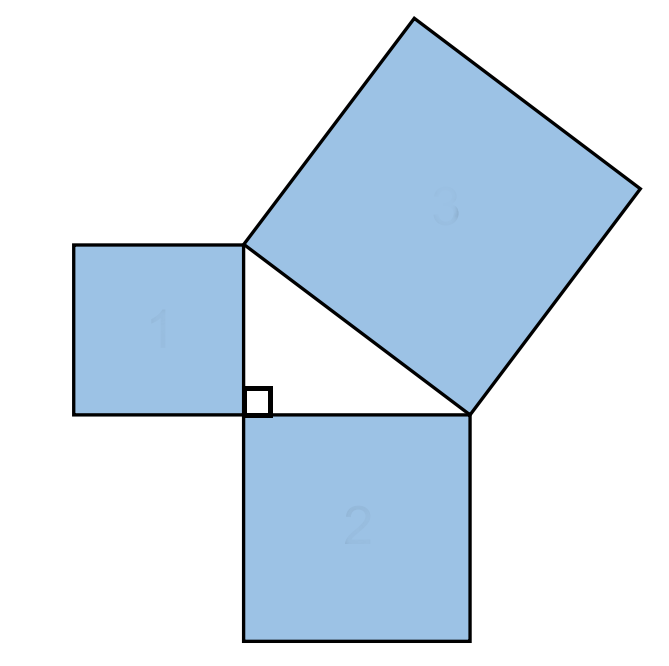
A square is added to each side of a right-angled triangle as shown in the above image. The sum of the the areas of the two smaller squares is equal to the area of the largest square. If the hypotenuse of the triangle has a length of $c$ and the other two sides are of length $a$ and $b$ then $a^2+b^2=c^2$
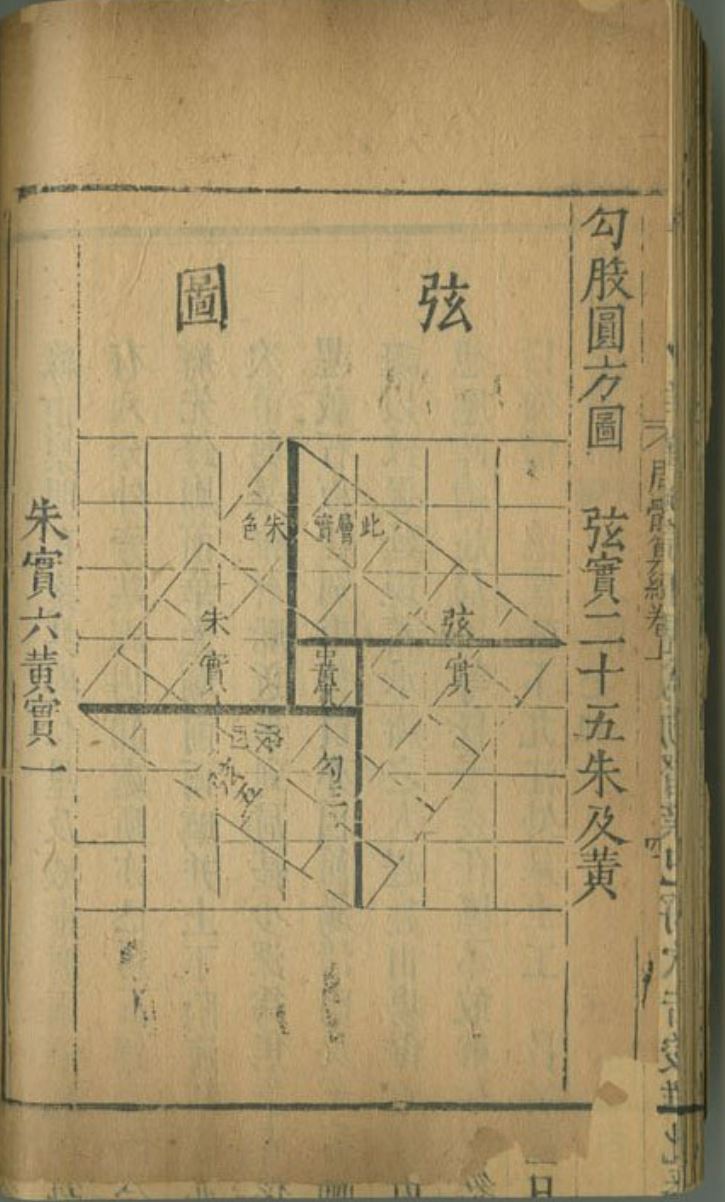
When the length of each side of the triangle is a positive integer, the three numbers make a Pythagorean triple. $(3, 4, 5)$ is the smallest triple with $3^2+4^2=5^2$. The Chinese text Chou Pei Suan Ching – original title Zhoubi – (周髀算经), (The Arithmetical Classic of the Gnomon and the Circular Paths of Heaven) gives this visual proof for the $(3, 4, 5)$ triple.
A visual proof for the Pythagorean triple $(3, 4, 5)$ from the Chinese text Chou Pei Suan Ching
$(3, 4, 5)$ is a primitive triple since $3, 4$ and $5$ are coprime – their only common divisor is $1$. $(n\times3, n\times4, n\times5), n = 2, 3, 4,…$ are part of the same ‘family’ and clearly not primitive triples. Another primitive triple is $(5, 12, 13)$ and an ordered sequence of hypotenuses for such triples are listed here. In the sequence I was surprised to see $185$ appearing twice. In fact there are exactly four distinct triples with hypotenuse $185$. With the aid of a spreadsheet, I was able to find them: $(57, 176, 185), (60, 175, 185),(104, 153, 185)$ and $(111, 148, 185)$
Generating Pythagorean triples
The sequence $\frac{1}{1},\frac{3}{2},\frac{7}{5},\frac{17}{12},\frac{41}{29},\frac{99}{70},\frac{239}{169},\frac{577}{408},\frac{1393}{985},…$ produces a Pythagorean triple from every other term beginning with $\frac{7}{5}$:
As an added bonus, the decimal equivalent of each term of the sequence converges to $\sqrt2$, in a similar way the Fibonacci sequence converges to the golden ratio $\psi=\frac{1+\sqrt5}{2}$
Another method to find Pythagorean triples uses consecutive even numbers and the sum of their reciprocals as shown below.
Euclid of Alexandria (325BC – 265BC) was a Greek mathematician who wrote a treatise, The Elements – a collection of 13 books. Books 1 to 6 are on plane geometry and books 7 to 9 on number theory. Euclid created a formula for generating Pythagorean triples from any pair of positive integers $m$ and $n$, where $m>n$:
($m^2-n^2, 2mn, m^2+n^2$) is the triple.
If $m=7$ and $n=3$, the triple is ($40, 42, 58$) $\rightarrow 40^2 + 42^2 = 3364 = 58^2$
If $m=89$ and $n=11$, the triple is ($7800, 1958, 8042$) $\rightarrow 7800^2 + 1958^2 = 64673764 = 8042^2$
A lovely link between Pascal, Fibonacci, Euclid and Pythagoras comes via any four consecutive Fibonacci numbers
$F_{1}$
$F_{2}$
$F_{3}$
$F_{4}$
$F_{5}$
$F_{6}$
$F_{7}$
$F_{8}$
$F_{9}$
$F_{10}$
$1$
$1$
$2$
$3$
$5$
$8$
$13$
$21$
$34$
$55$
The first 10 Fibonacci numbers
Using $3, 5, 8, 13$
Multiply the first and the last numbers $\rightarrow 3 \times{13}=39$
Multiply then double the middle two numbers $\rightarrow 5 \times{8}\times{2}=80$
Sum the squares of the middle two numbers $\rightarrow 5^{2}+8^{2}=89$
The Pythagorean triple is $(39, 80, 89) \rightarrow 39^{2}+80^{2}=7921=89^{2}$
$F_{1}$ to $F_{4}$ gives the primitive triple $(3, 4, 5)$
$F_{2}$ to $F_{5}$ gives the primitive triple $(5, 12, 13)$
$F_{3}$ to $F_{6}$ gives the triple $(16, 30, 34)$
$F_{7}$ to $F_{10}$ gives the primitive triple $(715, 1428, 1597)$
In addition, for any set of four consecutive Fibonacci numbers, $F_{7}$ to $F_{10}$ for example, the following connection is true
$7+10=17$ and the $17^{th}$ Fibonacci number is $1597$, the third member of the triple, the hypotenuse of the triangle!
Amazingly, if we use $m$ and $n$ as consecutive Fibonacci numbers when using Euclid’s method, then the last number of the triple is again a Fibonacci number
$m$
$n$
Triple
Fibonacci number
$2$
$1$
$(3, 4, 5)$
$5^{th}$
$3$
$2$
$(5, 12, 13)$
$7^{th}$
$5$
$3$
$(16, 30, 34)$
$9^{th}$
$8$
$5$
$(39, 80, 89)$
$11^{th}$
$13$
$8$
$(105, 208, 233)$
$13^{th}$
Another pattern is created with the the sequence of odd numbers $5, 7, 9, 11, 13,…$ The $15^{th}$ Fibonacci number is $610$, the hypotenuse when $m=21$ and $n=13$
A visual proof of the theorem
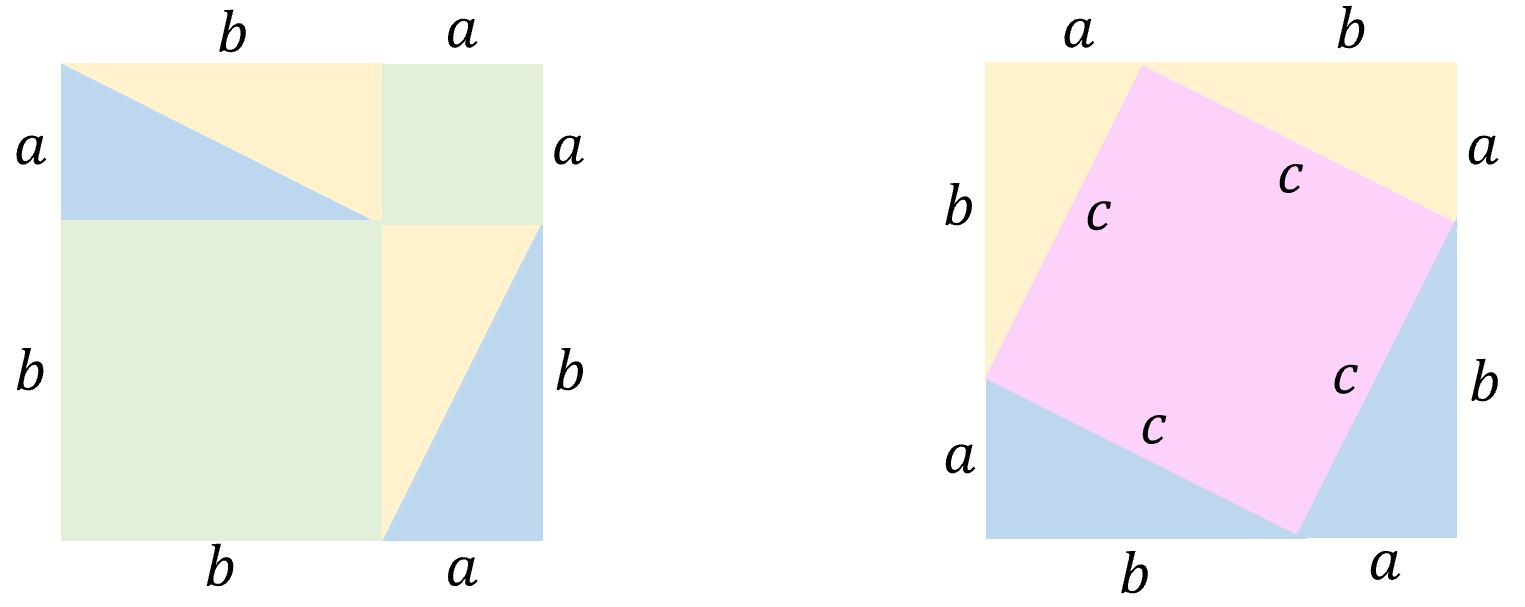
I first came across a visual proof of Pythagoras’ theorem for all right-angled triangles in Roger B. Nelsen’s wonderful book Proofs Without Words, Exercises in Visual Thinking. Nelsen noted the proof (author unknown, circa B.C. 200?) is adapted from the Chou Pei Suan Ching. The two images below combine to show the proof:
A visual proof of Pythagoras’ theorem for all right-angled triangles
A proof by trapezium area and an untimely painful death
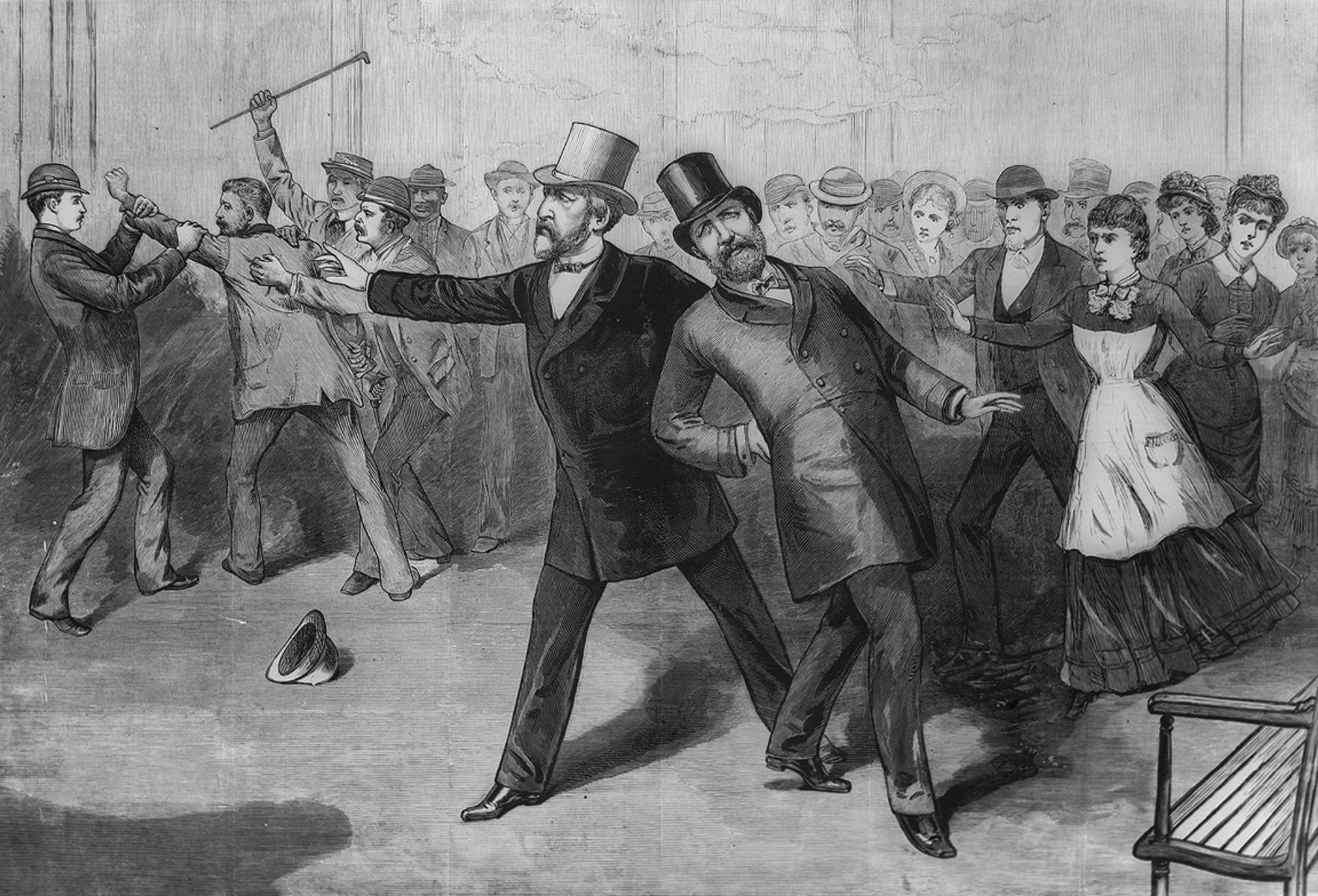
James Garfield (November 19, 1831 – September 19, 1881) was elected as the United States’ 20th President in 1880. He was assassinated after just 200 days in office after being shot on July 2, 1881, in a Washington railroad station. Garfield remained mortally wounded in the White House for many weeks where Alexander Graham Bell, inventor of the telephone, attempted to locate the bullet with an induction-balance electrical device which he had designed. Bell and physicians were unsuccessful in their attempts and Garfield died from an infection and an internal haemorrhage on September 19, 1881.
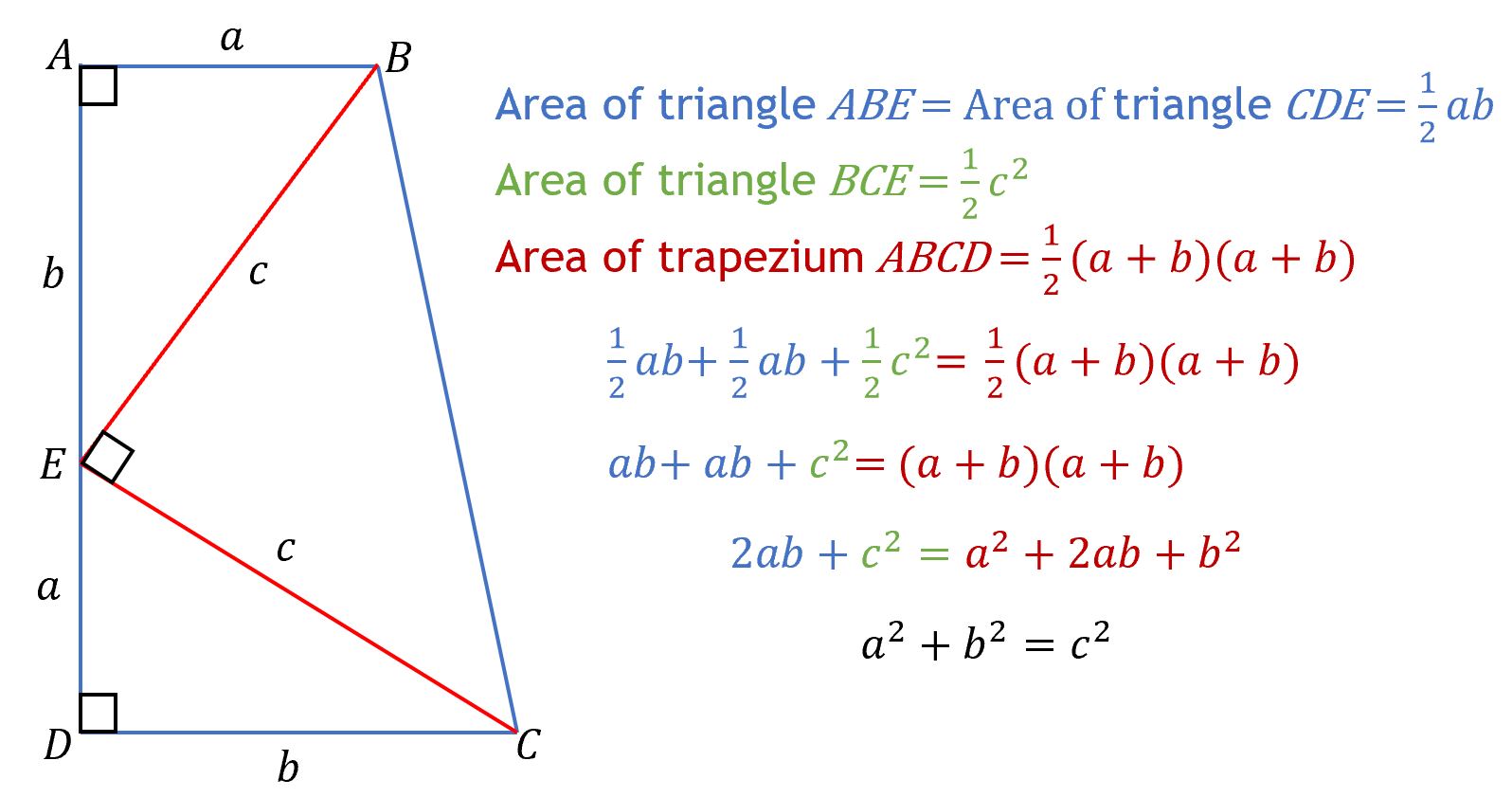
In 1876, Garfield had an elegant proof of Pythagoras’ theorem published. The proof makes use of the formulae for the areas of a triangle and a trapezium. The proof is demonstrated in the image below
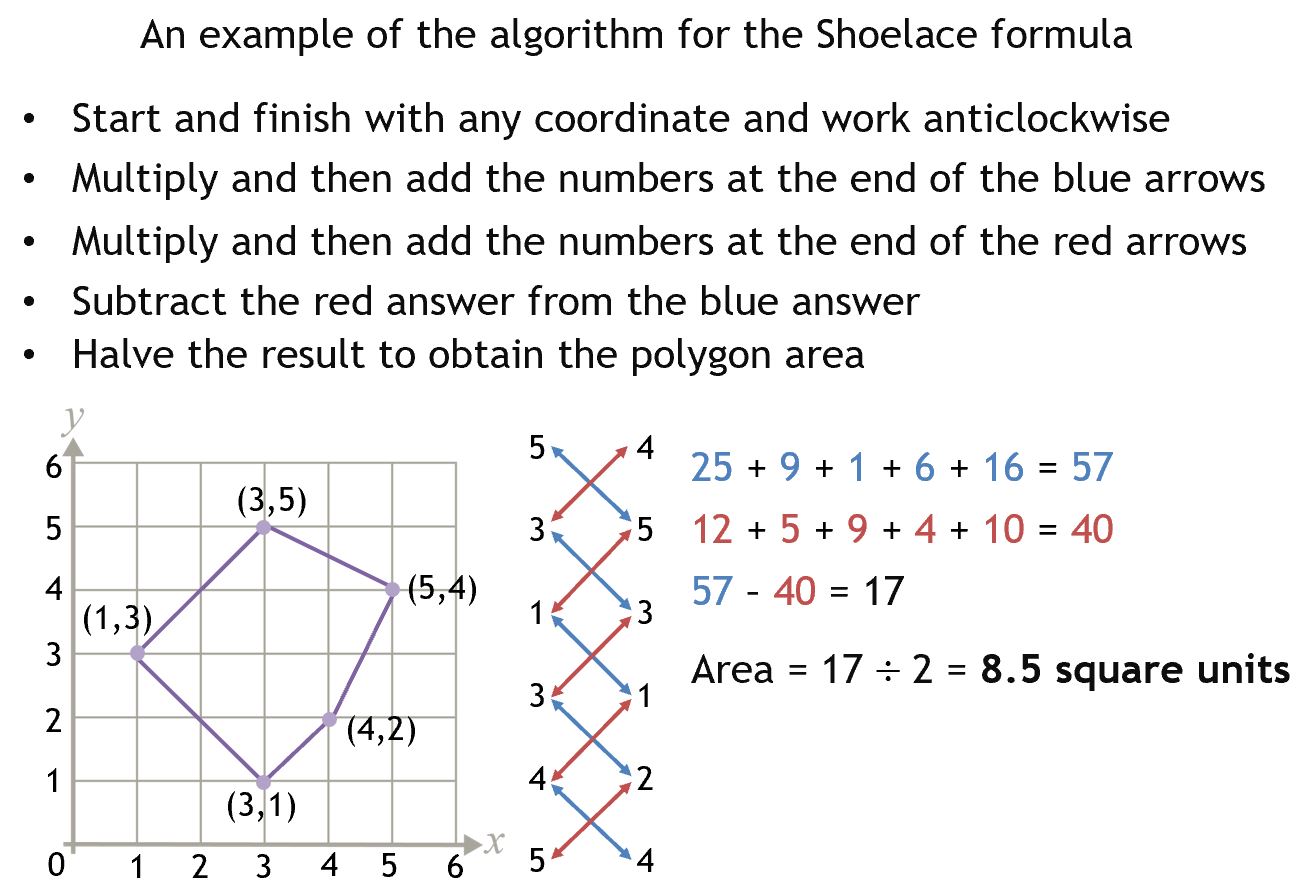
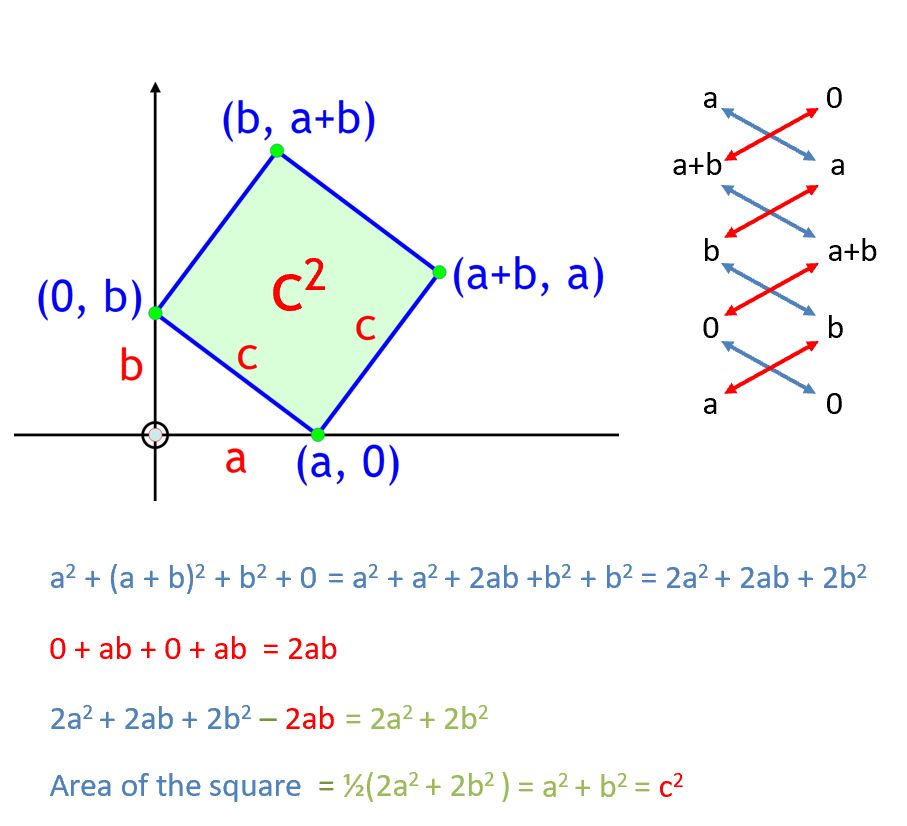
A proof using the Shoelace formula
The brilliant German mathematician Johann Carl Friedrich Gauss (30 April 1777 – 23 February 1855) developed a formula to calculate the area of a polygon if every vertex of the polygon lies on a known Cartesian coordinate. The formula is widely known as the Shoelace formula and makes use of the calculation to find the determinant of a 2 by 2 matrix.
John Molokach observed that the Pythagorean theorem follows from Gauss’ Shoelace Formula, as shown below
It’s not just squares
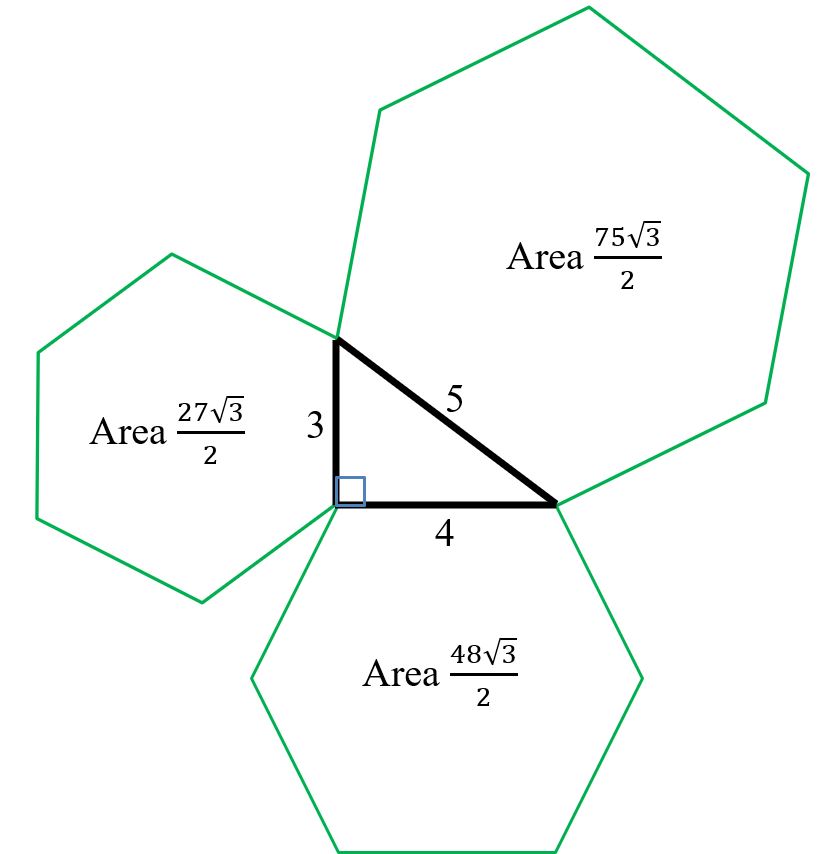
If the same regular $n$-gon, $n$ = 3, 4, 5,.. is drawn on each side of a right-angled triangle, then the sum of the areas of the two smaller $n$–gons equals the area of the $n$–gon on the hypotenuse. Semicircles also produce the same result. As $n\rightarrow \infty$, a regular $n$-gon approaches a circle and so circles, where the sides of the triangle act as tangents to the circles can be said to satisfy Pythagoras’ theorem. The same result can be obtained by rotating the semicircles through $180^ \circ$ and adding matching semicircles.
Three regular hexagons drawn on a $3, 4, 5$ triangle with $\frac{27\sqrt3}{2}+\frac{48\sqrt3}{2}=\frac{75\sqrt3}{2}$
The spiral of Theodorus of Cyrene
When $n$ is not a square number, $\sqrt{n}$ is called a surd
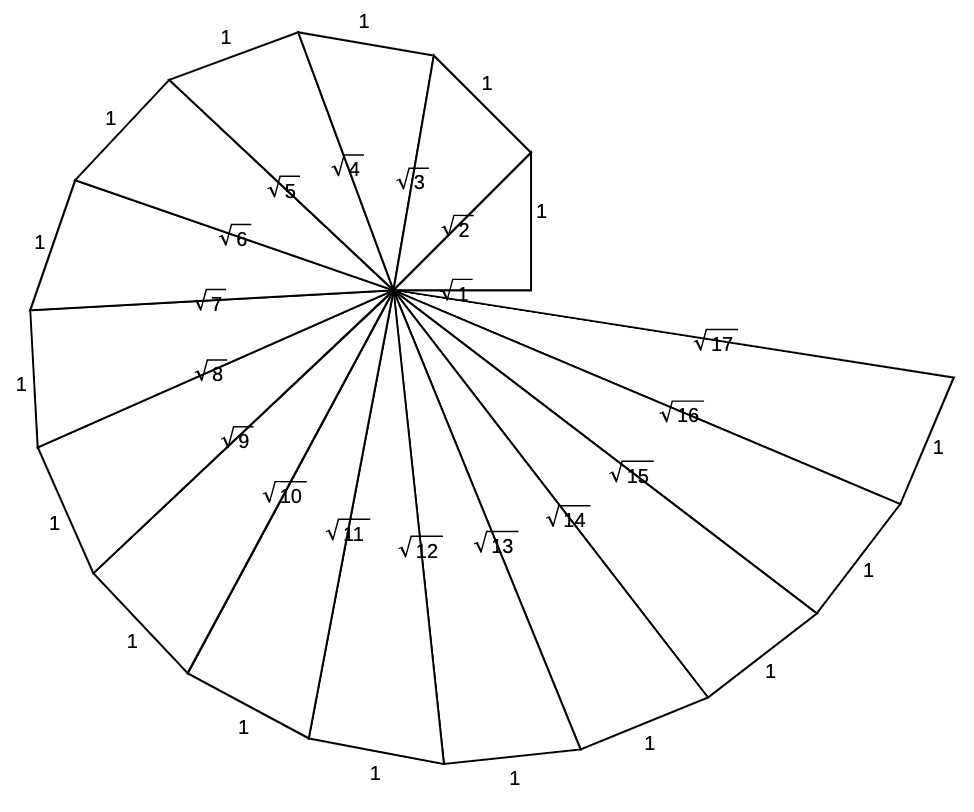
Pythagoras and his followers, the Pythagoreans, believed that the universe can be explained by whole numbers and the ratio of whole numbers. Their moto – “All is number” – was carved above the entrance of their meeting place. However, a spanner was thrown in the works when Hippasus of Metapontum, one of the Pythagoreans suggested that $\sqrt2$, the length of the hypotenuse of the right-angled triangle with sides $1, 1$ and $\sqrt2$, could not be written as the ratio of two whole numbers. Such numbers are now called irrational and it was approximately 200 years before Euclid of Alexandria proved $\sqrt2$ was irrational. The Pythagoreans were sworn to secrecy and one legend suggests that Hippasus was thrown off a boat and drowned for revealing his discovery to non-Pythagoreans. Then again, some believe Hippasus drowned because he revealed how to construct a dodecahedron inside a sphere. The ($1, 1$,$\sqrt2$) triangle is the start of the spiral of Theodorus. Further right-angled triangles, each containing a side of length $1$ unit, are added sequentially to produce the sequence $\sqrt2, \sqrt3, \sqrt4, \sqrt5,…$. The sequence is the length of each new hypotenuse, as shown in the diagram below. Theodorus probably stopped at $\sqrt17$ as it the length of the hypotenuse of the triangle before the triangles begin to overlap. The spiral can be expanded here.
The Theodorus spiral – also known as the Einstein spiral, Pythagorean spiral, square root spiral
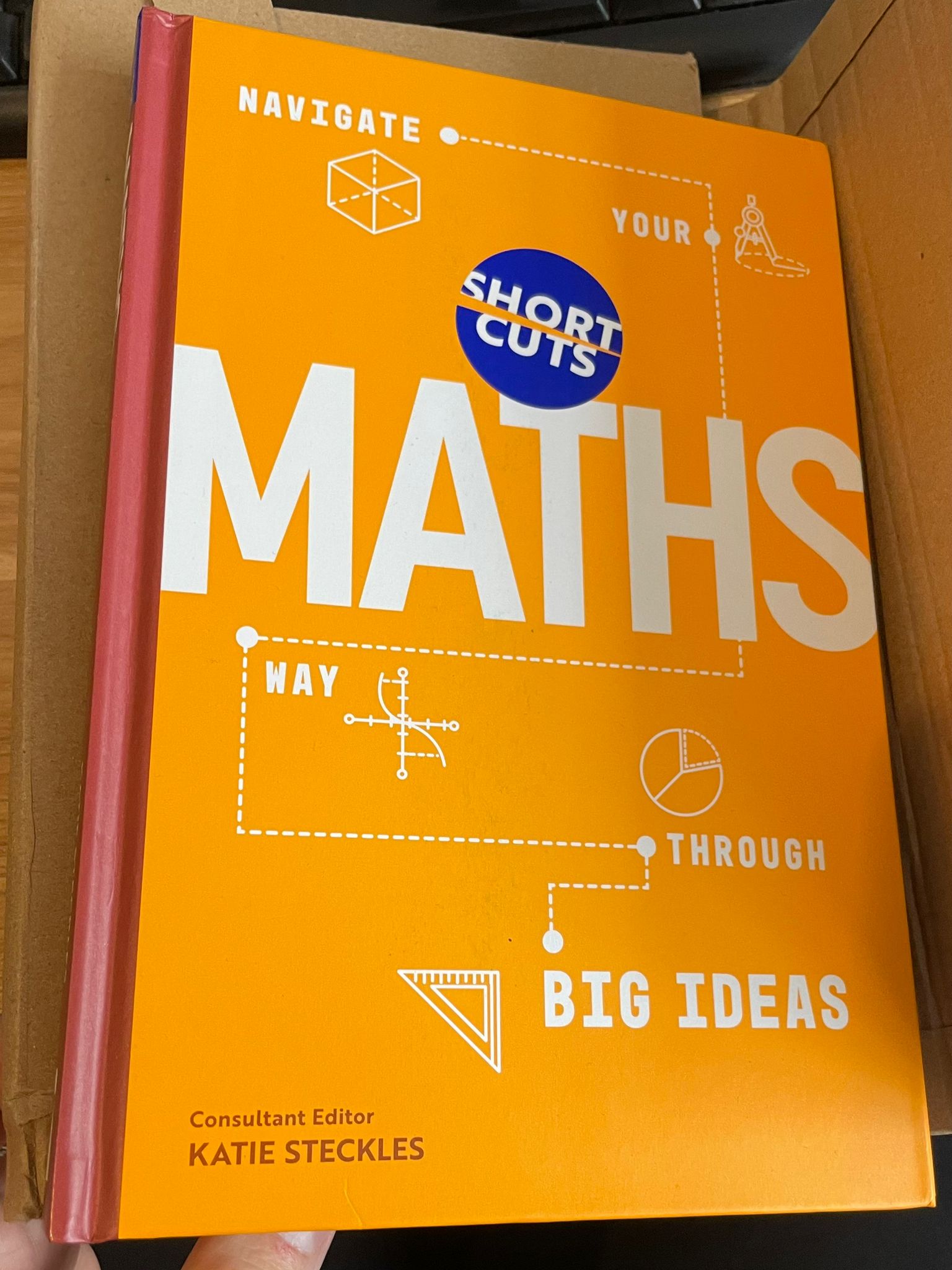
Our own Katie and Peter have collaborated on a new popular maths book, along with friends of the site Alison Kiddle and Sam Hartburn, which is out today. Short Cuts: Maths is an “expert guide to mastering the numbers behind the mysteries of modern mathematics,” and includes a range of topics from infinity and imaginary numbers to mathematical modelling, logic and abstract structures. We spoke to the four authors to see how they found it writing the book and what readers can expect.
How did this project come to be?
Peter: From my point of view, Katie approached me to ask if I’d like to be involved, which was very exciting! She’d worked on a couple of books with the same publisher and was asked to commission authors for this one.
Katie: The publishers wanted to make this book – one of a ‘Short Cuts’ series which needed a maths title – and asked me to be commissioning editor, which meant I could write some of it and ask others to write the rest. I chose some people I’ve worked with before who I thought would have something interesting to say about some topics in maths (in particular, the topics I know less about, so they could help me with those bits!)
Alison: As I was the last of the four of us to come on board, I think everyone had already expressed a preference for their favourite bits to write about, but luckily that left me with the two best topics, logic and probability.
Do any of you have previous experience of working on a project like this?
Alison: I’ve been involved in writing a book before but that one was about maths education, for an audience of mainly teachers, so this was a different sort of challenge, writing for a general audience with different levels of maths prior knowledge and enthusiasm.
Sam: I’ve worked on many books in the same genre as a copyeditor and proofreader, but this was my first time as an author. I enjoyed seeing how the publishing process works from the author’s point of view – it’s definitely had an impact on my editorial work!
Peter: My first time in popular book form, though I felt it used a bunch of skills I’ve developed in other work. And Katie is so great at organising projects that it went really smoothly.
What’s the book like?
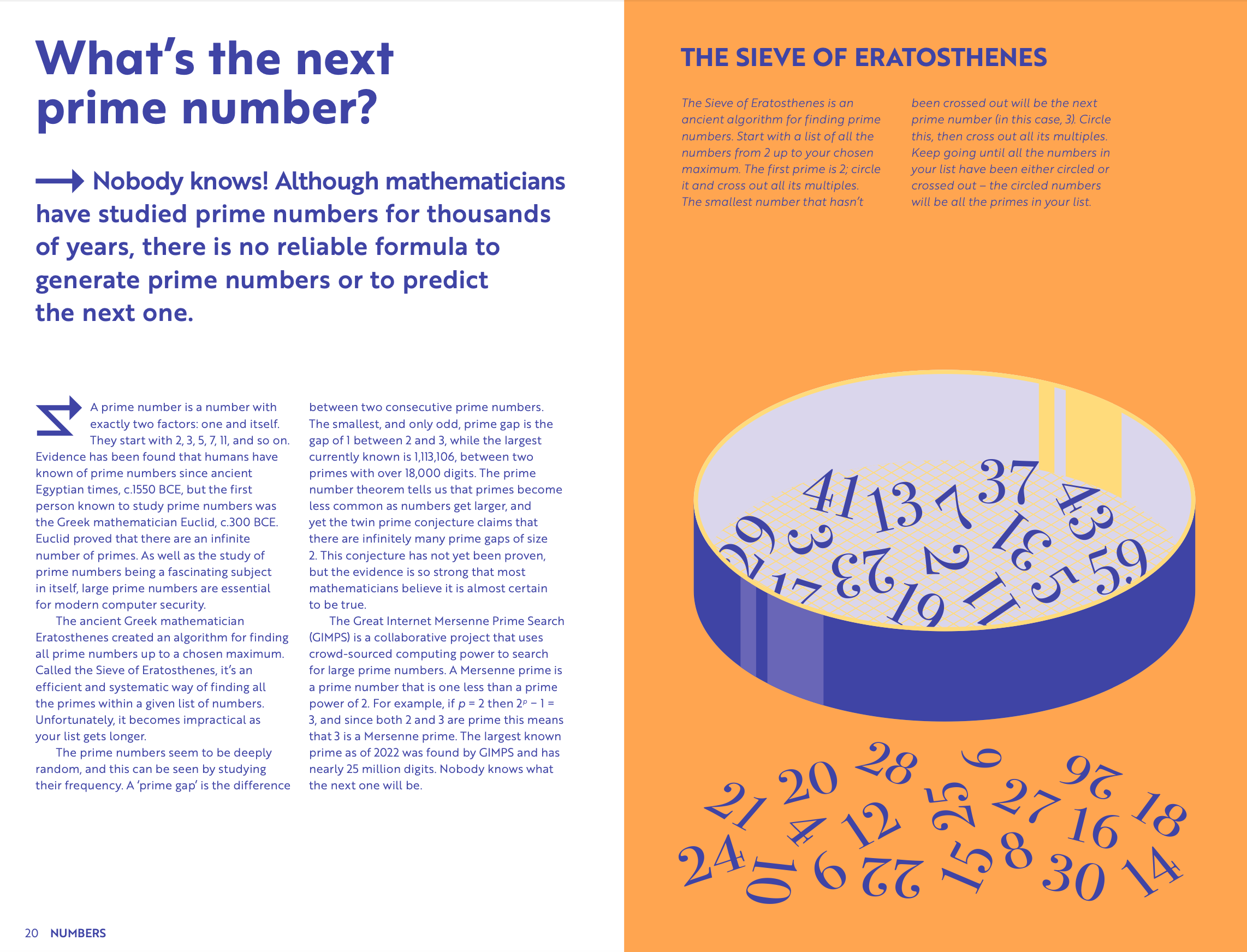
Sam: It’s a book you can dip into – you don’t need to read it from front to back. Each page is self-contained and answers a question, and we tried to make the questions as interesting as possible (two of my particular favourites are ‘Is a mountain the same as a molehill?’ and ‘Do Nicholas Cage films cause drownings?’).
Alison: We had quite a strict word limit to write to, which was a bit hard to get used to at first as I have a tendency to use ten words when two will do – but this turned out to be a blessing because it focussed us all on what the really important concepts were, and we found ways to express those concepts in a concise manner.
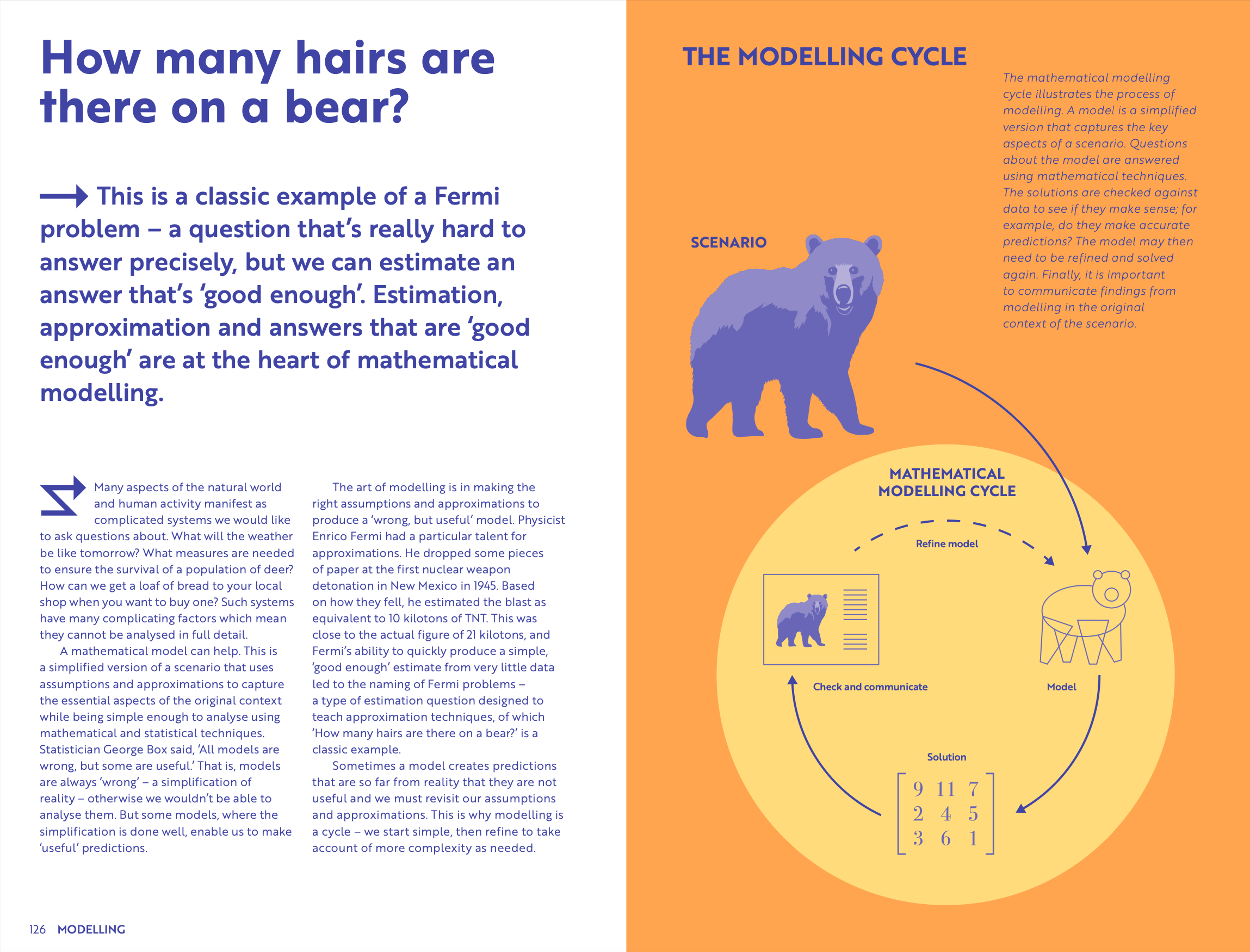
Katie: I love how the style of the book builds in these gorgeous illustrations – we worked with the illustrator to make sure they fit with the text, but also bring out fun aspects of the ideas we’re talking about.
Who do you think would enjoy reading this book?
Sam: I’d like to think that anyone who has a vague interest in maths would get something out of it. Even though it delves into some deep mathematical topics, we’ve (hopefully!) written it in such a way that it’s understandable to anybody with school-level maths. But I’d hope that experienced mathematicians would also be able to find something new, or at least fun, in there.
Alison: I’m definitely going to be recommending it to the students I work with. The bite-size dipping in and out model is great for them to skim read so they can find out a little bit about the mathematical ideas that appeal to them. Particularly useful for people preparing for university interviews where they want to show off that they know some maths beyond the usual curriculum!
Katie: My mum’s definitely getting a copy for Christmas – and not just because I was involved in writing it: she’s not from a mathematical background but I think she’d enjoy the straightforward explanations and discovering new ideas.
What’s your favourite bit?
Sam: The publisher did commission some lovely illustrations. The bear in the modelling cycle is a particular delight!
Katie: Yes! We love the modelling bear. I also liked being able to share ideas people might not otherwise encounter if they read about mathematics, like how mathematical modelling works, or what topology is, or some of the nitty-gritty of mathematical logic.
Peter: There are loads of quick summaries of areas of maths I know less about, which is really nice to have. The illustrations are great — the baby failing to manage a crocodile always makes me chuckle, and I can’t wait to show my son the game theory dinosaurs!
Short Cuts: Maths is available to buy today from all good bookshops.