Khan Academy has released a new library to typeset mathematical notation on webpages, called KaTeX.
You're reading: Posts By Christian Lawson-Perfect
Have fun playing with curvature
Recently Tim Hutton and Adam Goucher have been playing around with hyperbolic tesselations. That has produced a {4,3,5} honeycomb grid for the reaction-diffusion simulator Ready, which Adam talked about on his blog a couple of days ago. Tim has also made a much simpler toy to play with in your browser: a visualisation of mirror tilings (the Wythoff construction) in spaces with different curvatures.
Hyperplay lets you select the kind of regular polygon you want to tile, and then your mouse controls the curvature of the space it sits in. Certain curvatures produce exact tilings of the space – for example, triangles tile a space with zero curvature – and you get projections of polyhedra for certain positive curvatures.
Zaha Hadid’s design for the Science Museum’s new maths hall is certainly something
For a while, the Science Museum has been forming groups and making noises and tickling rich people with the aim of working out how they’re going to update their rather neglected maths hall. Yesterday they made an unexpectedly positive announcement: they’ve been given £5 million by rich people David and Claudia Harding, and Dame Zaha Hadid has drawn up a swooshy new design.
GeoGebra in 3D: ThreeoGebra!
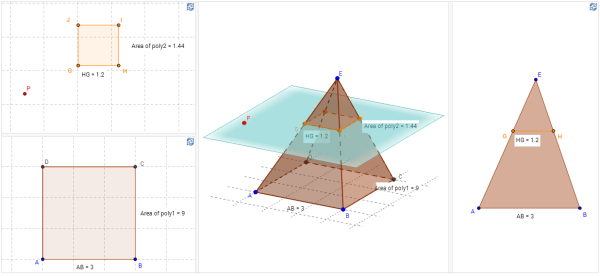
GeoGebra, the Aperiodical’s official Favourite Thing for Messing About With Geometry, has just bumped up to version 5. With that bigger number comes another dimension – GeoGebra now supports three-dimensional geometry!
Interesting Esoterica Summation, volume 9
Oof! It’s been nearly a year since I last shared my findings in the field of interesting esoterica. I fear this may be quite a long post.
In case you’re new to this: every now and then I encounter a paper or a book or an article that grabs my interest but isn’t directly useful for anything. It might be about some niche sub-sub-subtopic I’ve never heard of, or it might talk about something old from a new angle, or it might just have a funny title. I put these things in my Interesting Esoterica collection on Mendeley. And then when I’ve gathered up enough, I collect them here.
In this post the titles are links to the original sources, and I try to add some interpretation or explanation of why I think each thing is interesting below the abstract.
Some things might not be freely available, or even available for a reasonable price. Sorry.
Small gaps between large gaps between primes results
The big news last year was the quest to find a lower bound for the gap between pairs of large primes, started by Yitang Zhang and carried on chiefly by Terry Tao and the fresh-faced James Maynard.
Now that progress on the twin prime conjecture has slowed down, they’ve both turned their attentions toward the opposite question: what’s the biggest gap between subsequent small primes?
Not mentioned on The Aperiodical this month – August 2014
As usual in the summer, we’ve all been off doing our own things and consequently neglecting the news queue. Time to break out our tried-and-tested solution: a combo-post summarising everything we failed to cover in depth, before it goes completely out of date.
The Royal Society has Opinions about Education
The Royal Society has released a report outlining their idea of what science and maths education should look like in the future. It’s over a hundred pages long, but they’ve made a nice website to go along with it, with pages summarising their recommendations for things like “stability for curricula” and the teaching profession.
More information: The Royal Society’s vision for science and mathematics education
Cédric Villani is setting up a Maths Museum in Paris
The 2010 Fields Medal winner Cédric Villani announced at Copenhagen’s Euroscience Open Forum last month that there will be a museum dedicated to mathematics, based at the Institut Henri Poincaré, where he is the director. It’s expected to open in 2018.
Source: Cédric Villani annonce la création d’un musée des mathématiques à Paris, in Sciences et Avenir (in French)
Science Magazine establishes a Statistical Board of Reviewing Editors
In response to recent increases in flawed quantitative analysis and statistical bias in papers, Science has announced its intention to establish a Statistical Board of Reviewing Editors to provide better oversight on data interpretation. Recognising that a technical reviewer may not also be fluent in data analysis, the panel will consist of experts in stats and data analysis, and will be sent papers identified by their regular Board of Reviewing Editors (BoRE) as being in need of further scrutiny. Hooray for maths!
More information
Science Magazine raises its statistical bar. Will we? at Chris Blattman’s blog
Raising the Bar, at Science (free registration required to view, because of Science reasons)
Science joins push to screen statistics in papers in the Nature blog
ASA launches ‘This is Statistics’
The American Statistical Association, in a push to provide a new perspective on a subject often misunderstood and considered to be boring, has launched This is Statistics, a new website full of videos, applets and articles outlining how useful and interesting stats can be. It’s aimed at students, parents and educators and includes quizes and case studies of how stats has helped science change lives.
Website: This is Statistics