Doodal is a happy little toy which helps you draw fractals. This video explains how:
It’s a Flash applet, which means it doesn’t work on mobile devices :(
Play Doodal
Doodal is a happy little toy which helps you draw fractals. This video explains how:
It’s a Flash applet, which means it doesn’t work on mobile devices :(
Play Doodal

“It is hugely complicated. In fact, compared to football I think Quantum Physics is relatively straightforward.”
– Professor Stephen Hawking
Even you, Stephen?
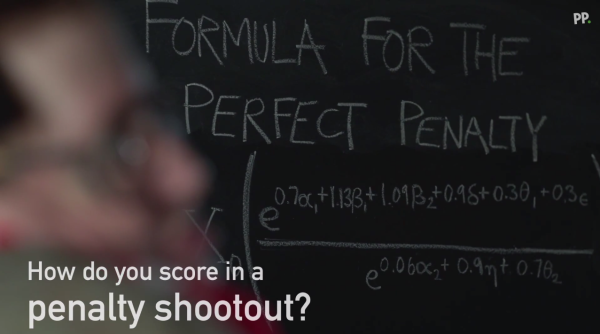
If you pick up basically any newspaper in Ireland or the UK today, you’ll probably find a story about Professor Stephen Hawking’s “formula for World Cup success”. At first glance, it doesn’t look good: The World’s Most Famous Scientist appears finally to have succumbed to the temptation of nonsense formula publicity.
Ten! TEN! TEN! Incredible. David Cushing asked me a very good question once: what have you done between five and ten times (inclusive)? Well, this is the last time ‘Writing an Aperiodical Round Up’ will be in the same category as ‘getting a new wallet’ and ‘saying hello to Peter Beardsley’.
Hello, my name’s Christian Perfect and, more often than an unbiased observer would expect, I find odd maths things on the internet.
The Homotopy Type Theory book was an ambitious attempt to relay the foundations of maths on a combination of type theory and topology. It also makes heavy use of computer proof-checking, which might be why the US Department of Defense is interested in it: they’ve just given Carnegie Mellon University’s Steve Awodey $7.5 million to continue the project.
Here’s a snippet from the press release announcing the grant:
The MURI [Multidisciplinary University Research Initiative] award, officially entitled “Homotopy Type Theory: Unified Foundations of Mathematics and Computation,” is through the Air Force Office of Scientific Research. It will establish CMU as the international center of research in this new field, which uses a fusion of tools drawn from abstract mathematics, such as homotopy and category theory, and the powerful computational paradigms of type theory and program verification. The resulting new, computational foundation for mathematics is not only an important theoretical advance. It also promises to provide a useful practical tool for mathematicians and other scientists in the form of powerful computer systems that can automatically verify the correctness of large and complex mathematical proofs and organize and unify a large body of verified mathematical theory in a form that can be reused for other scientific purposes. Equally important is the promise of new applications in theoretical computer science through the use of abstract geometrical intuitions and methods.
The American Mathematical Society has published its first book for children. It’s called Really Big Numbers.
They’ve made a rather pleasant trailer for it.
[youtube url=https://www.youtube.com/watch?v=cEOY9UAsCFM]
It made me want to wait for the audiobook version: author Richard Evan Schwartz has a soothing Bob Ross-like voice. (Edit: turns out the voice is Alexander Dupuis)
Really Big Numbers will be available from the AMS from the 12th of May, priced $25.
Imagine, if you will, a group of people who enjoy recreational mathematics and consequently decide that there should be more places for them to share fun maths. It’s crazy and unprecedented, I know, but humour me.
Recreational Mathematics Magazine does what it says on the tin. It’s a semiannual electronic journal published by the Ludus Association addressing “games and puzzles, problems, mathmagic, mathematics and arts, history of mathematics, math and fun with algorithms, reviews and news.”
Here’s a fun thing I found: the Journal of Number Theory has a YouTube channel on which it publishes video abstracts of its papers. To my surprise, they’ve been doing it since 2008!