[youtube url=https://www.youtube.com/watch?v=85LJh4sFi_M]
Erik Åberg is selling a short documentary about these lovely foldy cubes on his website.
via Will Davies on Twitter
[youtube url=https://www.youtube.com/watch?v=85LJh4sFi_M]
Erik Åberg is selling a short documentary about these lovely foldy cubes on his website.
via Will Davies on Twitter
Hands up if you knew there was a working replica of Babbage’s difference engine in California.
(My hand is not up.)
This glorious machine lives in the Computer History Museum in Mountain View, California. A company called xRez Studio, which specialises in taking extremely high resolution gigapixel photos of things, has taken some extremely high resolution gigapixel photos of the difference engine. They’re so lovely that it feels wrong to be looking at them at work.
The photos are only avaiable on xRez Studio’s website, or as part of the Babbage exhibit at the Computer History Museum, but xRez has also released a video of the machine in action, which we can embed here.
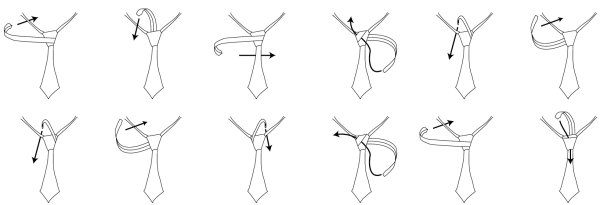
Novel knot news now! You might already be aware that there are 85 ways to tie a tie. Well, cast that preconception aside because there are actually loads.
University of Chicago grad student Kathryn Mann spotted this possibly-sexist flyer handed out by the AMS at a recent event:
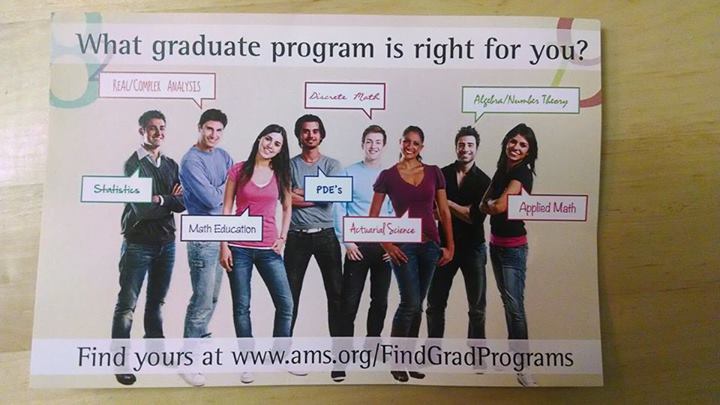
The beautiful stock photo men are all doing pure maths, and the beautiful stock photo women are all doing applied! Heinous!
Media math-man Alex Bellos has made another programme for BBC Radio 4, this time about How to Teach Maths.
Alex Bellos takes you on a mathematical learning journey from the first stages of number recognition through to an understanding of how children solve sums and calculate answers. On the way he will look at the neuroscience of maths and how our mathematical brain develops. He investigates the scientific evidence behind teaching maths and he’ll compare how modern methods of teaching children differ from those taught to their parents, helping kids today go beyond basic numeracy to develop a passion for numbers.
By the way, Radio 4 have also been repeating Marcus du Sautoy’s enjoyable A Brief History of Mathematics at a quarter to two each afternoon. That’s also available to listen to on the Radio 4 website.
Listen: How to Teach Maths on BBC Radio 4.
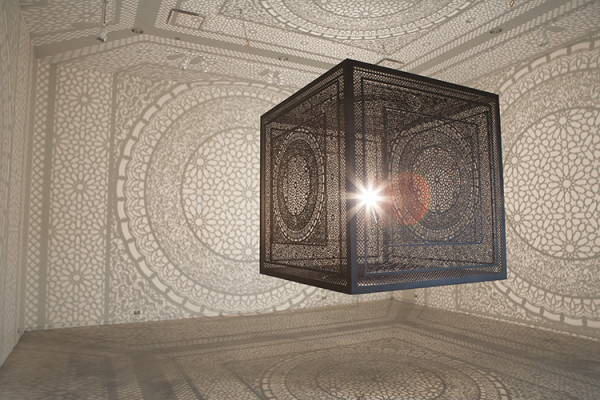
Intersections by Anila Quayyum Agha.
via Colossal.
Here’s a nice idea: a journal for people to write about open problems, with the aim of inspiring someone to have a go at solving them. Open Problems in Mathematics is a new open-access journal set up by Krzysztof Burdzy and a few others, and it’s online now.