[vimeo url=https://vimeo.com/65475425]
You're reading: Posts By Christian Lawson-Perfect
All Squared, Number 5: Favourite maths books (part 1)
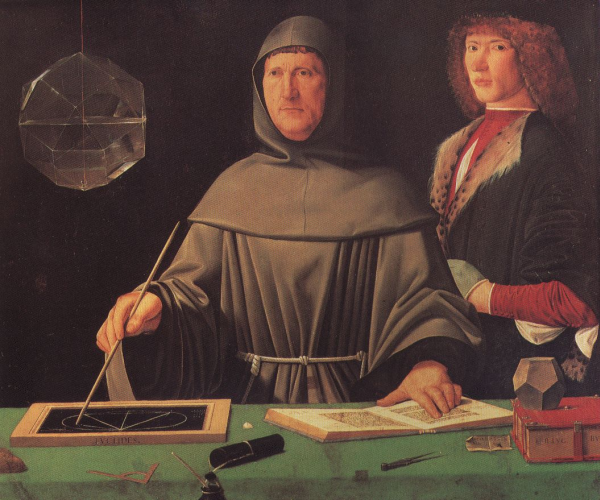
Good maths books are simultaneously plentiful and rare. While there are a few classics almost everyone knows about and has copies of (Gardner, Hardy, etc.), the trade in lesser-known maths books is considerably less well-organised. Very few bookshops have well-stocked maths sections, and insipid pop maths books dominate. Unless you hear about a good maths book through word of mouth, you’ll often only encounter it once it’s ended up in a second-hand bookshop, usually a refugee from an emptied maths department library.
But books, more than anything else, are where the beauty of maths really manifests itself. It’s where ideas are presented most clearly, after they’ve had time to percolate through a few more brains. We talked to David Singmaster, professor of maths and metagrobologist, about his favourite maths books.

Podcast: Play in new window | Download
Subscribe: RSS | List of episodes
Random walks on slides
Some grad students at Carnegie Mellon had a fun idea: what if each slide in a presentation was made by a different person, based only on the previous slide?
Being grad students and thus having nothing better to be getting on with, they did just that, and nominated one of their number to deliver the resulting presentation without having seen any of the slides in advance.
Watch the video below. Prepare to hear lots of nerdy giggling.
[youtube url=https://www.youtube.com/watch?v=XIz1XcPpcx4]
abc: the story so far
You should take some time to read this very well-written piece about Shin Mochizuki’s claimed proof of the abc conjecture: “The Paradox of the Proof”, by Caroline Chen.
It covers the story from all angles: a biog of Mochizuki, a clear, non-nonsense description of the conjecture, the tale of the mathematical community’s attempts to understand it, and some insightful rumination on the nature of proof.
via Marcus du Sautoy on Twitter, among others
(TL;DR – still nobody knows whether the proof is correct or not)
Integer sequence review: A010727
The Online Encyclopedia of Integer Sequences contains over 200,000 sequences. It contains classics, curios, thousands of derivatives entered purely for completeness’s sake, short sequences whose completion would be a huge mathematical achievement, and some entries which are just downright silly.
For a lark, David and I have decided to review some of the Encyclopedia’s sequences. We’ll be rating sequences on four axes: Novelty, Aesthetics, Explicability and Completeness.
A010727
Constant sequence: the all 7’s sequence.7, 7, 7, 7, 7, 7, 7, 7, 7, 7, 7, 7, 7, 7, 7, 7, 7, 7, 7, 7, 7, 7, 7, 7, 7, 7, 7, 7, 7, 7, 7, 7, 7, 7, 7, 7, 7, 7, 7, 7, 7, 7, 7, 7, 7, 7, 7, 7, 7, 7, 7, 7, 7, 7, 7, 7, 7, 7, 7, 7, 7, 7, 7, 7, 7, 7, 7, 7, 7, 7, 7, 7, 7, 7, 7, 7, 7, 7, 7, 7, 7, ...
Monthly MathsJams – November 2012 Survey Data
Those of you with long, long memories (and who attend a MathsJam) may recall that back in November 2012, MathsJam HQ sent out a questionnaire to monthly regional meetups, with various questions about attendance and ping-pong balls. The purpose of the survey was to get a snapshot of what the monthly MathsJams are like, as well as to produce some spurious graphs. Christian and I, who run the Newcastle and Manchester MathsJams respectively, were tasked with analysing the data. Here are our findings!
Newcastle MathsJam March and April 2013 Recap
Better late than never, I’ve posted my recap of Newcastle MathsJam’s March and April meetings on my mathem-o-blog. We talked about topology, made a tiny blanket for a baby snake, failed to work a cardboard computer, and a lot more.