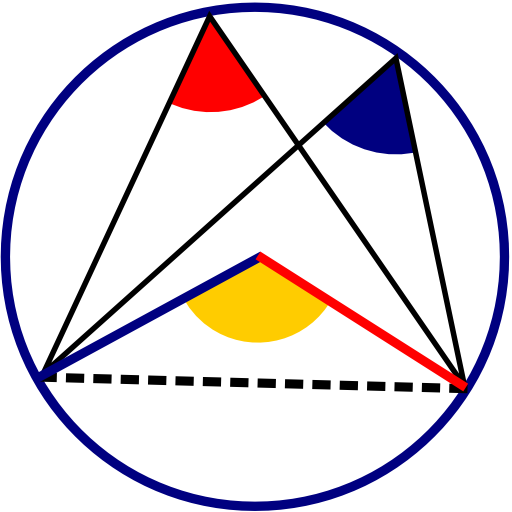
This organ’s benevolent editing triumvirate is making its way to a conference centre outside Crewe this weekend for our AGM, which happens to coincide this year with the big MathsJam conference. If you’re going as well, please do say hello, and if you’re not, keep an eye on each of our Twitter feed @aperiodical and the #MathsJam hashtag. We’re going to be trying to tweet along with most of what’s happening, as will most of the other 100 attendees, and we’re going to have some good posts lined up for the coming weeks based on what we see there.
You're reading: Posts By Christian Lawson-Perfect
Recreational Maths Seminar – Picture-hanging puzzles
I hosted the first (proper) Aperiodical recreational maths seminar yesterday. We discussed the paper Picture-hanging puzzles, by Demaine et al. Click through to watch the YouTube recording of the session.
Relatively Prime is done
This is the first Monday in quite a while that I haven’t had a new episode of Relatively Prime to listen to. That’s because all eight episodes have now been released. I meant to put a little post up each week reminding you to listen to the latest episode, but I completely forgot to do that, so here’s a post saying you can now listen to the whole lot. And you should.
Not mentioned on The Aperiodical last week
The way the news section of this site works is, the three of us send in links throughout the week to stories we’ve seen. They go into a section of the site’s backend titled “anyone can edit”, which is code for “someone else please write this up.” It tends to fill up until one of us takes a day, typically a Friday, to run through it and write up as many news stories as they can manage before finger cramps or brain blockages kick in.
This ad hoc news coverage system tends to mean that we miss quite a few big stories, because they take time to research and present in a form we’d be happy with. There are also times when it’s quite hard to tell whether something that’s big in the mainstream press is actually worthwhile, or the result of a canny university PR department framing something uninteresting in a way that will grab editors’ attentions.
On top of all of this, we haven’t been particularly good neighbours so far: there’s a lot of good maths blogging going on around the world, and we’ve been a bit of a closed shop so far.
So what we thought we should do is write a post at the end of each week quickly mentioning the things we didn’t get round to covering, or decided not to cover, and throw in some links to good maths posts we’ve seen elsewhere. Here’s the first one of those.
US high school mathematics teacher Liz Ratliff is going to the South Pole with the IceCube neutrino observatory under a programme called PolarTREC (Teachers and Researchers Exploring and Collaborating). You can follow her adventures on her online journal, in the most recent post of which she describes the theoretical background behind the IceCube facility (“basically a giant telescope buried under the ice at the South Pole”). (This story via Samuel Hansen on Math/Maths 120.)
New Scientist published a piece ‘Mathematical proof reveals magic of Ramanujan’s genius‘, about Ken Ono’s (unpublished) work on modular forms.
And, of course, the big news this week, to which we felt we had little to contribute, was the work of Nate Silver in predicting the outcome of the US Election.Some was more triumphant, such as Mashable’s ‘Triumph of the Nerds: Nate Silver Wins in 50 States‘ or the xkcd comic ‘Math‘, and some were more in the mode of sober reflection, such as The Baseline Scenario’s ‘A Few Thoughts on Nate Silver‘, which offers “as Daniel Engber pointed out, the fact that Obama won (and that Silver called all fifty states correctly) doesn’t prove that Silver is a genius any more than Obama’s losing would have proven that he was a fraud”, with some discussion of how probabilistic forecasting should be treated.
Some drew wider conclusions about the state of mathematics and numeracy in the general public, like the Cocktail Party Physics blog’s ‘Why Math is Like the Honey Badger: Nate Silver Ascendant‘. How did he do it? There’s a good piece on More or Less still available via iPlayer Radio, and the GrrlScientist blog offers ‘How did Nate Silver predict the US election?‘ Felix Salmon wrote about Nate’s ability to cast his predictions in a compelling narrative in ‘When quants tell stories‘. But the definitive account of how his process works is given by the site Is Nate Silver a Witch?
Nate himself offers a roundup of ‘Which Polls Fared Best (and Worst) in the 2012 Presidential Race‘.
AMS Mass Media Fellowships
Americans, the AMS needs YOU!
The Best Writing on Mathematics 2012
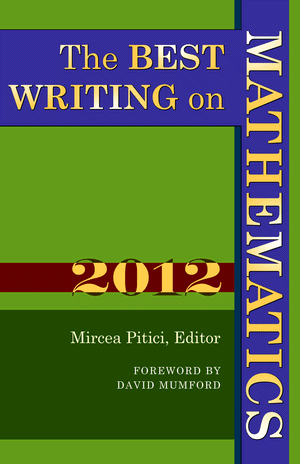 Every year, Princeton University Press gathers together a small anthology of the best writing on mathematics from the past 12 months.
The Best Writing on Mathematics 2012 was released last week. Now that Princeton’s web servers have been dried out after Hurricane Sandy’s visit, I can give you its blurb:
This annual anthology brings together the year’s finest mathematics writing from around the world. Featuring promising new voices alongside some of the foremost names in the field, The Best Writing on Mathematics 2012 makes available to a wide audience many articles not easily found anywhere else–and you don’t need to be a mathematician to enjoy them. These writings offer surprising insights into the nature, meaning, and practice of mathematics today. They delve into the history, philosophy, teaching, and everyday occurrences of math, and take readers behind the scenes of today’s hottest mathematical debates. Here Robert Lang explains mathematical aspects of origami foldings; Terence Tao discusses the frequency and distribution of the prime numbers; Timothy Gowers and Mario Livio ponder whether mathematics is invented or discovered; Brian Hayes describes what is special about a ball in five dimensions; Mark Colyvan glosses on the mathematics of dating; and much, much more.
The “much, much more” alluded to above includes our very own Peter Rowlett’s collection of essays “The unplanned impact of mathematics”, which was published in Nature last year. And at only £13.95, just £1.95 more than what Nature is asking for Peter’s article alone, The Best Writing on Mathematics 2012 is a steal.
The Best Writing on Mathematics 2012 at Princeton University Press. $19.95/£13.95 in paperback or ebook.
MAA Mathematical Pumpkins
The Mathematical Association of America asked its Facebook fans to send in pictures of their mathematical pumpkins. They answered the call admirably!
You can see the pictures at the MAA’s Facebook page. I particularly like the honeycomb one.