
Tim Locke displayed his geometric metalwork at the 2012 Bridges conference.
via Mr Honner

Tim Locke displayed his geometric metalwork at the 2012 Bridges conference.
via Mr Honner
Having gathered a few data points about people’s availability for the recreational maths seminar, and heavily weighted towards my own, it looks like weekend evenings are the most convenient times for everyone to get together for the recreational maths seminar. So, let’s say 7pm GMT on Sunday evening, the 11th of November. That’s 2pm EST (New York), 11am PST (California) and 6am EDT (Eastern Australia, on the 12th of November).
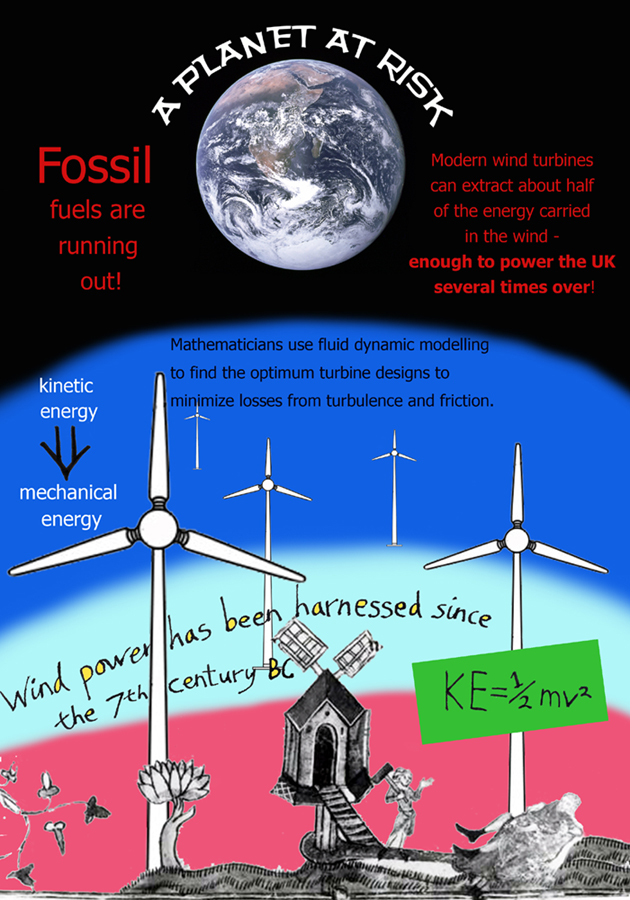 The IMA’s Maths Careers campaign runs a yearly competition for posters illustrating applications of maths. Entry for the 2012/13 competition has opened, and it’s on the theme of the planet Earth, to join in with the Mathematics of Planet Earth year 2013. UK students between the ages of 11 and 19 are invited to submit posters about “A planet to discover“, “A planet supporting life“, “A planet organised by humans” or “A planet at risk“.
The deadline for submissions is my birthday, the 14th of January, and the winners from the three age categories will each receive “an Android tablet”.
Find more info and the entry form on the Maths Careers website.
I’ve posted my recollections of what happened at last month’s Newcastle MathsJam over at my mathem-o-blog.
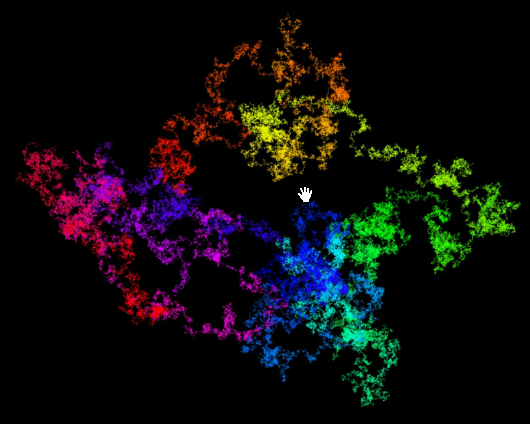
Fran Aragón Artacho has emailed to tell us that he and Jon Borwein have entered their image of a walk on the first 100 billion digits of π in the National Science Foundation (of the USA)’s International Science & Engineering Visualization Challenge. Fran says:
Jon Borwein and I have submitted our picture of a walk based on 100 billion digits of pi to a visualisation contest from the NSF (National Science Foundation). The winners will appear in Science (one will be selected for the front cover!). And we have good news: we are one of the 10 finalists in the Illustration category!
Would you be interested in taking part in a sort of online video-chat seminar about recreational maths? Then read on!

Quite a few designery visualisations of the prime numbers have been put out on the web recently, to varying degrees of success. Most of the time they look pretty but don’t tell you very much; the most recent example I can think of is El Patrón de los Números Primos by Jason Davies.
A few weeks ago Brent Yorgey posted on his excellent blog The Math Less Traveled some really nice “factorization diagrams“, along with the code to produce them. Straight away, anyone with a text editor and a knack for fancy web coding set to work making the animated version that was so clearly required.
Stephen von Worley has made, I think, the nicest one. He calls it the Factor Conga. Sit back and enjoy the mysteries of the natural numbers as they dance their beguiling dance!