
Enjoy a wonderful 11 minutes of @FryRSquared talking about the probability problems associated with assigning Secret Santa presents by drawing names from a hat:
This post is part of the Aperiodical’s 2018 Aperiodvent Calendar.
Enjoy a wonderful 11 minutes of @FryRSquared talking about the probability problems associated with assigning Secret Santa presents by drawing names from a hat:
This post is part of the Aperiodical’s 2018 Aperiodvent Calendar.

By stitching carefully between a set of points, you can create a parabola – these Christmas cards have taken this idea and given it a festive twist.

Six is the number of sides on a hexagon, and hexagonal symmetry is one of the most wintry symmetries – due to the bond angle of water when frozen into ice, all snowflakes (with some minor exceptions) have hexagonal symmetry.

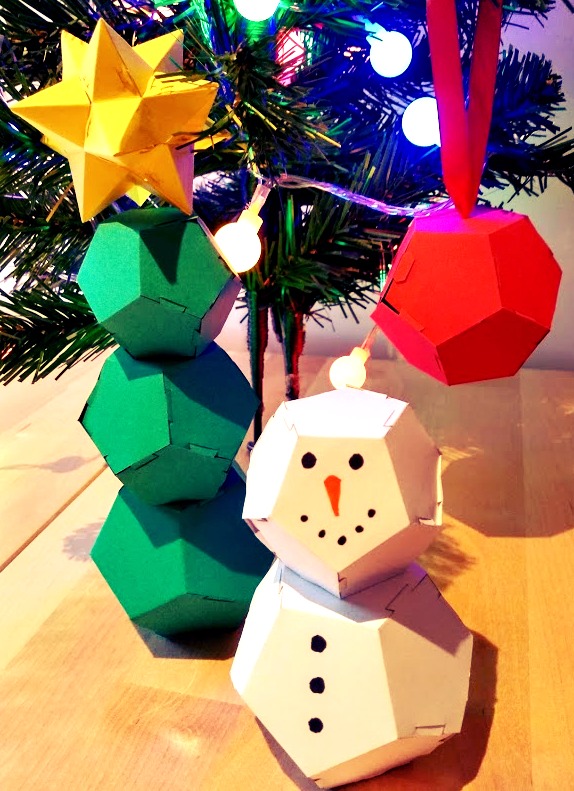 If you’re thinking about decorating your house for the festive season, we recommend the Twelve Pentagons of Christmas – dodecahedrons. Here’s a few ways to get more regular twelve-sided polyhedra into your life.

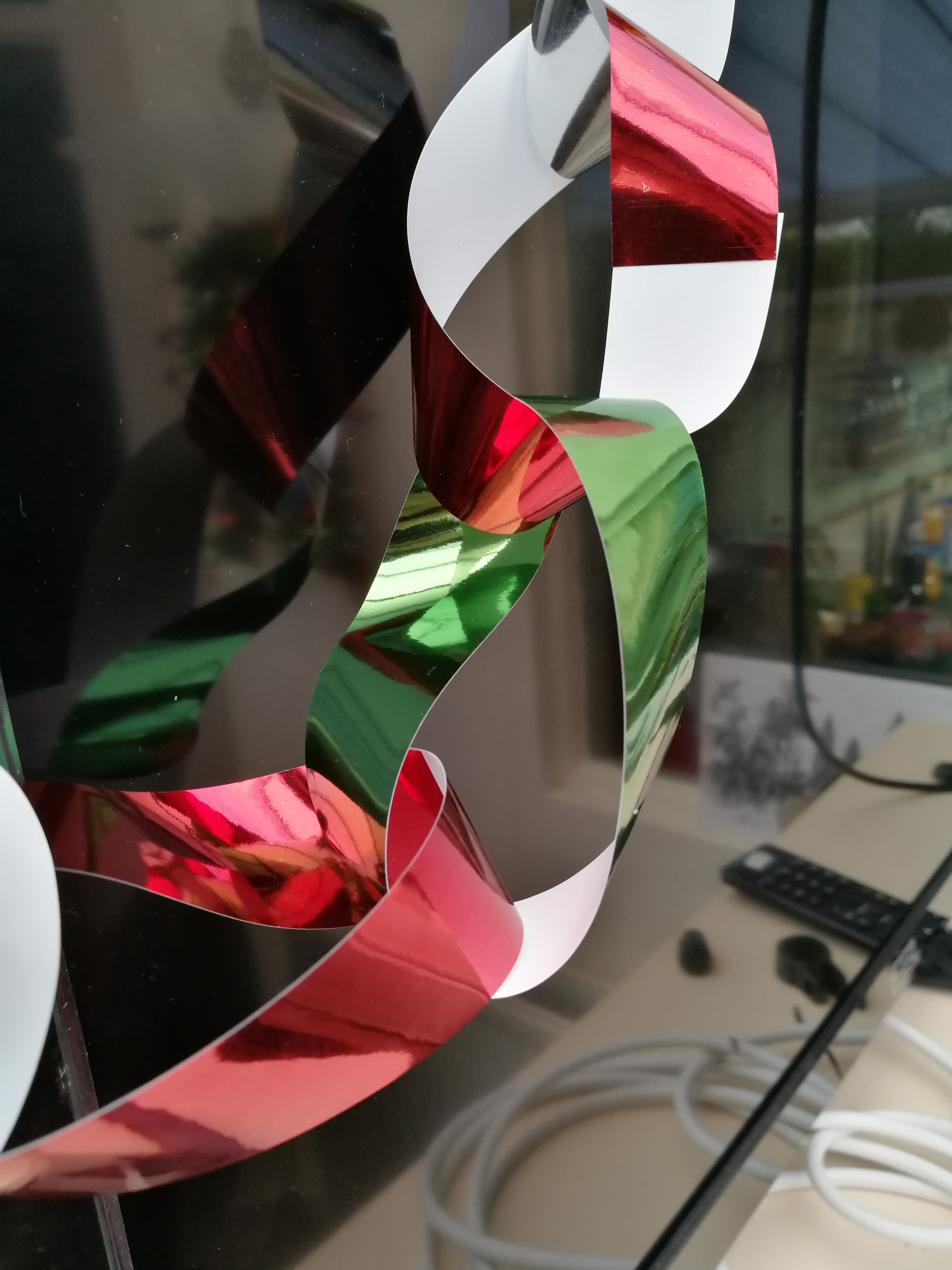
Möbius Paper Chain photo by SpaceLlamaMK1 on Imgur
If you’re trying to think of ways to decorate your home, office or classroom, look no further than mathematically non-trivial paper chains, made from Möbius bands.
All you need is some double-sided coloured paper (ideally the same colour on both sides, but if you want to show off the twist, you can go two-tone) cut into long strips, and tape to loop them together.
If you consistently use the same handedness of Möbius loop (twisting the same way each time) your chains will hang nicely, and they’ll all sit in the same orientation – unlike those messy normal paper chains, where every second loop is at right angles.
Share your photos of finished Möbius paper chains on Twitter, mentioning @Aperiodical, and we’ll retweet the best.
This post is part of the Aperiodical’s 2018 Aperiodvent Calendar.

Today’s contribution is from friend of the site, Festival of the Spoken Nerd’s Matt Parker, who’s found a way to approximate π using a mince pie (or any type of pie, or indeed any small object with non-zero mass, but the mince pie is the most festive option). The trick is to use it as the weight on the end of a 2.45m-long pendulum, and time the swings.
The pendulum is part of the latest Spoken Nerd show, You Can’t Polish a Nerd (which we’ve reviewed here recently), and this clip shows Matt’s preparations to do the approximation live on stage:
https://twitter.com/FOTSN/status/1062402096572575744
The diagram below outlines how it’s done:
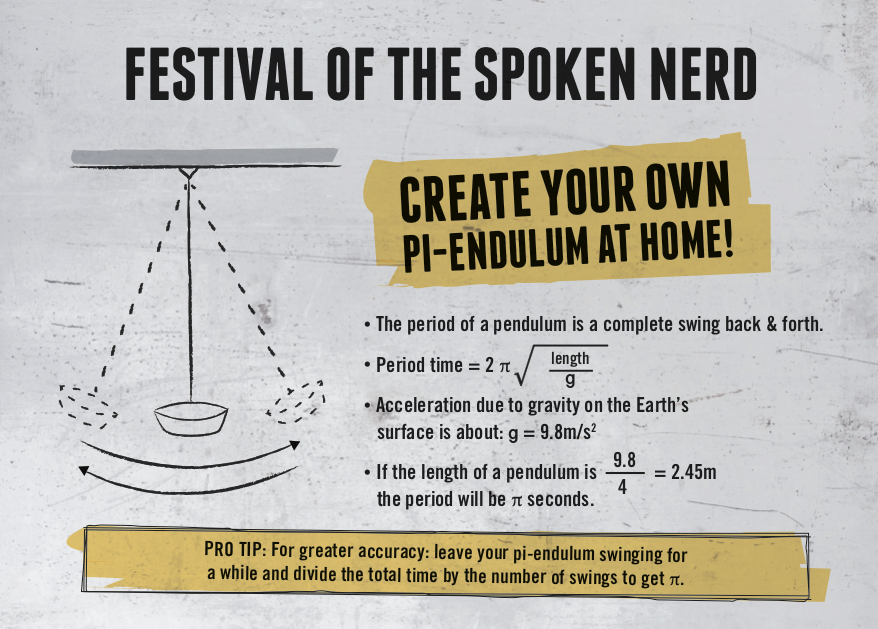
Share your own photos, videos and approximations to mince π on Twitter, and give @FOTSN a mention so they can see just what they’ve started. Visit the FOTSN shop to get your hands on the show in various formats (great Christmas presents!).
This post is part of the Aperiodical’s 2018 Aperiodvent Calendar.
At the MathsJam weekend gathering earlier this month, we found ourselves invited to join maths podcasting supremo Samuel Hansen for a recording session. Nothing unusual there: podcasts have been recorded at MathsJam before. But this time Samuel wanted to record more than one podcast at the same time – since many of the maths podcasting community were present, it seemed like a good plan to grab anyone who wasn’t already doing something else and record something quite unlike any podcast you’ve ever heard.