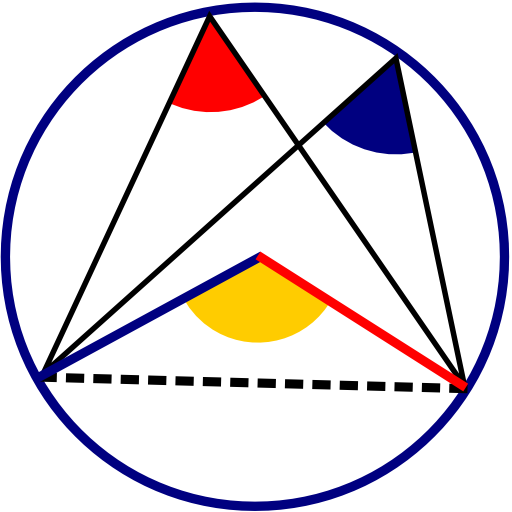
They say that $\pi$ is everywhere. (They say that about $\phi$ too, but I’m not buying it.) I thought it would be interesting to discuss the most unexpected place I’m aware it’s ever appeared.
You're reading: Irregulars
- Imagine you have some playing cards. Of course if you actually have some cards you don’t need to imagine!
- Pick your favourite natural number $n$ and put a deck of $n$ cards in front of you. Then repeat the next step until the deck is empty.
- Take $2$ cards from the top of the deck and throw them away, or just take $1$ card from the top and throw it away. The choice is yours.
Apiological: mathematical speculations about bees (Part 2: Estimating nest volumes)
This is part 2 of a three-part series of mathematical speculations about bees. Part 1 looked at honeycomb geometry.
Honeybees scout for nesting sites in tree cavities and other nooks and crannies, and need to know whether a chamber is large enough to contain all the honey necessary to feed their colony throughout the winter. A volume of less than 10 litres would mean starvation for the whole colony, whereas 45 litres gives a high chance of survival. How are tiny honeybees able to estimate the capacity of these large enclosed spaces, which can be very irregular and have multiple chambers?
Apiological: mathematical speculations about bees (Part 1: Honeycomb geometry)
Bees have encouraged mathematical speculation for two millennia, since classical scholars tried to explain the geometrically appealing shape of honeycombs. How do bees tackle complex problems that humans would express mathematically? In this series we’ll explore three situations where understanding the maths could help explain the uncanny instincts of bees.
Honeycomb geometry
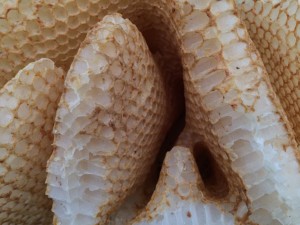
A curvy wild honeycomb.
Honeybees collect nectar from flowers and use it to produce honey, which they then store in honeycombs made of beeswax (in turn derived from honey). A question that has puzzled many inquiring minds across the ages is: why are honeycombs made of hexagonal cells?
The Roman scholar Varro, in his 1st century BC book-long poem De Agri Cultura (“On Agriculture”), briefly states
“Does not the chamber in the comb have six angles, the same number as the bee has feet? The geometricians prove that this hexagon inscribed in a circular figure encloses the greatest amount of space ((Translation by Hooper and Ash in the Loeb. I’ve been told that ‘Hexagonon’ is in its singular form, and the only Greek word (also having Greek grammar) amongst this part of Varro’s Latin text. I would be happier that Varro understood what he was writing about if the text more explicitly described the construction, perhaps ‘Three hexagons encircling a point’, or ‘Six hexagons arranged around a seventh’. In translation, it could be viewed as falsely suggesting that the hexagon is the polygon with the greatest area that fits inside a circle. In his defense though, Varro also earlier suggests that orchards be arranged regularly in quincunxes, the arrangement of spots representing the number five on dice, to take up less room and give better quality produce. The centres of hexagons in a regular hexagonal tiling can be thought of as an elongated quincunx, repeated. As this is essentially the same result used in another context, I’ll give Varro the benefit of the doubt and defer to Varro’s poetic license.)).”
Things I Made And Did
Since you’re here reading this, you probably know that on October 30th, Matt “Friend of the Site” Parker released his book, Things to Make and Do in the Fourth Dimension. If you’ve gone one further and read it, you might have seen the occasional reference to the website, makeanddo4d.com. If that website is the book’s DVD extras, this is the website’s extras. We’re going to peek behind the scenes and see how it all works. (Spoiler alert: the maths is powered by maths. It’s recursive maths, all the way down.)
Discovering integer sequences by dealing cards
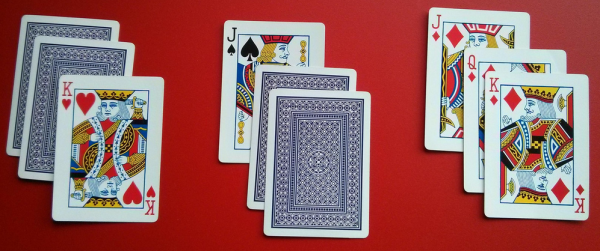
Let’s play a game:
If you pick a small $n$, such as $n=3$, it’s pretty easy to see how this game is going to play out. Choosing to throw away $2$ cards the first time means you’re then forced to throw away $1$ card the next time, but only throwing away $1$ card the first time leaves you with a choice of what to throw away the next time. So for $n=3$ there are exactly $3$ different ways to play the game: throw $2$ then $1$, throw $1$ then $2$, or throw $1$ then $1$ then $1$.
Now, here comes the big question. How does the number of different ways to play this game depend on the size of the starting deck? Or in other words, what integer sequence $a_0$, $a_1$, $a_2$, $a_3$, $a_4$, … do we get if $a_n$ represents the number of different ways to play the game with a deck of $n$ cards? (We already know that $a_3=3$.)
Poetry in Motion
Phil Ramsden gave an excellent talk at the 2013 MathsJam conference, about a particularly mathematical form of poetry. We asked him to write an article explaining it in more detail.
Generals gathered in their masses,
Just like witches at black masses.(Butler et al., “War Pigs”, Paranoid, 1970)
Brummie hard-rockers Black Sabbath have sometimes been derided for the way writer Geezer Butler rhymes “masses” with “masses”. But this is a little unfair. After all, Edward Lear used to do the same thing in his original limericks. For example:
There was an Old Man with a beard,
Who said, “It is just as I feared!-
Two Owls and a Hen,
Four Larks and a Wren,
Have all built their nests in my beard!”(“There was an Old Man with a beard”, from Lear, E., A Book Of Nonsense, 1846.)
And actually, the practice goes back a lot longer than that. The sestina is a poetic form that dates from the 12th century, and was later perfected by Dante. It works entirely on “whole-word” rhymes.
The minch, the mound and the light-gigaminch
On Wednesday 27th November 2013, friend of The Aperiodical and standup mathematician Matt Parker tweeted a link to his latest YouTube video.
In the video Matt apologises for some remarks on the imperial number system that he made in an earlier Number Hub video about the A4 paper scale. He then goes into some of the quirkiness of the many imperial number units used for measuring length. It is an unusual ‘apology’, although very entertaining.
This got me thinking about how I think about lengths, and I tweeted that I often think in ‘metric-imperial’ units of length, or multiples of exactly 25mm in my job as a civil and structural engineer – a metric inch, if you like. Colin Wright suggested the name ‘minch’ for these units; there are then two score minch to the metre.