 Welcome to the 101st edition of the Carnival of Mathematics. The Aperiodical took over running the Carnival when it launched in April 2012, at Carnival 85. Although it’s conventional to celebrate round number anniversaries (and even though I’m left-handed), we decided for a combination of reasons not to make a big deal out of Carnival 100 – instead inviting maths author Richard Elwes to host it on his blog – and instead to make the more exciting number 101 into our big celebration of how long the Carnival’s been running.
You're reading: Columns
- From Bracket 1: A002210, the decimal expansion of Khintchine’s constant.
- From Bracket 2: A001220, the Wieferich primes.
- From Bracket 3: A001462, Golomb’s sequence.
- From Bracket 4: A023811, the largest metadromes in base $n$.
- From the first round of reviews, we picked the one whose score we fiddled the least: A010727, all the 7s.
- And the wildcard is A058883, the wild numbers.
Manchester MathsJam recap, July 2013
This month we had a lovely MathsJam, with plenty of old and new faces and a disturbing quantity of activity related to black and white counters. I’d brought a big pile of them and some stuff to do with them, and we got cracking.
Aperiodical Round Up 9: Frank Nelson Cole is the best at math
Hello. My name’s Christian Perfect and I have some maths links for you.
Brad Neely, a member in good standing of my list of male role-models, once made a show called China, IL. Here’s a clip.
http://www.youtube.com/watch?v=r086uma9HBM
Mathematicians like to tell non-mathematicians (and themselves) that real maths isn’t like that; real maths is about seeing the structure behind the numbers and using pure logic to deduce true statements with enormous explanatory power. The platonic ideal of doing real maths involves going for a wander in your brain and then writing down a few of the true statements you saw along the way. But it almost never works out that way: you often have to start out by sitting down and crunching numbers, like any school-age chump, until you get a glimpse of what’s going on. Worse, sometimes it turns out that finishing the theory involves a reduction to cases, a.k.a. Yet More Crunching.
So, this one goes out to the number crunchers. Let these stories of quixotic computation give you solace.
Puzzlebomb – August 2013
 Puzzlebomb is a monthly puzzle compendium. Issue 20 of Puzzlebomb, for August 2013, can be found here:
Puzzlebomb – Issue 20 – August 2013
The solutions to Issue 20 can be found here:
Puzzlebomb – Issue 20 – August 2013 – Solutions
Previous issues of Puzzlebomb, and their solutions, can be found here.
Integer Sequence Review Mêlée Hyper-Battle DX 2000, THE GRAND FINALE
Welcome to the Field of Dreams. Talking of which: why can’t you grow wheat in $\mathbb{Z}/6\mathbb{Z}$?
Anyway, we’re finally here: the Grand Finale of our tournament to find the Integest Sequence 2013. Here’s a reminder of the sequences vying for the title:
It’s a been a long, hard battle. We’ve seen some good sequences, some bad sequences, and an awful lot of plagiarised GIFs. So, without further ado, it’s time to start the

Maths at the Fringe
Starting next week, the historic city of Edinburgh will be taken over by entertainers of all types, performing comedy, dance, theatre and music, entertaining visitors to their massive world-famous festival fringe. Since discerning mathematicians sometimes also enjoy being entertained, I thought I’d write a roundup of the shows maths has non-empty intersection with.
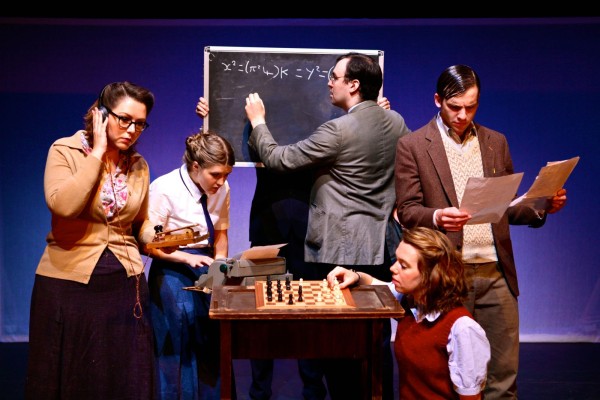
First up, since we haven’t mentioned him in a while, it’s Alan Turing! No, his reanimated corpse isn’t performing edgy stand-up, but theatre company Idle Motion is performing a visual theatre piece entitled That Is All You Need To Know, celebrating the work of Bletchley Park codebreakers. Alan Turing Alan Turing Alan Turing.
26th July 2004–23rd July 2013
Yesterday, with my tongue certainly in cheek, I tweeted to the BBC Breaking News Twitter account that I had handed in my thesis, with a promise of a press release to follow. Taking the lead from my over-inflated sense of self importance, Christian Perfect posted this news to The Aperiodical News feed as ‘Breaking: Peter Rowlett has submitted his doctoral thesis‘.
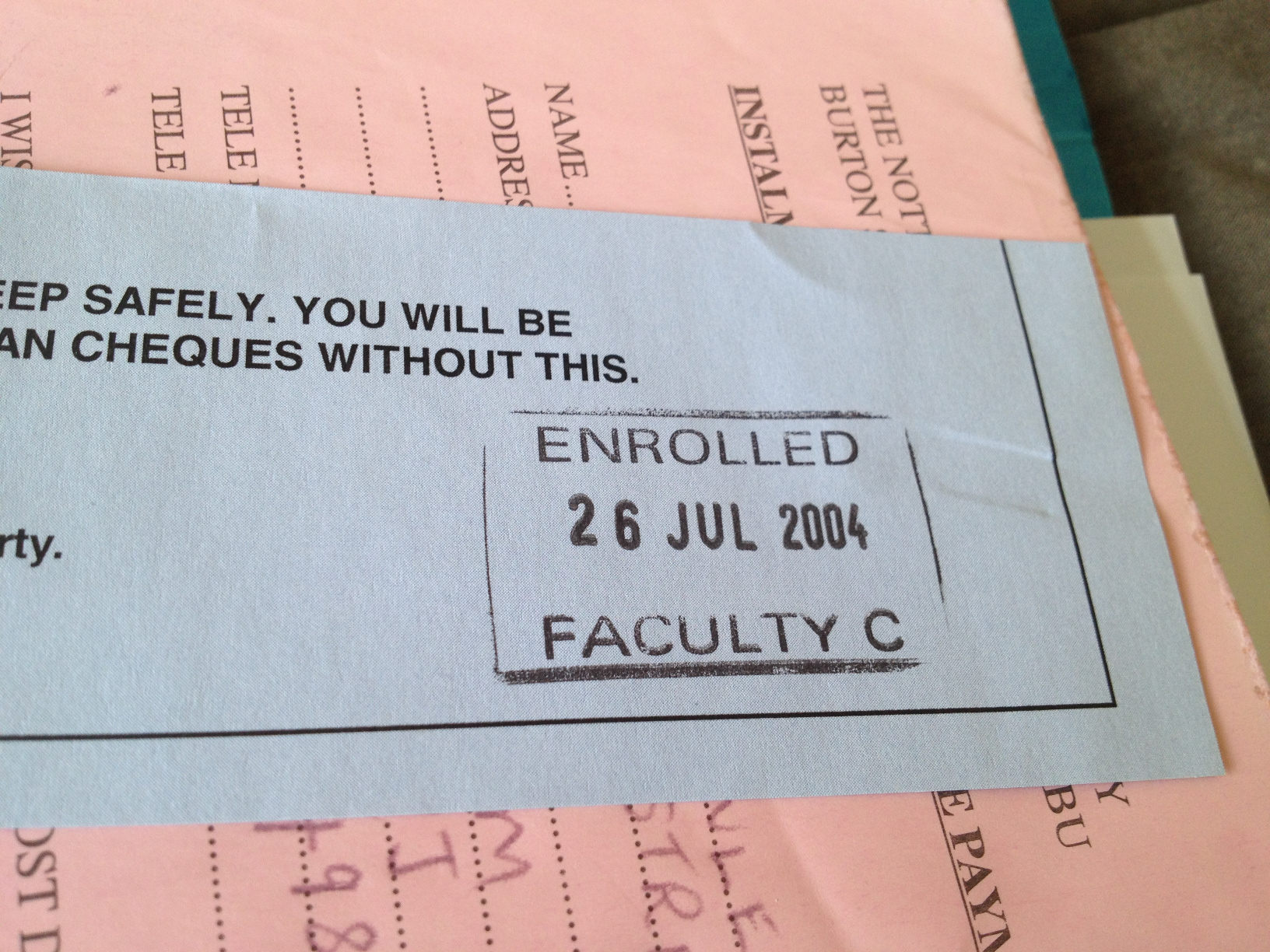
Recently, in order to complete the submission paperwork, I went through my PhD files and stumbled upon my original enrolment confirmation. Before the brave new world of online enrolment and online fee payment, I had to go to an office and give money to receive a stamp on a piece of paper. The enrolment slip asks me to keep it safe, which apparently I did.