Better late than never, I’ve posted my recap of Newcastle MathsJam’s March and April meetings on my mathem-o-blog. We talked about topology, made a tiny blanket for a baby snake, failed to work a cardboard computer, and a lot more.
You're reading: Columns
Integer sequence review: A225143
The Online Encyclopedia of Integer Sequences contains over 200,000 sequences. It contains classics, curios, thousands of derivatives entered purely for completeness’s sake, short sequences whose completion would be a huge mathematical achievement, and some entries which are just downright silly.
For a lark, David and I have decided to review some of the Encyclopedia’s sequences. We’ll be rating sequences on four axes: Novelty, Aesthetics, Explicability and Completeness.
A225143
Primes from merging of 10 successive digits in decimal expansion of $\zeta(2)$ or $\frac{\pi^2}{6}$.9499012067, 4990120679, 3040043189, 1896233719, 2337190679, 9628724687, 2510068721, 8721400547, 9681155879, 5587948903, 7564558769, 9632356367, 3235636709, 3200805163, 4445184059, 3876314227, 2276587939, 1979084773, 9420451591, 9120818099, ...
The Maths of Star Trek: The Original Series (Part III)
This is the third in a series of posts about the maths of Star Trek. Part I covered the probability of survival while wearing a red shirt, and Part II discussed the mathematics of alien biology.
Here’s How Little I See Your Point
You may have seen an article linked to last week, written by Jordan Weissmann at The Atlantic. The article was titled ‘Here’s How Little Math Americans Actually Use At Work‘, although mysteriously this journalist makes use of some mathematical analysis of survey data, and not only that, the data appears to show that 94% of Americans claim to use mathematics as part of their daily job.
The article discusses people’s misconceptions about the future utility of what they were learning, as well as the divide between using ‘any math’ and ‘advanced math’, which includes calculus, algebra and statistics. The number of Americans who admitted to using this type of maths appears to drop off once you get to anything more complicated than fractions, and also presented is an analysis of this divide by job type.
A very well-written and thoughtful response to this has already been posted at mathematics professor Bret Benesh’s blog, which gives four reasons why the article annoyed him (and probably several other people too).
Seeking election-themed graph blunders
Since we’d like to write a funny post about it, if you’ve been sent any literature for the upcoming local elections in the UK (or indeed, from the past or from other elections around the world) which contains a graph or chart of questionable rigor, we want to know about it.
As an example, Colin Beveridge sent us this classic from his doormat:
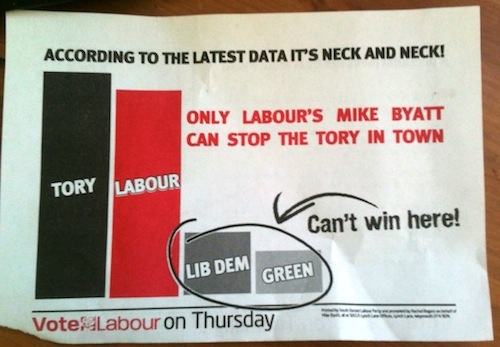
We’ll be awarding bonus points for inaccurate pie charts, exaggerated/meaningless bar sizes, the complete absence of axis label or scale, the use of ‘Can’t win here!’ and any other sneaky/incompetent features. Email your submissions to root@aperiodical.com, and watch out for a roundup post if we collect a sizeable pile.
Maths-Art seminars at London Knowledge Lab
While looking around for more arty maths, I came across the Maths-Art Seminars at London Knowledge Lab. Running more-or-less monthly since 2007, the seminar has invited architects, poets, musicians, painters and of course mathematicians to explore the connections between “mathematics” and “art”.
Previous talks include such intriguing titles as “Parametric Design and Construction in the sculpture “Tall Tree and the Eye” by Chiara Tuffaneli“; “To Live: Building Geodesic Shelters from Estate Agent Boards“; “Some mathematics within? What actually goes on in some traditional textiles crafts?“; and “From Tristram Shandy to Bad Sex: Some uses of mathematics in fiction“.
There’s a YouTube channel containing recordings of talks, but it doesn’t seem to have been updated since 2011.
Talks happen on the second Thursday of the month, during term time. The next talk is on the 9th of May, at the Institute of Education, where Michael Bartholomew-Biggs will be talking about maths and poetry. It’s just a pity they’re in London, or I’d go every month!
More information
Puzzlebomb – May 2013
 Puzzlebomb is a monthly puzzle compendium. Issue 17 of Puzzlebomb, for May 2013, can be found here:
Puzzlebomb – Issue 17 – May 2013
The solutions to Issue 17 can be found here:
Puzzlebomb – Issue 17 – May 2013 – Solutions
Previous issues of Puzzlebomb, and their solutions, can be found here.