Since the date is palindromic, and the weekday starts with an F, it’s time for another instalment of Follow Friday! Here’s some people I recommend following if you’re on Twitter, and some enjoyable tweets/links for you to look at if not.
You're reading: Columns
Carnival of Mathematics 92
The next issue of the Carnival of Mathematics, rounding up blog posts from the month of October, is now online at White Group Mathematics.
The Carnival rounds up maths blog posts from all over the internet, including some from our own Aperiodical. For more information about the Carnival of Mathematics, click here.
A recreational maths seminar?
Would you be interested in taking part in a sort of online video-chat seminar about recreational maths? Then read on!
Factor Conga

Quite a few designery visualisations of the prime numbers have been put out on the web recently, to varying degrees of success. Most of the time they look pretty but don’t tell you very much; the most recent example I can think of is El Patrón de los Números Primos by Jason Davies.
A few weeks ago Brent Yorgey posted on his excellent blog The Math Less Traveled some really nice “factorization diagrams“, along with the code to produce them. Straight away, anyone with a text editor and a knack for fancy web coding set to work making the animated version that was so clearly required.
Stephen von Worley has made, I think, the nicest one. He calls it the Factor Conga. Sit back and enjoy the mysteries of the natural numbers as they dance their beguiling dance!
Interesting Esoterica Spooky Halloween Edition
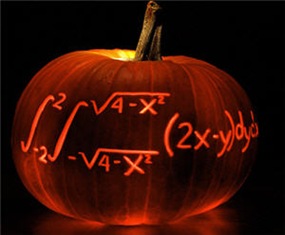
Today is Halloween, the day when skeletons and spooks and statisticians ((While The Aperiodical is an equal opportunity employer, the author maintains a legitimate fear of “approximate counting”)) roam the earth to wreak their awful revenge on the innocent.
Maths has a habit of borrowing peculiar words from the vernacular, so I thought I’d go on a witch-hunt in the arXiv and see what bone-chilling titles I could find. Here’s what fell into my genuine recreation Ghostbusters Ghost Trap:
Limiting Risk by Turning Manifest Phantoms into Evil Zombies
On the effect of ghost force in the quasicontinuum method: dynamic problems in one dimension
Taming the Ghost in Pais-Uhlenbeck Oscillator
Recovering Missing Slices of the Discrete Fourier Transform using Ghosts
An algebraic approach to laying a ghost to rest
Conclusion: mathematicians ain’t afraid of no ghosts.
Have you got any blood-curdling paper titles to share around the campfire?
Martin Gardner celebration week in Nottingham
Last Sunday saw the anniversary of the birth of Martin Gardner, and as a celebration, the Gathering for Gardner people planned a world-wide party ‘G4G Celebration of Mind‘. It happened to be Maths Jam night on Tuesday, so we put the Nottingham Maths Jam on the G4G-COM map. Then on Friday three of us had agreed to take a puzzles stall to the Nottingham STEM Pop Up Shop, so I added this to the map as well.
A Celebration of Mind party is supposed to “celebrate the legacy of Martin Gardner on or around Sunday, October 21, 2012 through the enjoyment of [one or more of] Puzzles, Magic, Recreational Math, Lewis Carroll, Skepticism and Rationality”.
At Maths Jam I printed a bunch of flexagon material from the Flexagon Party page. I also had a plan: having finished two jobs in recent years with piles of business cards outstanding, I brought these to try some business card origami. In fact, we decided to make a business card Menger sponge. So we started folding.
 |
| Business card folding begins |
Meanwhile, John Read had come equipped with some colourful designs to make hexahexaflexagons.
 |
| John Read’s first hexahexaflexagon of the evening. Designs from flexagon.net. |
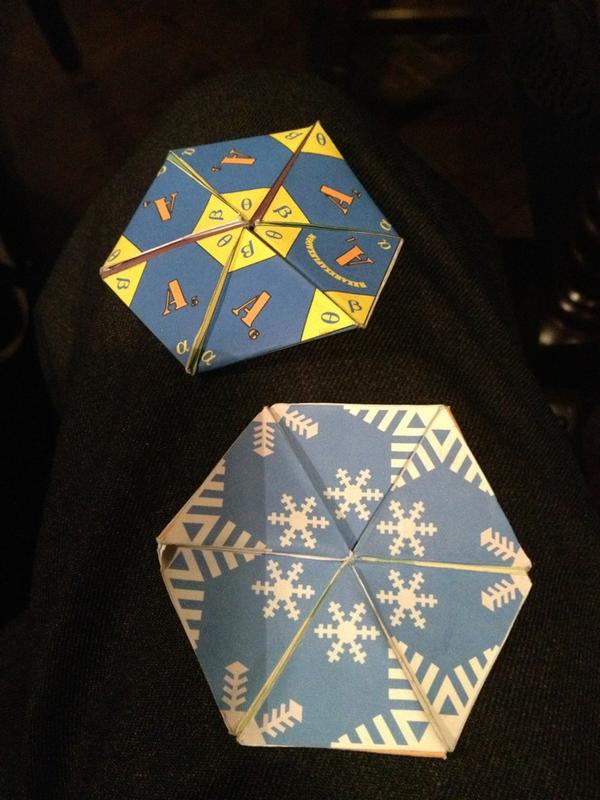 |
| John Read’s second hexahexaflexagon. Designs from flexagon.net. |
At the same time, Jon made a trihexagon.
 |
| Trying to make a triflexagon |
Finally, after much business card folding,we had a Menger sponge* (*not a real one, it being a fractal after all!). Here it is, in Maths Jam-style, balanced on a pint of beer.
 |
| The completed business card Menger sponge |
And here’s a shot through the Menger sponge, where a geometry puzzle is being attempted.
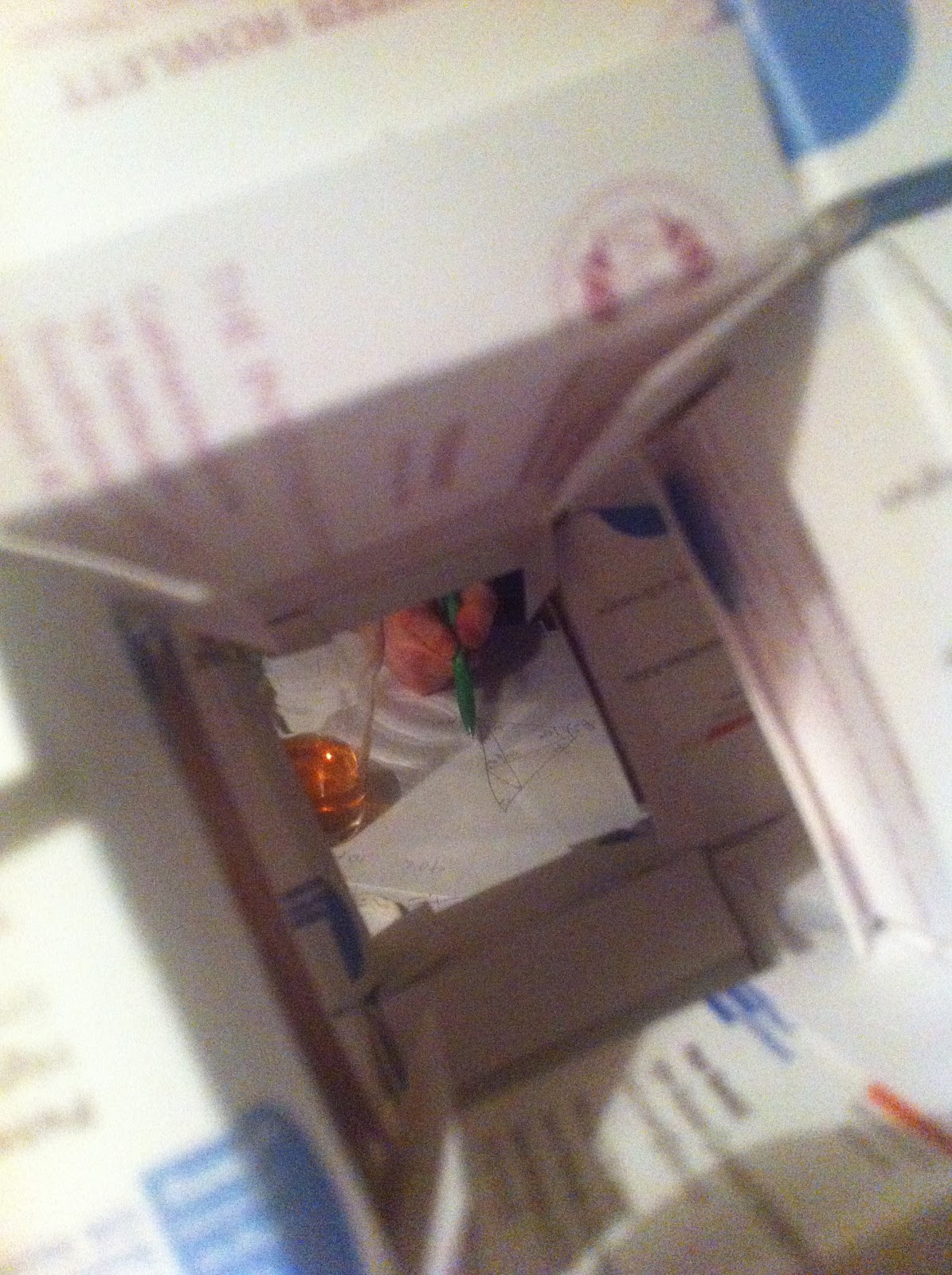 |
| Through the completed business card Menger sponge, some geometry is happening |
Here are a couple of the other puzzles that we tried, some from the #MathsJam tag on Twitter:
You have 100 coins, 10 of which are showing heads and 90 of which are showing tails (though these are indistinguishable by touch). Blindfolded, you must divide the coins into an even number of heads and tails.
Which is bigger, 3^(21!) or 2^(31!)?
Then on Friday we made our way to Broadmarsh shopping centre for our afternoon at Nottingham’s STEM Pop Up Shop.
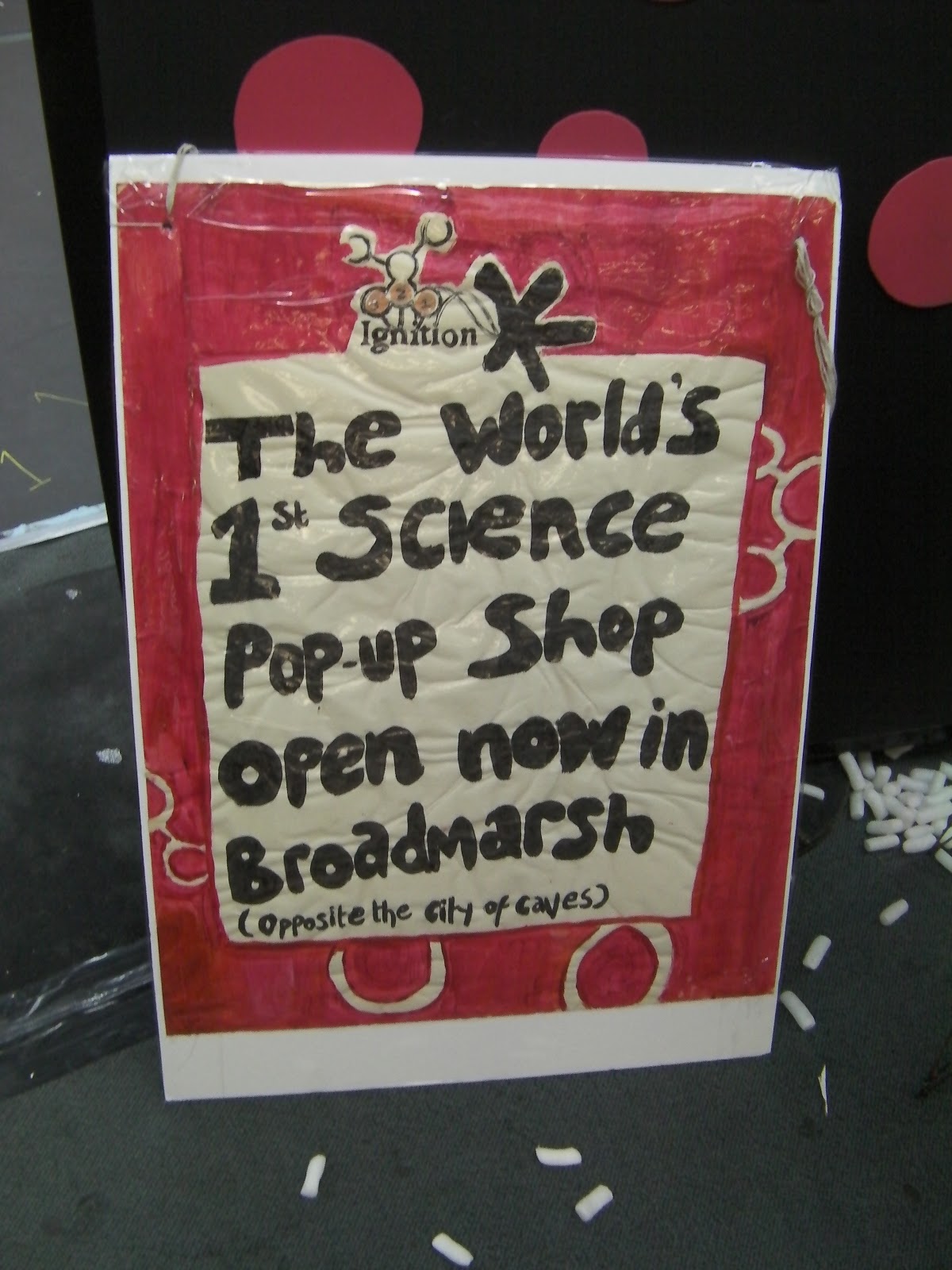 |
| Nottingham STEM Pop Up Shop welcome notice |
Here’s a picture of our stall, with Kathryn Taylor presiding, and in the foreground the posters about Martin Gardner, mathematical games and mathematicians that I had printed. Someone did ask me who Martin was and I explained a little; I think I also convinced him to come to Robin Wilson’s talk on Lewis Carroll next month in Derby.
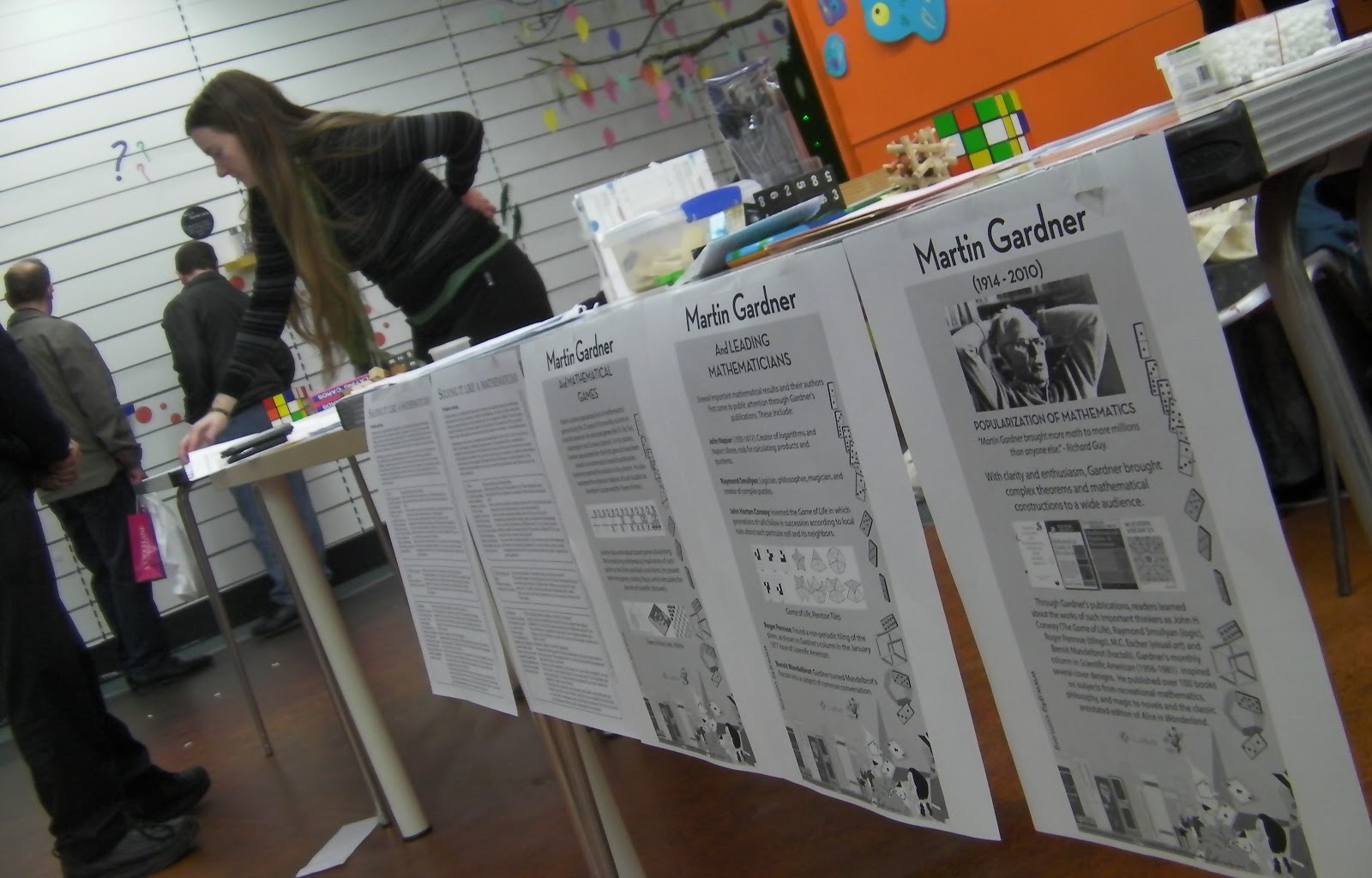 |
| Martin Gardner posters on our stall |
Here’s the detail of our stall, which we called ‘Solving it like a mathematician’. You can get details of the set of puzzles on my website.
 |
| The STEM Pop Up Shop ‘Solving it like a mathematician’ stall |
Looking around the shop, I requisitioned the Alan Turing postcards from the ‘My Favourite Scientist’ set for our stall!
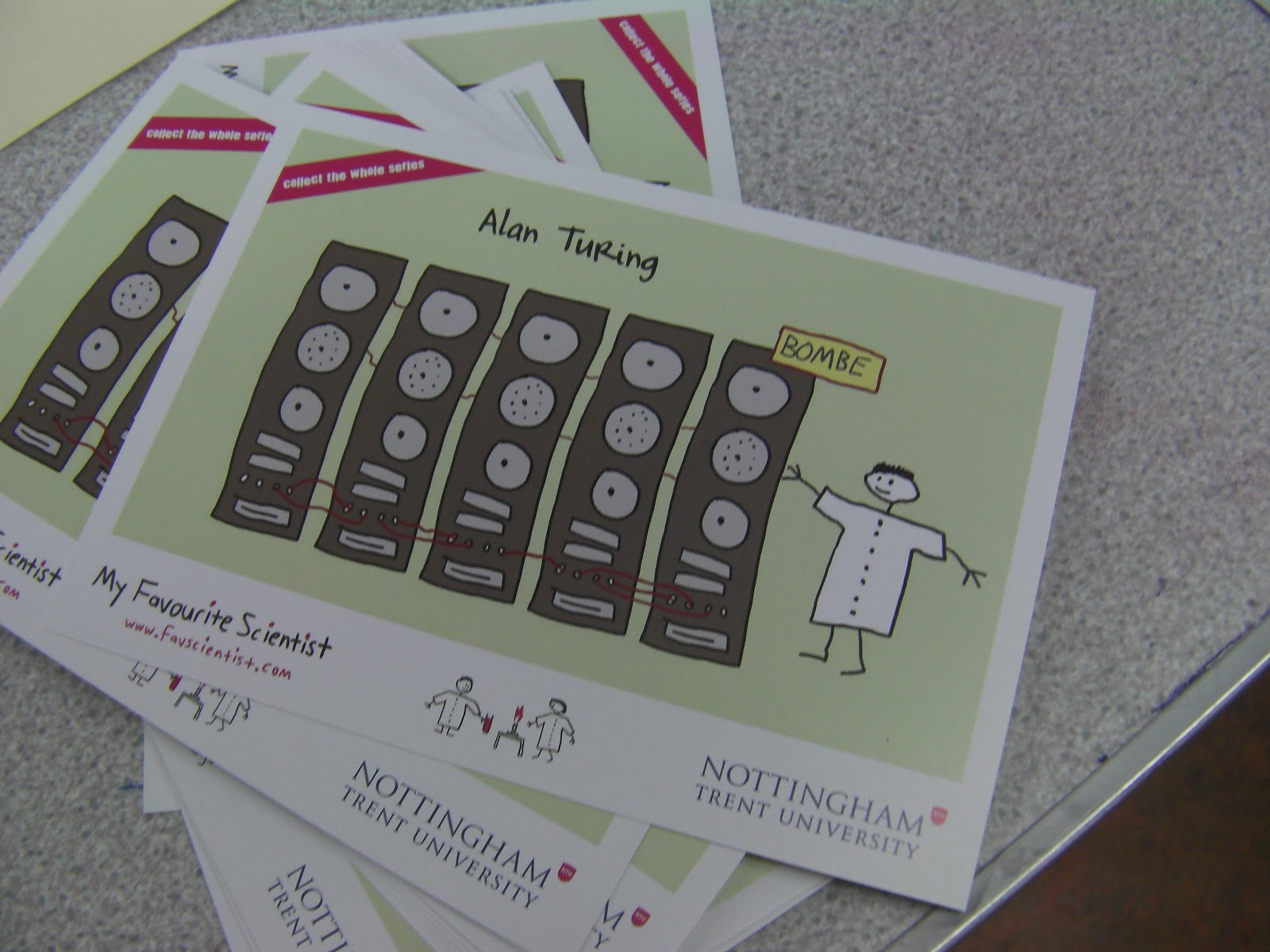 |
| Alan Turing postcards |
Here’s a wider view of the stall, with Kathryn entertaining a customer.
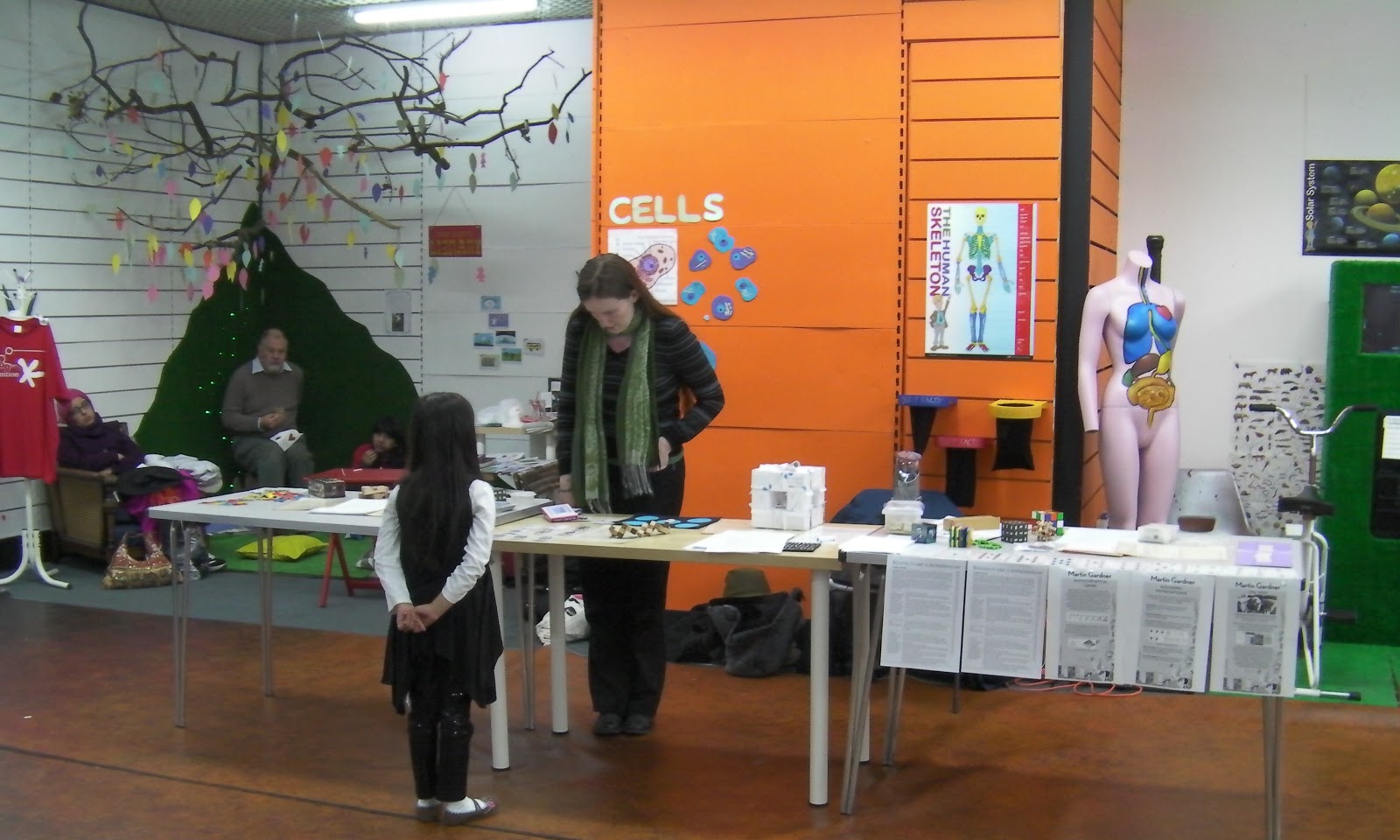 |
| Kathryn Taylor at our stall |
And finally, here’s John Read bewitching a crowd with the loop on a chain trick.
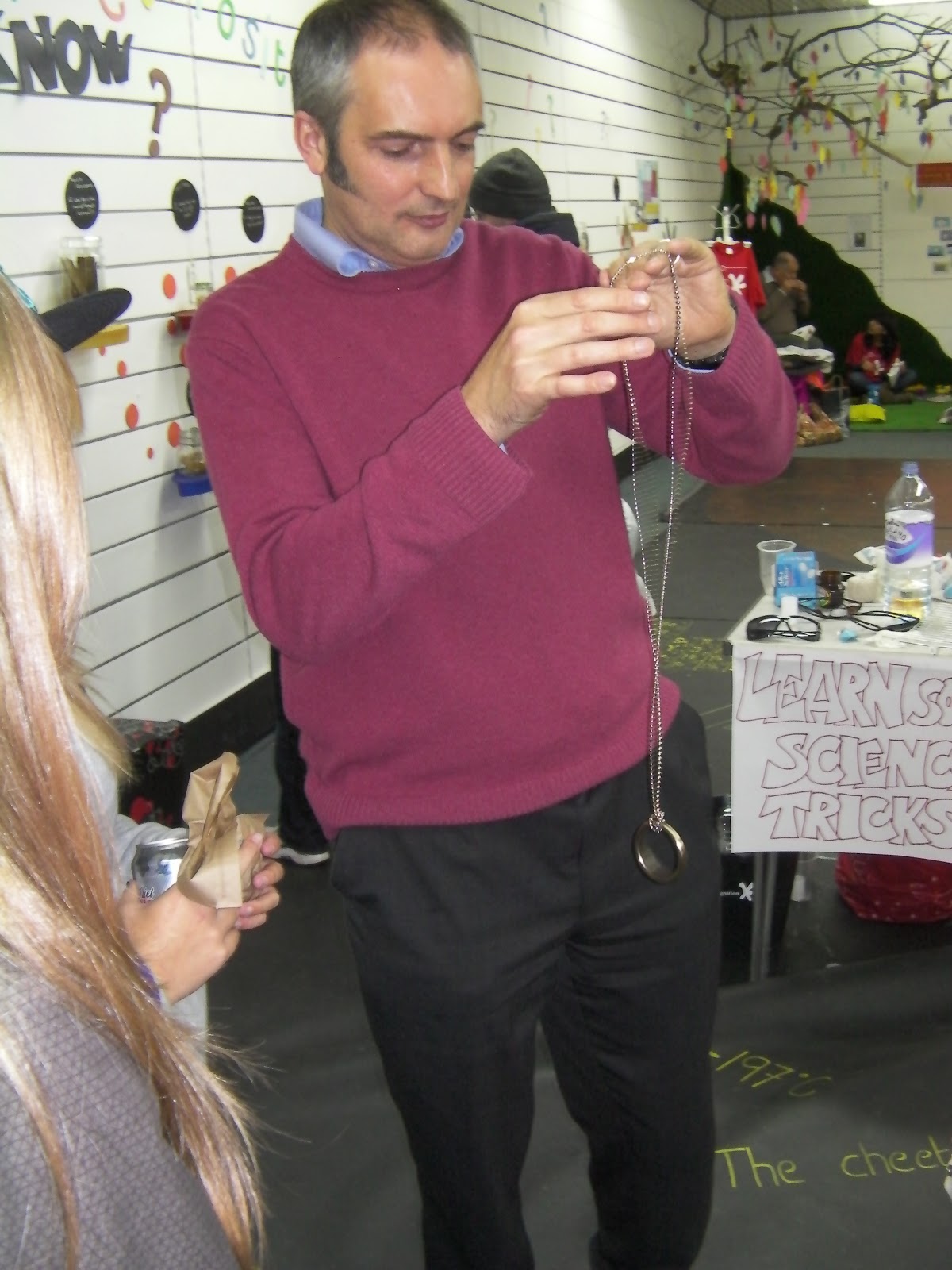 |
| John Read enthuses a crowd with a ring on a chain |
Thank you for reading!
 |
| Thank you for visiting |
Maths Week Ireland 2012
As fans of maths, you’ll all be pleased to hear that in Ireland, they’ve basically got the correct attitude to maths, which is to say they dedicate a whole $\frac{1}{52}$ of their time to it. That’s right, they have an annual Maths Week, now in its ninth year, during which events are organised all over the country, the national and local media get involved, and generally try to get everyone talking about maths.