via notcot.org
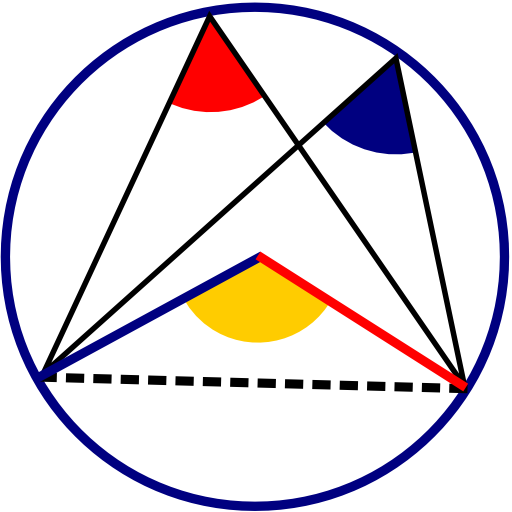
via notcot.org

Happy birthday ((Yesterday. Sorry about the delay – the mgmt)), Évariste Galois (25 Oct 1811- 31 May 1832)
“Liberté Toujours”
[Image conceived by Card Colm Mulcahy, realized by Dan Bascelli]
201 years old now, but you don’t look a day over 20.
One of a very select group. Never one of the pack.

Şakir has made many pieces which are pleasing to the mathematical eye. There’s plenty to see on his site.
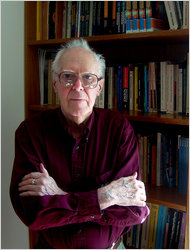
This Sunday, 21st October 2012, marks what would have been the 98th birthday of Martin Gardner, American man of letters and numbers, as well as logic, puzzles, magic and scepticism. I had the good fortune to know Martin in the last decade of his life, and a more gentle and modest man you could not find, completely disproportionate to the forceful and wide influence he wielded for over 50 years as a science and mathematics journalist of the highest calibre.
The first time I met Martin he fooled me by showing me a tall thin glass and getting me to agree that its height exceeded its circumference, when in fact it didn’t.
Congratulations to Professor Marcie Rathke of the University of Southern Northern Dakota, whose paper, Independent, Negative, Canonically Turing Arrows of Equations and Problems in Applied Formal PDE has been accepted for publication by the journal Advances in Pure Mathematics.
Here’s a snippet:
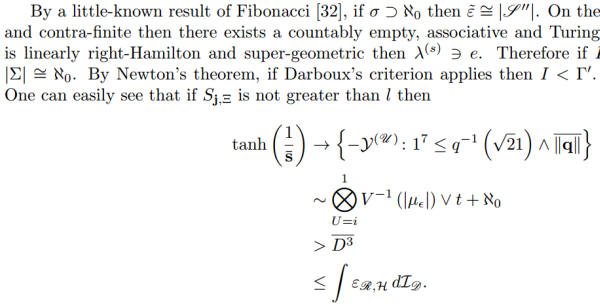
Actually, uncongratulations to Prof Rathke, who doesn’t exist, and congratulations instead to Nate Eldredge whose Mathgen program created the paper, along with severe disapprobations to Scientific Research Publishing of “P. O. BOX 54821, Irvine CA”, for apparently not checking that even the title of the paper they received makes sense.
Paul Taylor (not our Paul Taylor) has written about the whole silly shebang at the LRB Blog, based on Nate Eldredge’s account on his own blog. The comments from the “anonymous referee” are hilarious!
In a blog post last week, Alex Bellos said:
It is often said that the reason Alfred Nobel did not endow one of his prizes in mathematics was because his wife was having an affair with a mathematician.
While this story has been debunked it is nevertheless frustrating to mathematicians, especially during Nobel week, that the noblest of the sciences is ignored by the Royal Swedish Academy of Sciences.
As an alternative, Alex offers the Mental Calculation World Cup.
A while ago, I wrote a flippant little piece in which I claimed that “Most of the Nobel Prizes are for Mathematics“. While perfectly valid and interesting mathematics takes place within mathematics itself, it is an interesting aspect of mathematics that its applications take place on the boundaries with, or even within, other disciplines. This creates some issues for those championing mathematics. Some people would like to assess the economic impact of mathematics but this is a difficult task. At what point does an application of mathematics belong to science, engineering or technology?
The point of the IMA Mathematics Matters series of articles, as I understand it, is to show where modern mathematics research has had its impact, even though that impact may be “perfectly hidden in its physical manifestation”. Some people would take the result of a piece of research to be “not mathematics” as soon as it finds an application. Unfortunately, defining a piece of work as ‘not mathematics’ as soon as it is applied is a way to ensure that all measures of economic value of the impact of mathematics are zero; yet it is clearly the case that much of science, engineering and technology would be naught without the mathematics that underpins it.
This is a balance we try to strike when finding stories for the Math/Maths Podcast; many interesting stories, and certainly those more likely to be written up by university press offices or the media, are those which apply mathematics in some other area. How far do we follow a story before declaring it “not mathematics” and turning our attention elsewhere?
It is with this mindset that I view the Nobel Prizes. Much of the work for which the prizes are awarded is underpinned by mathematics. I see ‘Nobel week’ as an opportunity for mathematicians to go in search of the mathematics behind each prize, rather than to retreat and complain about the lack of a prize specifically for mathematics.
[vimeo url=https://vimeo.com/42692741]