Money Polyhedra by Kristi Malakoff:


Money Polyhedra by Kristi Malakoff:
A friend of mine recently contacted her MP on a matter of use or misuse of statistics in promotional material and received a reply. She wants to write a blog post about the experience. The fairest way to do this would be to quote the MP’s response, since this avoids hearsay and anecdote. Is she free to do this? I have an answer to this question and I share this below.
I googled a lot, to no avail, and asked on Twitter.
Help: If I write to my MP is it okay to publish the reply in full with comment on a blog? URL to reputable source yes or no appreciated.
The answers were unclear. Clearly a private letter from a private individual is copyright of that individual so permission must be sought, and this was the view taken by several respondents. However, a letter written on company time might result in copyright owned by the employer. In this case, the MP works for the state and has their time paid by the taxpayer to perform the public function of representing constituent’s issues. Then, is the constituent free to publish the letter without seeking permission? This was the view of several other respondents.
There are also issues of privacy, but if the MP has revealed nothing private and the constituent is happy is that okay?
Or perhaps there is a public interest defence?
Happily, @singinghedgehog suggested that I ask the House of Commons Information Office. I sent the following query.
Hello,
If a constituent writes to their MP and their MP replies, are they free to publish the response in a blog post?
I have been told that the contents of the email are private and the constituent should write back asking for permission. I have also been told that no permission is needed as the MP’s time is publicly funded so as long as the constituent is happy they may make the contents public.
Thank you for your help in clarifying this matter. As I found an answer hard to find, may I publish your response on my blog?
Thank you,
Peter.
Notice how I cleverly ask “may I publish your response on my blog?”? They didn’t reply to that bit! So I emailed back asking if this was okay and got this response (I’ve taken off the name of the respondent because there is no need to include this):
Dear Peter,
There are no restrictions on publishing emails from this office as we are a public information service.
I hope that this is useful.
So here is the original response (I’ve highlighted the key bit):
Dear Peter,
Thank you for your email.
I have spoken to our legal services team and they have given the following response to your question:
Letters written by Members
A Member has copyright in letters that s/he has written. Therefore, the relevant Member’s consent must be obtained before their letter can be published.
Letters written by constituents
Constituents are advised that, if they send a letter to their MP, it may be protected by qualified privilege for the purposes of defamation. However, this protection is likely to be lost if a constituent puts their letter in the public domain.
I hope that this is useful to you.
So my friend must ask permission. Better, she should have asked permission in her original letter. I don’t think the second part applies (though I haven’t seen the correspondence in question) but it is interesting to note.
This surprised me because the two seemingly most reputable responses – one originating with someone who works for an MP and one secret “reputable source” (“I’d tell you who but I’d have to kill us both”) – both gave the opposite answer. So I’m publishing this here in the hope it is useful to someone.
The American Chemical Society (ACS) are reporting research presented at the 243rd National Meeting & Exposition of the ACS about game theory in bacteria. The research investigated chemical signals exchanged between cells, which the press release calls “chat”. The press release reports that:
Faced with drought, radiation, over-crowding or other harsh environmental conditions, B. subtilis engages in quorum sensing, with individual microbes releasing chemical compounds that enable it to check out how their neighbors are responding to the unfavorable environment. Members of a colony of B. subtilis may decide to respond to the stressful environment in one of two ways.
I gave a talk to our internal postgrad forum last week about the princess in a castle puzzle. I made some slides for it using deck.js. They looked quite nice and I could just about get what I wanted in them, but I now know that using SVG in HTML is still an enormous faff if you want it to scale nicely, which is basically the only reason you would use SVG.
I’m not sure if you can follow along with the slides without me talking; maybe I’ll do a transcript with slide drive later.
Continue reading “Slides about the princess in a castle puzzle” on cp’s mathem-o-blog
For the April 2012 issue of Puzzlebomb, I devised Hilbert’s Space-Filling Crossword:
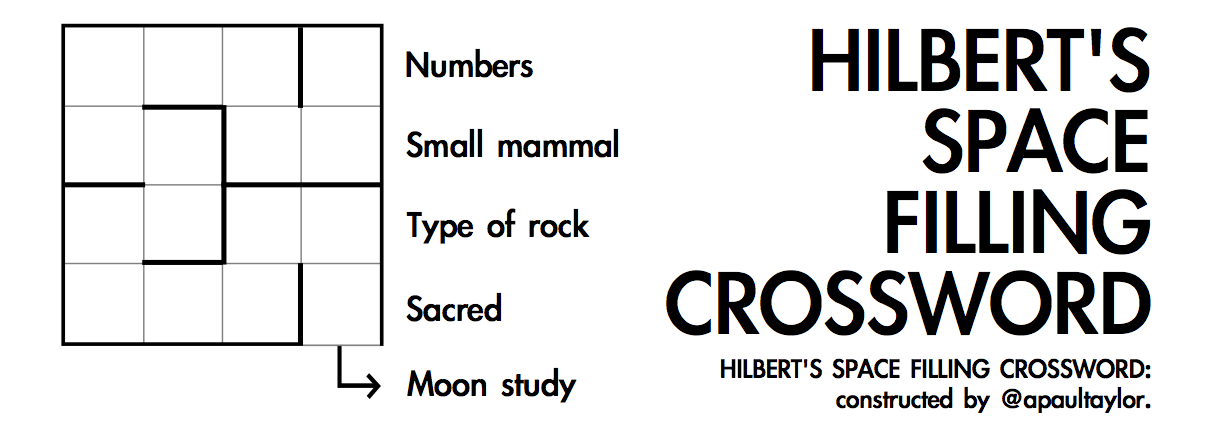
The five clues lead to four four-letter words along the rows of the grid, and one sixteen-letter word snaking round the shape given by the thick lines. The puzzle gets its name from the shape traced out by the long word, which is the second iteration of Hilbert’s space-filling curve.
 Puzzlebomb is a monthly puzzle compendium. Issue 4 of Puzzlebomb, for April 2012, can be found here:
Puzzlebomb – Issue 4 – April 2012
The solutions to Issue 4 can be found here:
Puzzlebomb – Issue 4 – April 2012 – Solutions
Previous issues of Puzzlebomb, and their solutions, can be found here.
(The April Fools’ version, in case you missed it, can be found here.)
