Tiles by Claesson Koivisto Rune:

Tiles by Claesson Koivisto Rune:
Having enjoyed a quick dip into the British Museum I headed to Lincoln’s Inn Fields.
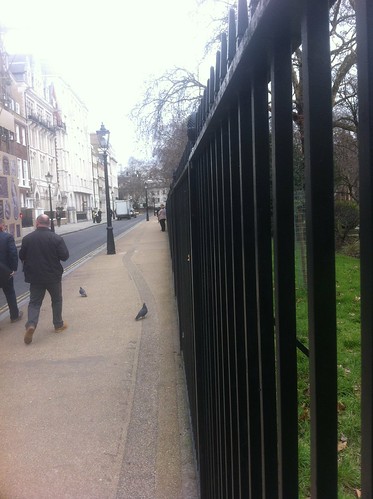
The Camden Council website describes Lincoln’s Inn Fields as “the largest square in London and the oldest in Camden”, noting that “there has been public open space here since at least the 12th century” and the space was once “popular for duellists” and known for a “minor speaker’s corner”.
I had come to Lincoln’s Inn Fields to visit Sir John Soane’s Museum (left of the photo above). The clue I tweeted to my location was the scaffolding on the outside of the museum. David Ault pointed out that this was a poor clue as it contained the name of the museum! I also tweeted the above photo of Lincoln’s Inn Fields, which Speakers for Schools guessed correctly.
Sir John Soane’s Museum is so named because Sir John Soane built it:
as a setting for his antiquities and his works of art. After the death of his wife (1815), he lived here alone, constantly adding to and rearranging his collections. Having been deeply disappointed by the conduct of his two sons, one of whom survived him, he determined to establish the house as a museum to which ‘amateurs and students’ should have access.
The Soane Museum had been placed on the suggestions map as a:
House packed with loads of ancient stuff and architectural bits and so on. Free to get in between 10 and 5, but there’s usually a bit of a queue.
The queue was minimal and I was able to enter the house. I had downloaded the audio tour, prepared to spend the recommended hour exploring the house, but I had arrived too late to begin this. What I saw from a quick dash (no photos, I’m afraid) was interesting and I definitely intend to go back when I had more time, but I had less than half an hour until I had to dash onwards to my first timed appointment of the day. I’ll save that for a later post.
Hello. It’s been a while since the last Aperiodical. That’s exactly how long it takes me to prepare and write each issue, so here we are.
“Here” is not where it used to be, so I should explain — The Aperiodical is now the name of a big maths conblogerate, of which these untimely collections of miscellanea occupy a small corner. The first four editions of the Internet Maths Aperiodical are still available on ACMEScience.com, and will be for as long as Samuel wants them there.
So, on with the interesting maths links and so on!
A classic maths puzzle involves a line of one hundred prisoners, who have each been given a black or white hat by their nefarious captor, and must each correctly shout out the colour of their hat to win freedom. The twist is that the prisoners don’t know the colour of their own hat, and though they can see the colours of the hats in front of them, they don’t know many of each colour there are overall. They can confer on a strategy beforehand, and the aim is to get as many of them to correctly identify their hat colour as possible. You can find a full explanation here (and in many other places!)
There are several ‘sequels’ to this puzzle, some involving an infinite number of prisoners and requiring the axiom of choice to solve. This post is about a nice variation on the theme that I heard about at a recent MathsJam. It can (just about) be solved without knowledge of higher mathematics, and though it seems impossible at first glance, the prisoners in this situation can in fact save themselves with 100% certainty.
Leaves don’t just grow equally in all directions, or they would have a regular shape. To understand how a few cells give rise to such complex structures as leaves is described in the abstract of a new paper in Science as “a major challenge in biology”.
The paper presents a new model that shows how leaf shape can arise through feedback between early patterns of oriented growth and tissue deformation, and some experimental evidence to support this model. Researchers filmed individual cells and tracked them as the plant grew. One of the researchers, Professor Enrico Coen, is quoted saying:
The model is not just based on drawings of leaf shape at different stages. To accurately recreate dynamic growth from bud to leaf, we had to establish the mathematical rules governing how leaf shapes are formed.
Professor Douglas Kell, Chief Executive of the Biotechnology and Biological Sciences Research Council (BBSRC), who funded the research, is quoted saying:
This exciting research highlights the potential of using computer and mathematical models for biological research to help us tackle complex questions and make predictions for the future.
I’ve just uploaded to youtube a video I made with Katie Steckles to demonstrate why zero-knowledge protocols exist and how one works.

Katie is a habitual liar, so we followed the zero-knowledge protocol described in the paper, “Cryptographic and Physical Zero-Knowledge Proof Systems for Solutions of Sudoku Puzzles” which you can download from http://www.mit.edu/~rothblum/papers/sudoku.pdf
By following this protocol, Katie can prove that she isn’t lying to me about being able to solve the puzzle, without revealing anything about how she solved it.
The paper I mentioned, “How to explain zero-knowledge protocols to your children” is an excellent explanation of the ideas behind zero-knowledge proof.
Before this magnificent website existed, I published four editions of what was then known as The Internet Maths Aperiodical at Samuel Hansen’s site ACME Science.
You can find those earlier works in their own category at ACME Science.