Science Showoff is a monthly night which takes place in a pub in London, and features acts from all areas of science, who each have 9 minutes to perform an act – a science demo, a routine, songs, experiments – anything entertaining or fun. Having tried a little bit of the short-set, trying-to-be-funny type of science communication involved in Bright Club (a similar venture, giving researchers the chance to try stand-up comedy, which started in London and has now spread all over the country), I thought it would be good to give it another go – in fact, Science Showoff was recommended to me by someone who saw my Bright Club set in Manchester. I had prepared an 8-minute piece about Fibonacci numbers to perform in Manchester, inspired by my artist friend’s admission that she didn’t see how maths could be interesting in the same way as art; she wasn’t there to watch, but I went down well (and ran horribly over time). So I decided to reprise my set at Science Showoff in February 2012 – and this time it would be the right length, and would be new and improved with all the best jokes left in and the duds taken out.
You're reading: Columns
Invisibility from elastic waves
A technique, which a University of Manchester press release describes quite incorrectly as a “Harry Potter style ‘cloaking’ device”, could protect buildings from earthquakes. Dr William Parnell and his team have shown that by cloaking components of structures with pressurised rubber, powerful waves such as those produced by an earthquake would not ‘see’ the building – they would simply pass around the structure and thus prevent serious damage or destruction. The building, or important components within it, could theoretically be ‘cloaked’.
The abstract for the paper in the February 2012 issue of Proceedings of the Royal Society A, “Nonlinear pre-stress for cloaking from antiplane elastic waves“, says:
A theory is presented showing that cloaking of objects from antiplane elastic waves can be achieved by employing nonlinear elastic pre-stress in a neo-Hookean elastomeric material. This approach would appear to eliminate the requirement of metamaterials with inhomogeneous anisotropic shear moduli and density. Waves in the pre-stressed medium are bent around the cloaked (cavity) region by inducing inhomogeneous stress fields via pre-stress. The equation governing antiplane waves in the pre-stressed medium is equivalent to the antiplane equation in an unstressed medium with inhomogeneous and anisotropic shear modulus and isotropic scalar mass density. Note however that these properties are induced naturally by the pre-stress. As the magnitude of pre-stress can be altered at will, this enables objects of varying size and shape to be cloaked by placing them inside the fluid-filled deformed cavity region.
This comes as one of a series of announcements in recent years on various aspects of invisibility but the production of this sort of invisibility without the requirement for metamaterials is significant. Dr Parnell said:
Five or six years ago scientists started with light waves, and in the last few years we have started to consider other wave-types, most importantly perhaps sound and elastic waves. The real problem with the latter is that it is normally impossible to use naturally available materials as cloaks.
We showed theoretically that pre-stressing a naturally available material – rubber – leads to a cloaking effect from a specific type of elastic wave. Our team is now working hard on more general theories and to understand how this theory can be realised in practice.
This research has shown that we really do have the potential to control the direction and speed of elastic waves. This is important because we want to guide such waves in many contexts, especially in nano-applications such as in electronics for example.
If the theory can be scaled up to larger objects then it could be used to create cloaks to protect buildings and structures, or perhaps more realistically to protect very important specific parts of those structures.
Source: ‘Invisibility’ cloak could protect buildings from earthquakes.
Geometric snow art
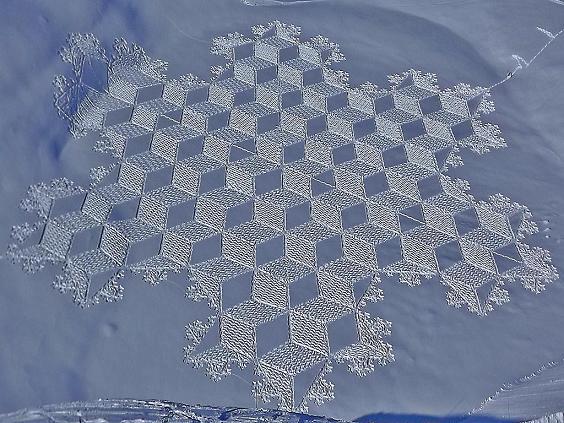
A man called Simon Beck has more than his fair share of free time and good ideas. He spends his days walking about in the snow at a French ski resort to create geometric patterns like the Sierpinski triangle, tilings of the plane and optical illusions. He posts photos of his works on his facebook page.
Deriving dynamical equations is NP-Hard
This paper has just been accepted by Physical Review Letters:
The behavior of any physical system is governed by its underlying dynamical equations. Much of physics is concerned with discovering these dynamical equations and understanding their consequences. In this work, we show that, remarkably, identifying the underlying dynamical equation from any amount of experimental data, however precise, is a provably computationally hard problem (it is NP-hard), both for classical and quantum mechanical systems. As a by-product of this work, we give complexity-theoretic answers to both the quantum and classical embedding problems, two long-standing open problems in mathematics (the classical problem, in particular, dating back over 70 years).
This paper has been accepted, so I can’t see why I shouldn’t be able to read it yet. Possibly something to do with money. The preprint is on the ArXiv, anyway.
via ScienceNOW via Slashdot, who reported it as “It’s Official: Physics is Hard”. That’s exactly the kind of unhelpful attention-grabbing headline we’re hoping to avoid here at The Aperiodical. ((They weren’t wrong, though: physics is hard.))
A commenter on Slashdot raises an interesting point:
Could we then map NP-HARD computation problems onto real world physics systems to find solutions?
Fractal dimension in IKEA
A long time ago, I realised that IKEA’s shopfitters must be experts in fractal dimension – they manage to lay out their shop so that you have to walk past every single thing they’re selling. You can’t just nip into IKEA – you have to go through the whole hour-long “It’s A Small World” of affordably wobbly furniture even if all you want is some kitchen utensils from the bit at the end.
I’d been meaning to add something about this to the Maths in the City site but it required going in to IKEA and taking a picture of their floor plan for illustration.
Click here to continue reading Fractal dimension in IKEA on cp’s mathem-o-blog
Picture this!, an interactive problem/puzzle
“PSUM: problem-solving in undergraduate mathematics”, a project we are supporting at work, have produced an interactive problem/puzzle as an early prototype for a virtual problem solving resource package.
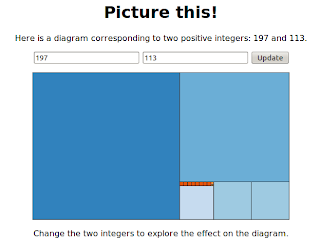
Picture This! is an interactive problem solving application. You are shown a diagram which somehow relates to two integers. You are asked to change the two integers and explore the effect on the diagram. Once you have figured out the effect of the two numbers on the diagram, you are invited to consider a series of probing questions, such as:
What is allowed to change and what must stay the same? Do different pairs of integers necessarily lead to different diagrams? Can you start from a diagram and work back to the initial numbers?
Important: Once you have played with the virtual problem solving environment, please fill out this survey from the researchers. The researchers have said to me that they are happy for the page to be public and hope that anyone who uses it will fill out the survey. Doing so, you will help the researchers discover whether the use of this software to present problems is worthwhile and beneficial. The survey asks if you are a student or a tutor. If you choose “student” you will be asked about your use of the simulation and your understanding of the underlying mathematics. If you choose “tutor” (or leave the question blank) you will be asked about how you used it with undergraduate students.
This project seeks to produce “a virtual problem solving environment which hosts problems suitable for a range of undergraduate mathematics courses“. If you want to find out more about this project then you can read the interim report from this project over on my work blog.
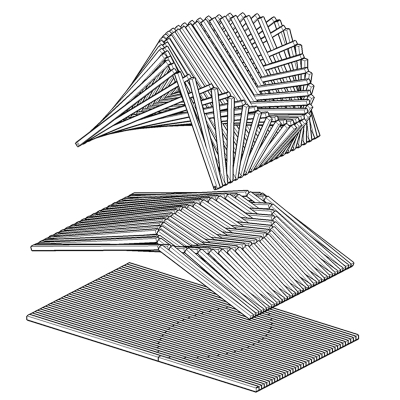
Rising chair by Robert van Embricqs
Rising chair by Robert van Embricqs: