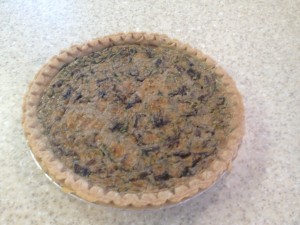
This year, π day will be celebrated, as always, on 14th March. Unlike most years, π day will be more accurate than usual – owing to the fact that the year, 2015, will give the date 3/14/15 (provided you’re using a US calendar date format) – and for this reason, some people are calling it Ultimate π day. But how truly Ultimate is it?
You're reading: Columns
Mandelbrot’s bum is full of π
They say that $\pi$ is everywhere. (They say that about $\phi$ too, but I’m not buying it.) I thought it would be interesting to discuss the most unexpected place I’m aware it’s ever appeared.
How I Wish I Could Celebrate Pi
People with an interest in date coincidences are probably already getting themselves slightly over-excited about the fact that this month will include what can only be described as Ultimate π Day. That is, on 14th March 2015, written under certain circumstances by some people as 3/14/15, we’ll be celebrating the closest that the date can conceivably get to the exact value of π (in that format).
Of course, sensible people would take this as an excuse to have a party, so here’s my top $\tau$ recommendations for having a π party on π day.
Puzzlebomb – March 2015
Puzzlebomb is a monthly puzzle compendium. Issue 39 of Puzzlebomb, for March 2015, can be found here:
Puzzlebomb – Issue 39 – March 2015
The solutions to Issue 39 can be found here:
Puzzlebomb – Issue 39 – March 2015 – Solutions
Previous issues of Puzzlebomb, and their solutions, can be found here.
Wolfram|Alpha can’t. But CP can!
. @christianp has turned into a one-man plug for the holes in Wolfram Alpha. I’m genuinely impressed.
— Colin Beveridge (@icecolbeveridge) February 28, 2015
For a while, I’ve been following this cool Twitter account that tweets questions Wolfram|Alpha can’t answer. The genius of it is that the questions all look like things that you could half-imagine the solution algorithm for at a glance, and many of them look like the kinds of questions Wolfram like to give as examples when they’re showing off how clever their system is.
Questions like this:
number of words between "landslide" and "Beelzebub" in Bohemian Rhapsody
— Wolfram|Alpha Can't (@wacnt) January 22, 2015
The answer to that is 278. How do I know that? I know that because I went on a little problem-solving binge answering the questions that Wolfram|Alpha can’t.
From the Mailbag: Golfing Combinatorics
Sam’s dad is in a mathematical conundrum – so she’s asked Katie, one of our editors, if maths can save the day.
My dad is going away on a golfing holiday with seven of his friends and, since I know a little bit about mathematics, he’s asked me to help him work out the best way to arrange the teams for the week. I’ve tried to work out a solution, but can’t seem to find one that fits.
They’ll be playing 5 games during the week, on 5 different days, and they’d like to split the group of 8 people into two teams of four each day. The problem is, they’d each like to play with each of their friends roughly the same amount – so each golfer should be on the same team as each other golfer at least twice, but no more than three times.
Can you help me figure it out?
Sam Coates, Manchester
Apiological: mathematical speculations about bees (Part 2: Estimating nest volumes)
This is part 2 of a three-part series of mathematical speculations about bees. Part 1 looked at honeycomb geometry.
Honeybees scout for nesting sites in tree cavities and other nooks and crannies, and need to know whether a chamber is large enough to contain all the honey necessary to feed their colony throughout the winter. A volume of less than 10 litres would mean starvation for the whole colony, whereas 45 litres gives a high chance of survival. How are tiny honeybees able to estimate the capacity of these large enclosed spaces, which can be very irregular and have multiple chambers?