Here’s a short round-up of mathematical and maths-adjacent news from this month.
The LMS are seeking Outreach Lecturers, who must work in UK HE mathematics, and will receive a two-year post during which they’re expected to deliver talks to a minimum of 4 schools around the UK each year. The talks should be free to the schools, targeted at a minimum 75% schools with a high proportion of pupils from disadvantaged backgrounds. The post comes with a small honorarium to cover travel and ‘associated costs’, and the deadline for applications is 9th March.
In a recent issue of DMFT posted here, Colin investigated the connection between Jeffrey Epstein and the Gathering 4 Gardner recreational maths events. (It turns out, he was on their mailing list but never registered to attend).
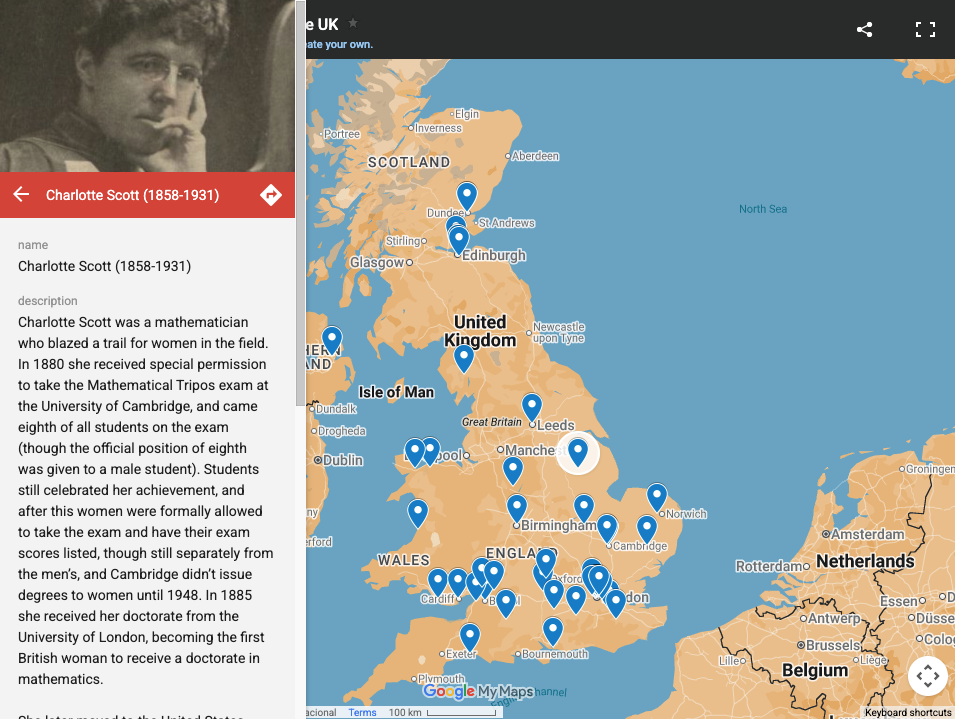
Accessibility of mathematical materials is often an afterthought, if it’s a thought at all. I had to hurry back to put alt-text on the picture above. It’s good to see that several of maths’s learned societies (the AMS, EMS, LMS and SIAM) have published author guidelines for preparing accessible mathematics content.
AI happenings
There’s a fair amount of chat lately about whether the current set of AI tools can be useful to research mathematicians. In establishing whether AI tools can really help with new maths or whether they’re just regurgitating something they’ve seen elsewhere, it would be useful to have a set of problems whose answers are definitely known to humans, but haven’t appeared in any text corpus that the AI might have been trained on.
Eleven Serious Mathematicians have announced a project called “First proof” (1stproof.org), aiming to do just that. They’ve come up with ten mathematical questions and solved them, but rather than publishing the answers straight away, they’ve encrypted them for a week. So people have a week to try to get AI tools to come up with solutions, after which the human answers will be published and the AI solutions verified.
(via Terence Tao, who noticed the similarities with the old practice of publishing encrypted proofs to establish priority before properly writing them up)
Opportunity
Applications are open for PROMYS Europe 2026, a six-week residential summer programme at the University of Oxford, UK (July 12th to August 22nd). It’s open to pre-university students (age 16+) from across Europe (including “all countries adjacent to the Mediterranean”); the deadline is March 8th, but PROMYS recommend allowing plenty of time to tackle the problems that form part of the application.
A portrait of mathematician Hannah Fry (below) has been commissioned by the Royal Society from Sky Arts Portrait Artist of the Year Chloe Barnes. The commission is part of a year-long celebration of the 80th anniversary of the first women elected to Royal Society Fellowship, Kathleen Lonsdale FRS and Marjory Stephenson FRS. Visitors can view the portrait at the Royal Society’s public events, including the Summer Science Exhibition during the first week of July, and Open House London in September (or by appointment on weekdays, or by looking at the image below).
Hannah Fry was awarded the Royal Society’s David Attenborough Award and Lecture 2024 in recognition of her significant work in public engagement with science and for her prolific role in popularising mathematics.
There’s a new π calculation record – starting last July, computing industry reviewing publication StorageReview crunched a whopping 314 trillion digits, using a Dell PowerEdge R7725. The calculation took 110 days and finished in December. Still don’t know what the last digit is though, do they?
And in other slightly-larger number news, the number 751882!/751879# + 1 is the new largest known compositorial prime number, found by PrimeGrid. A compositorial number is one which is $n$ factorial (the product of all the numbers less than or equal to $n$, denoted $n!$) divided by $n$ primorial (the product of all the primes less than or equal to $n$, denoted $n\#$), so-called because it’s the product of all the composite numbers less than or equal to $n$. This number plus one, if prime, is then called a compositorial prime. At a truly whopping 3765621 decimal digits, this is now the largest known prime of this form. (via MOULE on mastodon)
The UK Government have announced the latest list of honours, and we’ve taken a look for the particularly mathematical entries. Here is the selection for this year – if you spot any more, let us know in the comments and we’ll add to the list.
Chris Pritchard, Chair, Scottish Mathematical Council, Secretary, James Clerk Maxwell Foundation and lately President of The Mathematical Association. Appointed OBE for services to mathematics education.
Here’s a round-up of maths news from October and November 2025 which we didn’t otherwise cover on the site.
Awards and Grants
Applications for participation in the 13th Heidelberg Laureate Forum for Outstanding Young Researchers in Mathematics and Computer Science is now open . If you’re selected, you can join the conference in September in Heidelberg, Germany, and meet laureates of the most prestigious prizes in the fields of mathematics and computer science – including the Abel Prize, the ACM A.M. Turing Award, the ACM Prize in Computing, the Fields Medal, the IMU Abacus Medal and the Nevanlinna Prize – and engage in cross-generational scientific dialogue, including with other young researchers. The 13th HLF will take place from September 13 to 18, 2026.
The application period runs until February 11, 2026, and young researchers at all phases of their careers (undergrad, PhD or postdoc) can apply at application.heidelberg-laureate-forum.org. There are 100 spaces available for researchers from both mathematics and computer science, respectively, and all applicants will be notified by the end of April 2026 about whether or not they have been selected. For questions regarding the requirements and the application process, please see the HLF FAQs or visit heidelberg-laureate-forum.org.
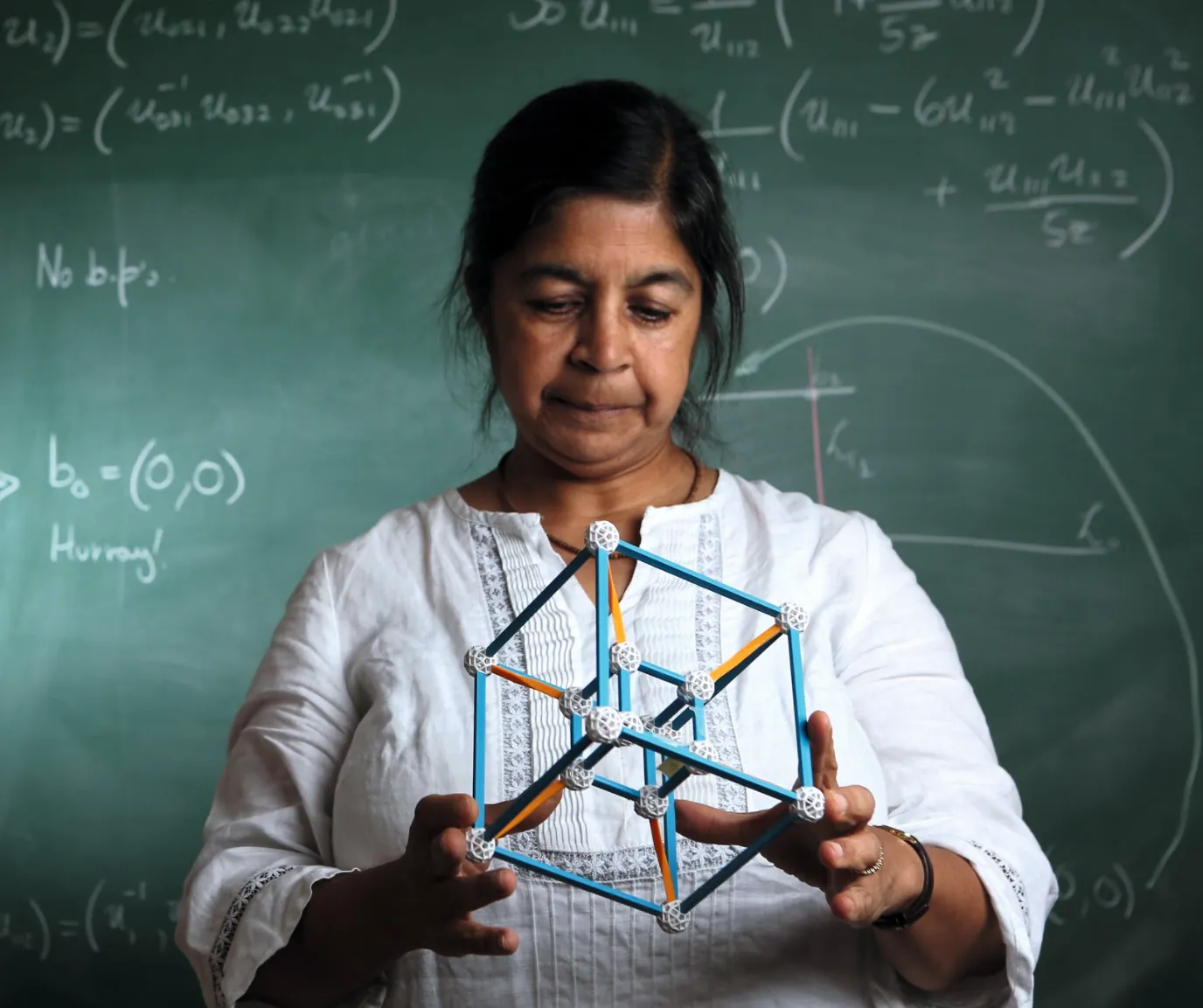
Mathematician Nalini Joshi has been awarded New South Wales Scientist of the Year 2025, for her pioneering work which “has transformed the field of integrable systems. She is internationally recognised for introducing geometric and asymptotic methods to study discrete and continuous nonlinear mathematical models, [and] her results have led to crucial information about singularity structure and to improved tests for the identification of critical models called integrable systems.”
Algorithmic trading firm XTX markets has announced £26m funding for PhD students and postdoctoral researchers in pure maths. According to the press release, “XTX Markets is launching the Early-Career Research Funding programme, designed to increase the number and quality of PhDs and postdocs entering the talent pipeline at top UK universities. The programme aims to create more than 100 new early career research positions, across seven universities, with entry in 2026, 2027 and 2028. The funding will support PhD students and postdoctoral research associates in pure maths.” (via Daniel Colquitt)
Other News
A Paris court has blocked Pascal’s La Pascaline calculator being exported from France – described as “one of the world’s first calculating machines”, the calculator is provisionally blocked from export due to heritage protection arguments. The auction, at which valuations suggested the machine could fetch €2m to 3m (£1.7m to £2.6m), has been postponed.
Here’s a round-up of maths news stories from this month we haven’t otherwise covered on the Aperiodical (not including, of course, the important enneahedron news Christian just posted about).
We’ve gone crashing into October and that means it’s also #Mathober, an annual maths/art celebration taking place on the internet. If you’re into maths or art, or both, and would like to try producing something creative this month, on an informal schedule, #mathober provides a structure for you to do that.