Here’s a round-up of mathematical news from the month of May.
The film Words of Women in Mathematics in the Time of Corona showcases the words of 86 women of mathematics from 37 countries, speaking in 25 languages, on their experience during the pandemic. The project website says:
This pandemic has indeed made women, and in particular women in mathematics, more invisible than ever and we hope that this project will contribute to letting them be heard and seen.
Mathematician, IMA president and one-time World’s Most Interesting Mathematician Nira Chamberlain appeared on Jim Al-Khalili’s excellent radio show The Life Scientific, and talked about how mathematics can solve real-world problems.
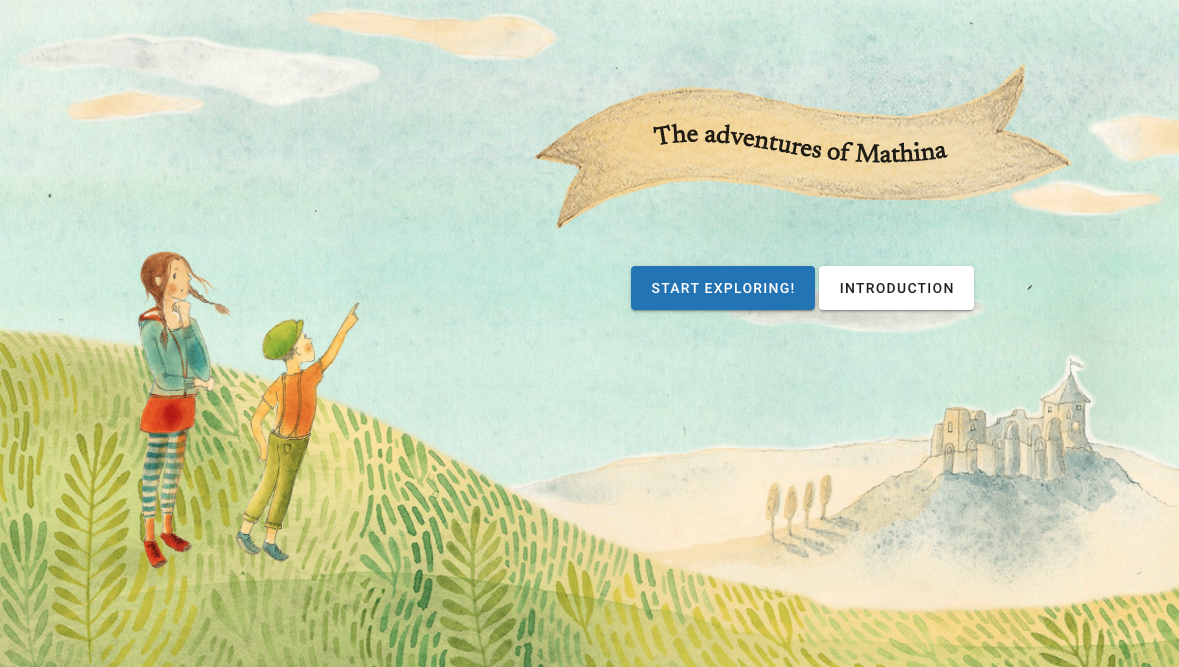
Mathina is an interactive story book, “based on story-driven experiences, in which children and young learners encounter fictional characters that find themselves in mathematical adventures”. It looks cool! (via Martin Skrodzki)
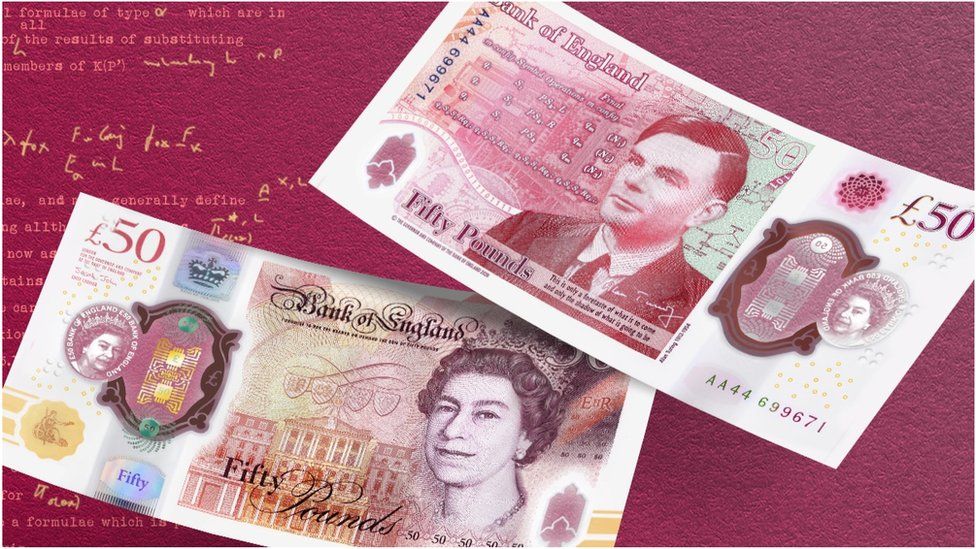
The winners of the Shaw Prize, “an international award to honour individuals who have recently achieved distinguished and significant advances in their respective fields”, have been announced for 2021, including the Shaw Prize in Mathematical Sciences. This is awarded in equal shares to Prof Jean-Michel Bismut and Prof Jeff Cheeger (pictured right, floating in an abstract mathematical universe), “for their remarkable insights that have transformed, and continue to transform, modern geometry”.
And finally, Turkish mathematician Tuna Altinel has his passport back after two years of fighting the Turkish courts. Altinel was detained by Turkish authorities and his passport confiscated on the grounds of “membership in a terrorist organisation”, due to his attempts to promote peace and support human rights as part of the group Academics for Peace.
Hannah Fry has a new TV show about maths and sport, on BT Sport and YouTube, called It’s A Numbers Game (or IT’S A NUMB3R5 GAME, if you believe the logo). She’s joined by Pippa Monique, Ugo Monye, Andrew Mensah and Dr Nick Owen. It’s on each Saturday on both BT Sport and YouTube. There are some resources for kids aged 5 to 14 on Twinkl, to go with the show.
The Institute of Mathematics and its Applications is again running a series of online talks.
The first talk at the 6th May event will be from Nick Higham who has been awarded the Gold Medal award in recognition of outstanding contributions to mathematics and its applications. This will be followed by Jane Leeks and David Abrahams discussing future developments in mathematical sciences knowledge exchange.
There will be a couple more talks on the 25th of May to do with modelling and Covid-19.
The London Mathematical Society is offering two summer placements – a Library and Special Collections Summer Placement (working with the LMS’s special collections) and an Equality and Diversity – Success Stories Placement (putting together profiles of successful mathematicians), both of which are paid hourly at three days a week for 8 weeks over the summer, and would suit prospective postgraduates with an undergraduate degree.
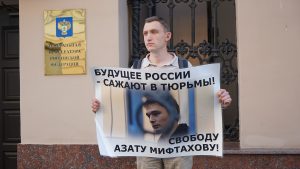
The International Congress of Mathematicians is running a surprising maths videos contest. Prizes include a grant to attend ICM 2022 in St Petersburg, which won’t be much use to LGBT+ mathematicians, whose existence in Russia is illegal, or Azat Miftakhov, a student at Moscow State University who has been detained by Russian authorities for two years. If that doesn’t faze you, the ICM has produced an example of a surprising maths video:
Proof news
Kelsey Houston-Edwards writes in Quanta magazine about a proof of the Erdős-Faber-Lovász conjecture on colouring hypergraphs. The preprint by Dong Yeap Kang, Tom Kelly, Daniela Kühn, Abhishek Methuku and Deryk Osthus is available on the arXiv.
Early Family Math is a new free maths resource website for children from 6 months to 6 years old. At the moment it has a lot of resources for activities, and some maths story books. They say that videos are forthcoming.
And finally, there’s a fundraiser for Mathematicians of the African Diaspora, which hosts the largest searchable database of mathematical scientists of the African Diaspora in the world, and is looking for funding to expand its database and reach a wider audience so it can continue to inspire the next generation of Black mathematicians. (via Edray Goins)
Here’s a round-up of some maths news we didn’t yet write about this month.
Awards
This month the Abel Prize committee announced this year’s award will go to László Lovász and Avi Wigderson “for their foundational contributions to theoretical computer science and discrete mathematics, and their leading role in shaping them into central fields of modern mathematics.” The prize will be handed over at a ceremony in May. You can read more about this year’s prize on the Abel Prize website.
Cheryl Praeger has been awarded the inaugural Ruby Payne-Scott Medal for her mathematical work on symmetry and developing algorithms that help power technology around the world. Named after pioneering Australian radio astronomer Ruby Payne-Scott, the medal recognises exceptional researchers in physical and biological sciences and is awarded by the Australian Academy of Science.
The IMA are running a What it’s like to study Mathematics at University?’ Conference online on 14th April – with speakers including researchers, maths teachers and A-level students, the event will explore what being a student mathematician entails and how to take it further into a career. For ages 16+, it’s free to attend and you can register online.
From the people who brought you the WayBack Machine, the Internet Archive Scholar includes over 25 million research articles and other scholarly documents preserved in the Internet Archive. The collection includes everything from digitised copies of eighteenth century journals through to the latest Open Access conference proceedings and pre-prints crawled from the World Wide Web.
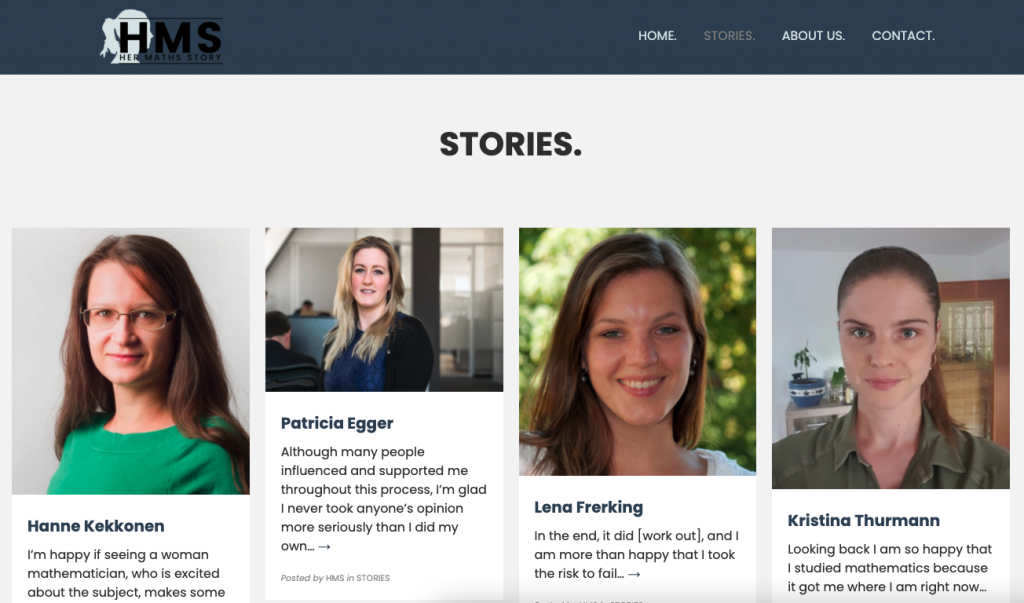
The newly launched Her Maths Story website collects stories of women mathematicians from all over the world, and includes photos and pithy quotes – it’ll be a useful resource if you want to showcase real mathematicians and their varied backgrounds and careers.
Registration is now open for the upcoming virtual Women and Non-Binary People in Mathematics conference funded by the LMS, taking place on 11th-12th February. The event is open to all mathematicians in all stages of their career and from any field, and is on MS Teams.
The LMS are also running their annual Women in Mathematics Day on 24th March, aiming to promote interest and careers in mathematics for women. Open to mathematicians of all genders, backgrounds and career stages, the event will include talks from academia and industry, a panel discussion and a poster competition with prizes.
International Day of Mathematics Website & Poster Challenge
For 2021’s International Day of Mathematics on 14th March, the theme is Mathematics for a Better World. The organisers have now launched their 2021 website, Mathematics for a Better World, which shows some cool applications of maths.
Medals of the Order of Australia awarded to maths people
Numberphile creator Brady Haran and maths pioneer Prof. Cheryl Praeger are among those awarded the Medal of the Order of Australia, as part of this year’s Australia Day celebrations on 25th Jan.
Communications of the AMS, a new diamond open access journal, is launched
Communications of the American Mathematical Society (CAMS) is a new, diamond open access journal designed to provide a home for the very best research and review articles across all areas of mathematics. CAMS will be a natural home for both pure and applied mathematics, presenting a window into a holistic view of mathematics and its applications to a wide range of disciplines. The AMS expects the journal to be a diverse and inclusive home for mathematicians around the world in support of emerging research. It is anticipated that the first published articles will appear in early 2021. For more information, visit the journal’s webpage.
Funding Boost for Mathematical Sciences Institutes
Three of the UK’s leading research institutes will be supported to widen access to mathematical sciences and support training through funding confirmed on 21st January. The Isaac Newton Institute (INI), the International Centre for Mathematical Sciences (ICMS) and the Heilbronn Institute for Mathematical Research (HIMR) will be able to support a wide range of education and training activities using the money.
The funding is part of the £300 million government investment in the Additional Funding Programme for Mathematical Sciences, announced in 2020.
‘This is What a Mathematician Looks Like’ badges raise money for charity
Aerospace engineer Krystina Pearson-Rampeearee has launched a new set of pin badges which proudly proclaim “This is what a mathematican looks like”. In the accompanying Twitter thread, she explains that £1.50 from the sale of each badge will go to maths positivity charity Maths on Toast.
The badges are available, along with a range of others, in Krystina’s Etsy shop for £6.99 + P&P.
Increase in Scientific Publications not mirrored in maths
Some scientific publishers are reporting a surge in submissions this year as scholars find more time during the pandemic to write papers. Does mathematics fit this pattern? Err, no. This blog post by Edward Dunne for the AMS goes into it.
The University of Leicester is planning to sack all its pure maths staff
In a move which claims to ‘shape for excellence’, the University of Leicester plans to cease research in pure mathematics. All pure mathematicians will be made redundant (in the middle of a pandemic) and three teaching-focused lecturers will be hired to cover their undergraduate programmes.
The idea is that the university needs to focus more onits “future research identity in AI, computational modelling, digitalisation and data science”, and that resources will be reallocated there. Presumably they’ll have to also outsource any integers or algebraic structures they need in order to do those things as well.
Previous attempts to do a similar thing in 2016 were met with outcry, including from the late Sir Michael Atiyah, and dropped, but they’re trying again. There’s a petition protesting the decision which already has over 5,000 signatures.
Today the European Mathematical Society launches PopMath, a calendar of popular maths events taking place across Europe and beyond, including online. It should be a great resource for people wanting to find or share details of mathematical outreach activities.