Who could have guessed that this non-story about somebody being out of his depth and quite obviously wrong would get so out of hand? Here’s an update on The Continuing Tale Of The Man Whose Claims Couldn’t Be Verified.
You're reading: News
AMS online opportunities
The American Mathematical Society have created a system of online listings for people offering awards, fellowships, professional opportunities and other maths-related callouts. There’s a website at ams.org/
The system is aimed at mathematics faculty/scientists, institutions, programs, postdocs/early-career mathematicians, postgrads, undergrads, high school students and teachers (so, pretty much anyone involved in maths), and we’ve cheekily used it to post a call for submissions of articles for our Irregulars column, where we feature guest posts from other authors.
More information
Awards, Fellowships and other opportunities, at the AMS website.
Riemann Hypothesis not proved

Here’s a tweet from Alex Bellos this morning:
BBC claims Nigerian solves Riemann Hypothesis, most famous problem in maths. Surely a hoax! https://t.co/Wkltfkh2P3 https://t.co/UHGy9W8shC
— Alex Bellos (@alexbellos) November 17, 2015
He’s right to be surprised – as reported in Vanguard, a Nigerian newspaper:
The 156-year old Riemann Hypothesis, one of the most important problems in Mathematics, has been successfully resolved by Nigeria Scholar, Dr. Opeyemi Enoch.
Suspicion levels are raised, as the paper also reports:
Three of the [Clay Millenium Prize] problems had been solved and the prizes given to the winners. This makes it the fourth to be solved of all the seven problems.
Unless we missed something, that’s not massively true – the only Millennium Prize problem solved so far is the Poincaré conjecture.
Make your own bauble with icosahedral symmetry with Shapeways
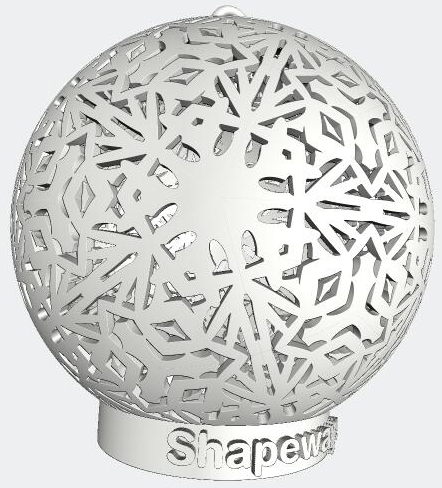
Internet 3D printing emporium Shapeways has released a nifty little tool to create your own unique Christmas bauble, which they’ll print out and send to you in time for the festive season.
It works by mapping a triangular design onto a blown-out icosahedron, and applying some “kaleidoscope effects”. As far as I can tell, that means they expand and rotate the patterns so they overlap.
There’s a selection of built-in patterns you can choose from, or you can upload your own pattern to make a really unique decoration. However, because the resulting object needs to exist in the real world, you need to take care to make sure it all comes out in one connected piece. Shapeways have written some very clear instructions about how to achieve that.
Play: Ornament Creator from Shapeways
via Vladimir Bulatov on Google+, who seems to work for Shapeways now. Exciting!
Cheng vs Colbert
Eugenia Cheng was on The Late Show with Stephen Colbert recently. Here it is:
Maths events at the Manchester Science Festival
In our traditional mode of picking apart the programmes of upcoming science festivals to make sure they’re doing their maths homework, here’s a round-up of the mathematicial goodies on offer at the upcoming Manchester Science Festival, running from 22nd October – 1st November at venues across Manchester.
Not mentioned on The Aperiodical this week, 18th September 2015
Gender inclusivity in mathematics at Harvard
Some mathematicians at Harvard have formed an organisation called “Gender inclusivity in mathematics”, which is dedicated to “creating a community of mathematicians particularly welcoming to women interested in math and reducing the gender gap in Harvard’s math department.”
They’re running a series of talks by invited speakers and discussion events, and hope to run a conference on women in mathematics this academic year.
More information: Gender inclusivity in mathematics at Harvard
via Nalini Joshi on Twitter
National Numeracy Family Maths Toolkit
The National Numeracy campaign, a British charity aiming to improve numeracy in adults as well as children, has relaunched its Parent Toolkit as the Family Maths Toolkit. It contains advice for parents on promoting good attitudes towards maths, as well as ideas for activities to get the whole family enthused and practised in maths. There’s also a section with information to help school teachers support parental engagement with maths.
Visit: Family Maths Toolkit
Pixar in a Box
Khan Academy has partnered with Pixar to produce a subsection of their site which explains some of the maths involved in computer animation. There are the usual videos explaining individual topics, but also plenty of interactive diagrams so you can play along at home. It’s also nice to see some “Get to know …” videos, which present real animators who work at Pixar, talking about why they got into computer animation.
Visit: Pixar in a Box, at Khan Academy