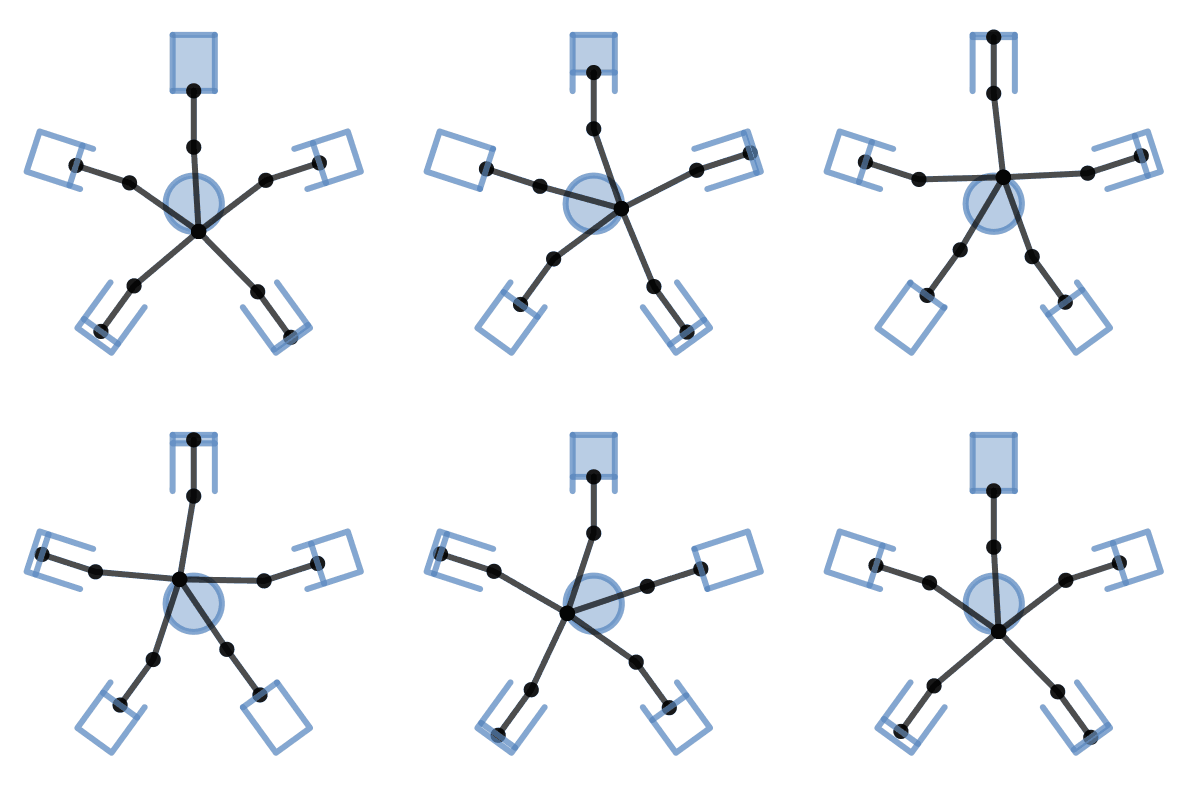
If you’re into tilings, or just looking to redo your bathroom in the most modern way possible, there’s big news. A team of researchers at the University of Washington-Bothell have discovered a previously unknown way to tile a plane using irregular pentagons.
You're reading: News
- Nick Higham’s blog post about the book
- Princeton Companion to Applied Mathematics at Princeton University Press
- For some reason, there’s a Twitter feed
Not mentioned on the Aperiodical, July 2015
Here’s a round-up of some of this month’s maths news.
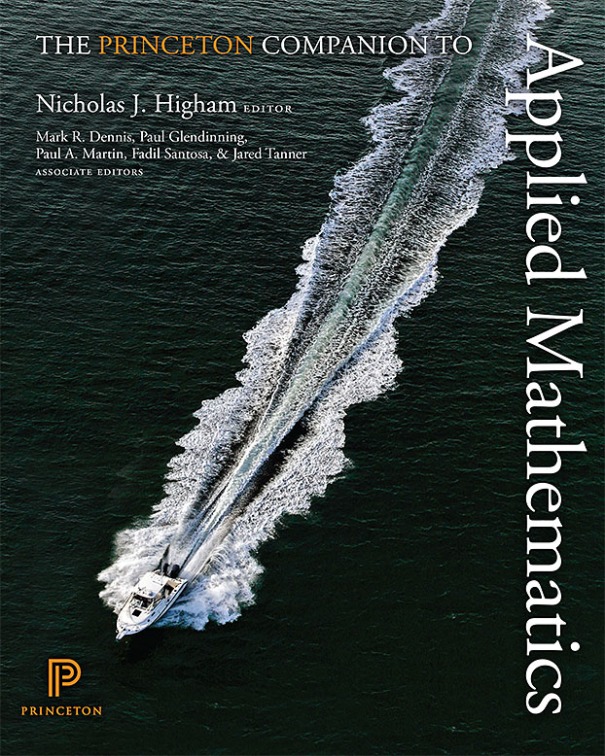
The Princeton Companion to Applied Mathematics
A group of applied mathematicians, including the University of Manchester’s Nick Higham, have been compiling a book on applied mathematics over the last few years, and they’ve announced it’s finally ready for publication. The book, which includes an introduction to applied mathematics, key concepts, and various examples of modelling problems, is aimed at undergraduate mathematicians and above (although some of the articles may be accessible to younger/lay readers) and comprises 186 articles by 165 authors from 23 countries. It’ll make a good companion (excuse the pun) to the Princeton Companion to Mathematics, edited by Tim Gowers and covering the pure end of the field. It will be published by Princeton University Press in September 2015.

English law hasn’t redefined the number one, but a journalist has discovered rounding
A recent court judgement ruled that the range “1 to 25” can include the value 0.51, if you round to the nearest integer.
That’s a little bit interesting – it will certainly make people think twice before writing numbers in patents – but it’s been reported in the most fantastically mathematically illiterate fashion in The Independent, by someone who seems to have discovered what ’rounding’ is in the course of their research.
Read: What exactly does ‘one’ mean? Court of Appeal passes judgement on thorny mathematical issue, in The Independent
(Via Tony Mann on Twitter)
Mathesia
No, it’s not what happens when you try to do maths under pressure and forget everything you ever knew about calculus – Mathesia is a new crowdsourcing platform for mathematics, which companies can use to pitch mathematical problems to their collection of maths experts, who can then bid to be awarded the project. It also has a section for universities to advertise research posts.
One thing that does make me sad is that the site extensively uses the word ‘brainies’ to describe the mathematicians, and it looks like the pitchers are adopting this as standard terminology. Bit naff, right?
Hypernom

Vi Hart, Andrea Hawksley, Henry Segerman and Marc ten Bosch each independently have long track records of doing crazy, innovative stuff with maths. Together, they’ve made Hypernom.
Naked Scientists on the Clay Millennium Prize Problems, f. Katie Steckles
The Naked Scientists Podcast has released an episode on the Clay Millennium Prize Problems, titled ‘The Seven Million Dollar Maths Mystery’. The episode description is:
This week, we’re investigating the Millennium Prize Problems – a set of mathematical equations that, if solved, will not only nab the lucky winner a million, but also revolutionise the world. Plus, the headlines from the world of science and technology, including why screams are so alarming, how fat fish help the human fight against flab, and what’s the future of money?
Better yet, the episode includes a contribution from our very own Katie Steckles talking topology, Poincaré and Perelman.
The episode is available to listen or download as a podcast or, less conveniently, at 5am tomorrow on Radio 5 Live (or later on iPlayer). Not a listener? Read a transcript.
MacTutor History of Mathematics website creators honoured by LMS
Edmund Robertson & John O’Connor of the University of St. Andrews have been honoured by the London Mathematical Society for their pioneering MacTutor History of Mathematics website hosted at St. Andrews.

On 3rd July it was announced that both men have received the Hirst Prize, and Edmund Robertson has been been invited to give the associated Hirst Lectureship, all part of LMS 150th Anniversary celebrations.
GIFsmos
Desmos is the web-based interactive geometry program that isn’t GeoGebra. It’s very popular with teachers.
Someone’s made a nifty tool to turn a Desmos construction into an animated gif. It’s called – you guessed it – GIFsmos. They’ve got a blog containing a few nice animations, but it doesn’t seem to have been updated since I discovered it in March. Anyway, the tool still exists, so go and see what you can create!
MathML 3.0 is now an ISO standard
Now, uninteresting international standards news!
It’s easy to forget about MathML, because unless you’re a publisher or doing complicated things with data flows, you never need to see it.
I’m not doing a great job of selling this story, am I? I couldn’t even find a picture to illustrate it.
After a lengthy lull in which MathML was deeply unpopular, mainly due to browser makers not supporting it but mainly due to it being extremely hard for the average mathematician to work with, the format which aimed to be able to represent all maths is having a bit of a resurgence these days. The web is catching up – MathJax uses MathML to represent mathematical notation internally, and that is adding pressure to browser makers to implement support for rendering MathML without any additional library.
The W3C have announced that MathML 3.0 is now an ISO/IEC international standard. That doesn’t have much impact on anything other than giving it a stamp of approval, so you can carry on with your day.
See, I told you this wasn’t interesting.