Birth of a Theorem, the autobiographical book by French mathematician and (spoiler) Fields Medallist Cédric Villani, is Book of the Week on BBC Radio 4 this week, read by non-French non-mathematician Julian Rhind-Tutt. Villani also appeared on discussion show Start the Week on Monday, talking about ‘the mathematical mind’ along with mathematician Vicky Neale; Morgan Matthews, director of kid-does-maths film X+Y; and novelist Zia Haider Rahman.
You're reading: News
George Boole at 200
Happy birthday AND many happy returns to George Boole, 200 this year!
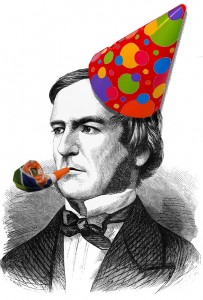
The Irish Taoiseach, Enda Kenny, has helped launch University College Cork’s year of festivities celebrating Boole, their first professor of maths and the inventor of Boolean algebra.
The year’s activities will include the restoration of Boole’s first home in Cork, an official film biography, an art exhibition of “contermporary art and mathematical data”, three conferences in maths and computer science, and of course a youth outreach programme. All the relevant information is available at a swishy new site set up for the purpose, georgeboole.com.
I’ve heard the year will end with a celebratory curry – and plenty of NAND bread to go around! Geddit?! (groan – Ed.)
More information
An Taoiseach launches George Boole celebrations – press release from University College Cork
Via Irish Maths Archive on Twitter
The John Riordan prize for the best solution to an unsolved problem in the OEIS
As mentioned previously, the Encyclopedia of Integer Sequences is 50 this year. To celebrate that fact, and to encourage readers to concentrate on filling in the gaps in the missing entries instead of just adding new ones, there’s a \$1,000 prize for the best solution to an open problem posed in an OEIS entry.
The announcement by OEIS creator Neil Sloane seems only to have been published as a PDF, so I’m reproducing it here for everyone’s convenience:
Each pair of smartphones has exactly one Dobble app in common
Card game fans might be familiar with the game of Dobble, in which a set of cards featuring symbols is laid out on the table, and family members tear each other’s hands off/eyes out in order to find the one symbol a given pair of cards has in common. Well, it’s now also available virtually!
The Topological Tverberg Conjecture is False
Attention, Topological Combinatorialists! The topological Tverberg Conjecture, described as ‘a holy grail of topological combinatorics’, is false.
The conjecture says that any continuous map of a simplex of dimension $(r−1)(d+1)$ to $\mathbb{R}^d$ maps points from $r$ disjoint faces of the simplex to the same point in $\mathbb{R}^d$. In certain cases the conjecture has been proven true, but there have been found counterexamples in the case where $r$ is not a prime power, for sufficiently large values of $d$: the smallest counterexample found is for a map of the 100-dimensional simplex to $\mathbb{R}^{19}$, with $r=6$.
The result was recently unveiled at the Oberwolfach Maths Research Institute, which is situated in the Black Forest in Germany and regularly hosts bands of fiercely clever mathematicians. The disproof, by Florian Frick, is found in the paper Counterexamples to the Topological Tverberg Conjecture.
More Information
From Oberwolfach: The Topological Tverberg Conjecture is False, at Gil Kalai’s blog
Counterexamples to the Topological Tverberg Conjecture, by Florian Frick on the ArXiv
Florian Frick’s TU Berlin homepage
via Gil Kalai on Google+
Axis is Missile Command for mathematicians
Axis is a retro-styled game a bit like Missile Command crossed with a graphing calcuator. Instead of pointing a turret and trying to estimate a parabolic trajectory ending at one of your enemies, your shot follows the path of any function $y=f(x)$ you can think of.
Turing round-up, February 2015
I just want to be done with Alan Turing posts, but stuff keeps happening. Here’s a very brief round-up of some recent Turing news:
There’s a petition to Pardon all convicted gay men, not just Alan Turing. Sign it or don’t or write 12,000 words hemming and hawing about it all. Up to you.
This is actually really interesting: some “Banbury sheets”, invented by Alan Turing to make breaking naval Enigma codes go quicker (here’s some more info on how that works by Tony Sale) have been found stuffed in the roof of Hut 6 at Bletchley Park.
The UK government is putting together a mega-huge new Alan Turing Institute for Data Science, combining support from all sorts of universities and research organisations. The Guardian tells us that it’s going to be based at the British Library in London, while the Manchester Evening News laments that the University of Manchester, where Turing worked after the war, has not been selected to be an official part of the Institute.