It’s time for our traditional trawl through the New Years Honours list for mentions of “mathematics”, hoping that better-informed readers will fill in the people this crude method has missed. I’ve found the following names:
You're reading: News
Ivor Grattan-Guinness 1941-2014
An obituary has been published in The Guardian for Ivor Grattan-Guinness, historian of mathematics and logic, who died of heart failure on 12th December 2014. This begins by explaining that when Ivor became interested in the history of mathematics in the 1960s,
it was an area of study widely considered to be irrelevant to mathematics proper, or something that older mathematicians did on retirement. As an undergraduate at Oxford, he found that mathematics was presented drily, with no inkling of the original motivations behind its development. So Ivor set himself the task of asking “What happened in the past?” — as opposed, he said, to taking the heritage viewpoint of asking “How did we get here?”
Read more: Ivor Grattan-Guinness obituary (The Guardian).
Say happy birthday to Christopher Zeeman on his 90th
Maths hero Christopher Zeeman will turn 90 in February. Normally when a mathematician reaches a big round number of years, there’ll be a celebratory day of lectures or even a small book. The LMS has decided to take things even further by setting up a website to collect people’s birthday wishes, as well as personal stories and photos, for the Z-man (as he’s known in downtown Warwick). They’ll all be collected into a book and presented to him at the launch of the LMS’s new online archive.
So if you want to say happy birthday to Sir Christopher, go to the Zeeman Turns 90 website.
via The London Maths Society on Twitter.
Just Get 10
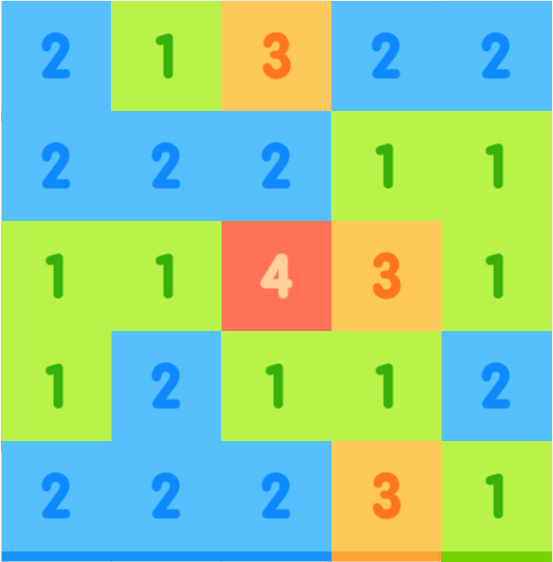
Here’s a new numberiffic game from Veewo, the people who made noted Threes-a-like 1024 (which begat 2048, which inevitably begat 2048: Harry Styles edition).
In Just Get 10, you have to get at least nineteen combine numbered blocks until you get one with a 10 on it. If you tap two adjacent blocks with the same number, they’re replaced by a single block with the next number up.
It’s alright.
Parable of the Polygons
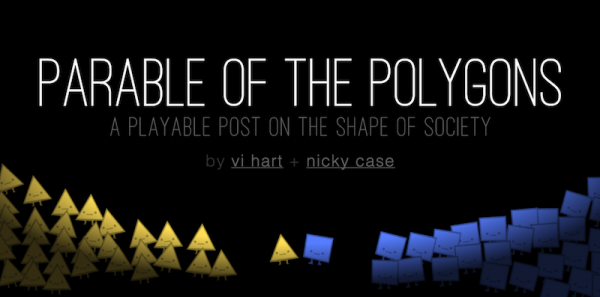
Sometimes maths can make a very clear point about a complicated subject.
It’s bunnies all the way down – GeoBunnies reveals geometry’s hidden rabbits
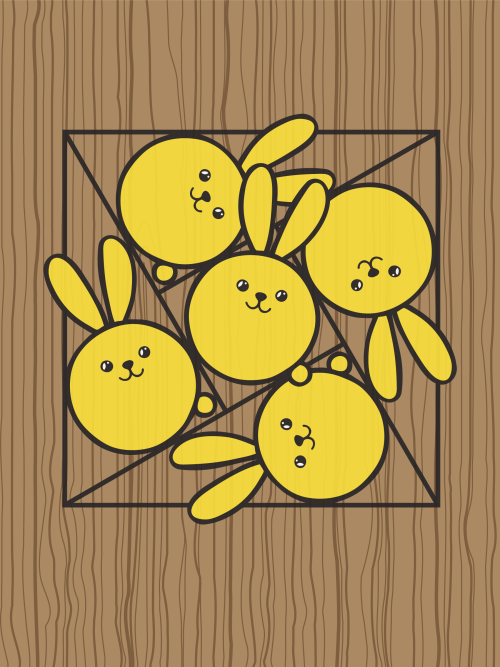
Theorem: You can turn any shape into a rabbit by adding a face, ears and a tail to it.
Proof (by construction): geobunnies.com
This is delightful. There’s a new school of Platonism, one which believes that not only do ideal shapes exist, so do the bunnies inside them.
Joy!
Bell’s Theorem Way
A street in Belfast is to be named after the late John Stewart Bell, a quantum physicist whose work has had a huge impact on modern physics and quantum information theory. Bell passed away in 1990, before he could be awarded a Nobel prize for his work, and Belfast Council have agreed to name a street in his honour.
However, in an awesome twist (since they avoid naming streets after people’s full names) rather than calling it ‘John Bell Way’, it’s going to be called ‘Bell’s Theorem Way’, after his most famous work. That’s nice!
The theorem, which relates to the distinction between quantum mechanics and classical mechanics, states:
“No physical theory of local hidden variables can ever reproduce all of the predictions of quantum mechanics.”
Presumably the first corollary of Bell’s Theorem will now be, ‘no left turn onto Queens Road’. The decision to name the street will be made at the next council meeting.
More Information
Belfast street to be named after John Stewart Bell, at BBC News
Bell’s Theorem, on Wikipedia
via Simon Singh on Twitter