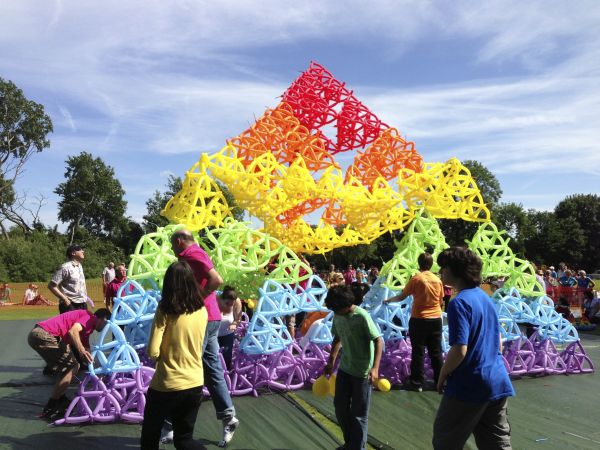
Caroline Ainslie has written in to tell us that she and her associates at Pyraloons are having another go at making the world’s largest Sierpiński tetrahedron… from balloons.

Caroline Ainslie has written in to tell us that she and her associates at Pyraloons are having another go at making the world’s largest Sierpiński tetrahedron… from balloons.
The British Library has an exhibition on at the moment that you might like to see.
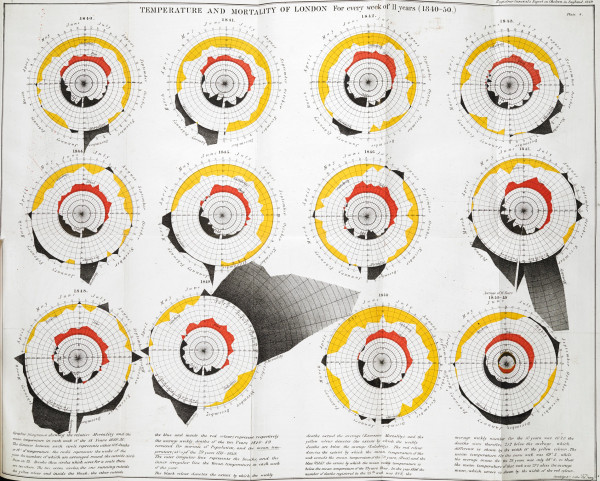
Beautiful Science: Picturing Data, Inspiring Insight is all about data visualisation. Here’s the blurb:
Turning numbers into pictures that tell important stories and reveal the meaning held within is an essential part of what it means to be a scientist. This is as true in today’s era of genome sequencing and climate models as it was in the 19th century.
Beautiful Science explores how our understanding of ourselves and our planet has evolved alongside our ability to represent, graph and map the mass data of the time.
From John Snow’s plotting of the 1854 London cholera infections on a map to colourful depictions of the tree of life, discover how picturing scientific data provides new insight into our lives.
Beautiful Science is in the British Library’s Folio Society Gallery until the 26th of May and admission is free.
Beautiful Science at the British Library.
A year and a bit ago, we posted about Elsevier’s possibly-generous, possibly-cynical move to make all papers in its maths journals free to access four years after their publication. I lamented at the time that the only way to access the free papers was through Elsevier’s sanity-sapping ScienceDirect portal.
Well, not any more! The Mathematics Literature Project (which we never got round to posting about when it started, sorry) has collected together all the content that’s been made available and collected it into nice BitTorrent packages for anyone to download. The MLP page on Elsevier open access journals has links to torrents of the complete back-catalogues of 39 journals, going up to 2009. They intend to update the torrents yearly, as more papers become available under the permissive licence.
The MLP was set up by Scott Morrison, who deserves a big pat on the back for putting in so much tedious work downloading papers and compiling the torrents. The project is also analysing journals to get an idea of how beneficial Elsevier’s licence is – if papers are available on the arXiv anyway, it doesn’t matter too much what Elsevier does with their copies. So far, at least in the journals the project is concentrating on, the vast majority of papers are on the arXiv or authors’ webpages anyway.
Elsevier open access mathematics torrents at the Mathematics Literature Project
The Mathematics Literature Project
Mathematics Literature Project progress at the Secret Blogging Seminar
Scott Morrison’s academic homepage
Previously: Elsevier has made lots more articles free to access
via David Roberts on Google+
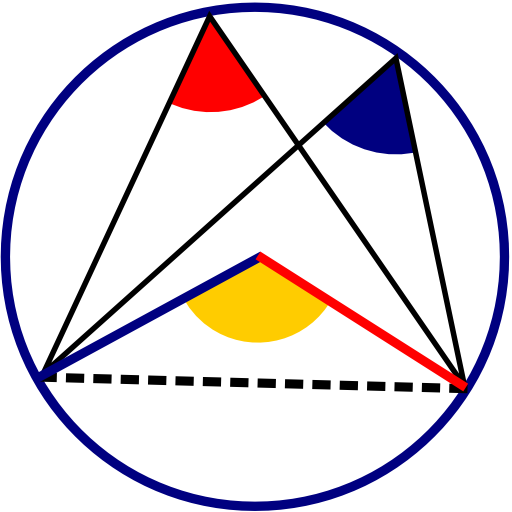
Boris Konev and Alexei Lisitsa of the University of Liverpool have been looking at sequences of $+1$s and $-1$s, and have shown using an SAT-solver-based proof that every sequence of $1161$ or more elements has a subsequence which sums to at least $2$. This extends the existing long-known result that every such sequence of $12$ or more elements has a subsequence which sums to at least $1$, and constitutes a proof of Erdős’s discrepancy problem for $C \leq 2$.
A recent study commissioned by Nationwide Building Society has revealed that more than one in four girls want to drop maths at 14, that less than half of 12-13 year old students surveyed could correctly calculate their change from £100 when paying for shopping worth £64.23, and that 76% of those who would choose to drop maths at GCSE said they either “couldn’t do maths” (31%) or “found it boring” (45%). They also tested respondents on their ability to identify the best value in a multi-buy situation, thus firmly conflating ‘the ability to do maths’ with ‘the ability to do arithmetic’.
Neuroscientists Semir Zeki and John Paul Romaya have put mathematicians in an MRI scanner and shown them equations, in an attempt to discover whether mathematical beauty is comparable to the experience derived from great art.
They’ve detailed the results in a paper titled “The experience of mathematical beauty and its neural correlates”. Here’s a bit of the abstract:
We used functional magnetic resonance imaging (fMRI) to image the activity in the brains of 15 mathematicians when they viewed mathematical formulae which they had individually rated as beautiful, indifferent or ugly. Results showed that the experience of mathematical beauty correlates parametrically with activity in the same part of the emotional brain, namely field A1 of the medial orbito-frontal cortex (mOFC), as the experience of beauty derived from other sources.
BBC News puts it: “the same emotional brain centres used to appreciate art were being activated by ‘beautiful’ maths”. This is interesting, according to the authors, because it investigates the emotional response to beauty derived from “a highly intellectual and abstract source”.
As well as the open access paper, the journal website contains a sheet of the sixty mathematical formulae used in the study. Participants were asked to rate each formula on a scale of “-5 (ugly) to +5 (beautiful)”, and then two weeks later to rate each again as simply ‘ugly’, ‘neutral’ or ‘beautiful’ while in a scanner. The results of these ratings are available in an Excel data sheet.
This free access to research data means we can add to the sum total of human knowledge, namely by presenting a roundup of the most beautiful and most ugly equations!
Novel knot news now! You might already be aware that there are 85 ways to tie a tie. Well, cast that preconception aside because there are actually loads.