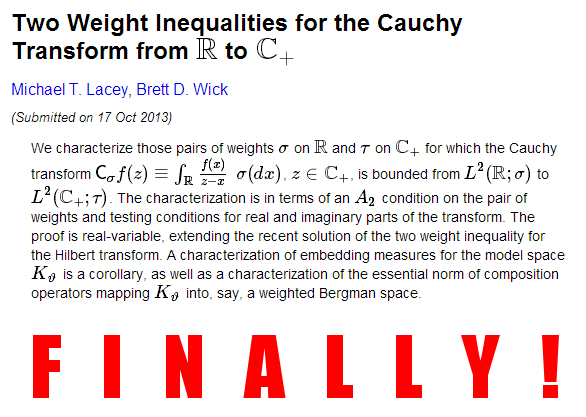
A bit of slightly overdue but welcome news: the arXiv has enabled MathJax on paper abstract pages. Authors have regularly been using LaTeX syntax in their titles and abstracts, but now the arXiv typesets them automatically for you.
You're reading: News
Prime gaps update
There’s been some progress on the bounded gaps between primes front since we last checked in.
The Polymath8 project has got the gap down to $4,680$. But that’s small beans: James Maynard, a postgrad student at Oxford, announced at a meeting in Oberwolfach that he has got the gap down to $700$. Emmanuel Kowalski has written an effusive post on his blog singing the praises of Maynard’s achievement.
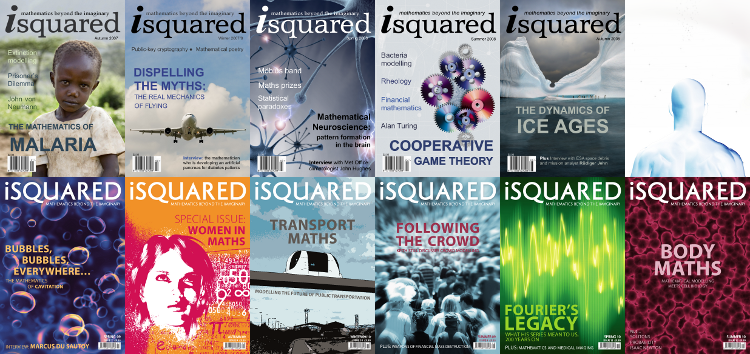
iSquared Magazine available for free download
I am delighted to report that the IMA and the National STEM Centre have made all twelve issues of iSquared Magazine available as PDFs for free download for the first time. The magazine was produced as a print-only publication by Sarah Shepherd from 2007-10.
GeoGebra Conference Budapest 2014
Just thought I’d bring the upcoming GeoGebra Conference 2014 in Budapest to your attention.
The main purpose of the conference is to provide a meeting platform for [International GeoGebra Institute (IGI)] members, and GeoGebra users, including teachers of all levels, educators, researchers, and developers from all over the World. The conference will allow ample time for speakers and audience interaction, and will encourage discussion of experiences, sharing of good practices, effective mathematics pedagogies that include GeoGebra, and enhancement of professional skills, and knowledge.
More information and registration: GeoGebra Conference Budapest 2014
The Magic Cube – a 3D logic puzzle
A chap called Jonathan Kinlay has innovented a Rubik’s cube variant which only has one colour, but six different integer sequences on its sides. As a colourblind integer sequence enthusiast, this basically has to be my ideal Christmas present, right?
Well, it’s currently looking for funding on Kickstarter in advance of actually existing, and the first units won’t be delivered before Christmas, but it’s a fun idea anyway.
Nirvana by Numbers
Alex Bellos has made another documentary for BBC Radio 4, this time about the number zero. It’s a pleasant bit of numerical tourism, as Alex travels to India to find the source of the number zero in a small shrine, with a diversion to talk about Vedic maths along the way.
You can listen to Nirvana by Numbers on the BBC iPlayer. It looks like it’s available indefinitely. If Alex has whetted your appetite for historical zeroes, the book Zero: The Biography of a Dangerous Idea by Charles Seife is a cracking read.
Listen: Nirvana by Numbers on BBC Radio 4.
Council orders maths & Sudoku to be removed from mathematician’s gravestone
There is a fine tradition of mathematicians with mathematics on their tombstones. What immediately springs to mind is Ludolph Van Ceulen and Jacob Bernoulli. Van Ceulen calculated $\pi$ to 35 decimal places; his grave carried both his lower bound of 3.14159265358979323846264338327950288 and his upper bound of 3.14159265358979323846264338327950289. Bernoulli asked for a logarithmic spiral on his gravestone, but the stonemasons etched an Archimedean spiral instead. Googling to fill in the details in my hazy memory, I discovered a blog post by Dave Richeson with the details of several more mathematical monuments.
Into this fine tradition steps Angela Robinson, widow of Shell numerical analyst and Sudoku enthusiast Allan Robinson.