Summer is a busy time for this site’s hard-working triumvirate, so we haven’t been keeping on top of the news as much as we’d like. There’s been some quite interesting news, so here’s a quick round-up of the most important bits:
You're reading: News
MathsJam Conference Website: Nice
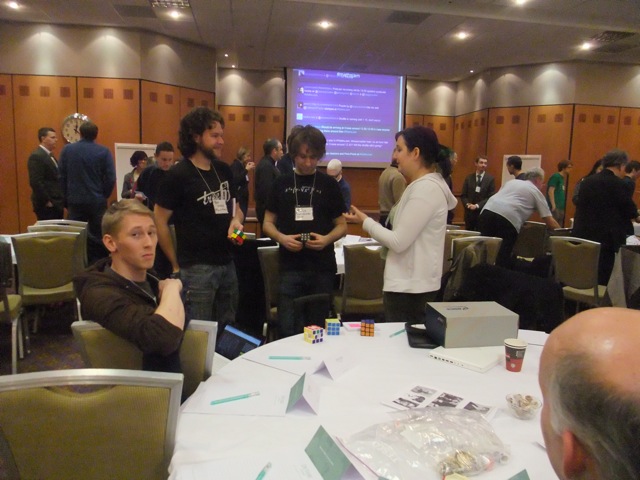 Maths news, of a sort! The MathsJam conference, which takes place in November and brings together recreational maths nuts from all over the UK and world, has now got a new improved website.
MathsJam is a monthly pub night for maths fans, where people can come together and share puzzles, games, problems or anything they think is cool or interesting. It meets in over 30 locations worldwide, on the same date, the second-to-last Tuesday of the month. It’s also an annual conference, now in its fourth year.
The new website was launched on Sunday, and as well as being a place where you can find out about booking for the conference and see details of the weekend, you can also find a full list of past conference talks – titles, blurbs and links to slides where possible. So, if you find yourself trying to remember something amazing which you think someone talked about at the MathsJam conference, you can now find it there.
The conference website can be found at www.mathsjam.com/conference. To find out more about the monthly MathsJams, visit www.mathsjam.com.
Another open source textbook
Recognising a good idea when he sees one, William Stein has put the source code to his Springer-published undergraduate textbook Elementary Number Theory: Primes, Congruences, and Secrets: A Computational Approach on GitHub.
The book introduces classical elementary number theory and elliptic curves, with lots of Sage code to encourage you to play around with the structures involved. If you want a physical copy, you can still get one from Springer-Verlag for £29.99.
If you don’t already know Stein, he’s the director of the Sage project to create a viable open source alternative to software such as Mathematica and Maple. At the moment he’s working on cloud.sagemath.com, a browser-based Sage environment hosted in the cloud. I think it’s pretty good!
Get the source code: Elementary Number Theory: Primes, Congruences, and Secrets on GitHub.
Announced by William Stein on Google+.
A bit of midweek fun: ANCIENT GREEK GEOMETRY
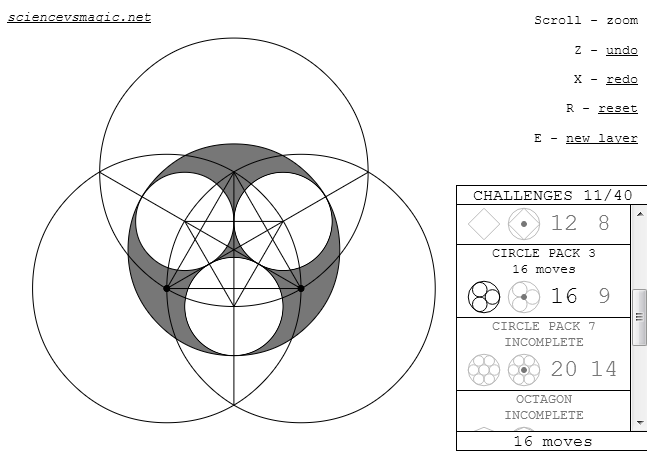
This is a fun game to while away the midweek blues. You’re presented with two dots. You can drag between dots to create lines and circles, as if you had a straightedge and compass. Apart from a few challenges to get you thinking, that’s pretty much it!
The game was created by Nico Disseldorp, who has a few more fun things on his website, Science vs Magic.
Play: ANCIENT GREEK GEOMETRY
Math Overflow 2.0
Math Overflow, where intimidatingly clever mathematicians ask and answer research-relevant questions, has just been upgraded to version 2.0 of the Stack Exchange software which has powered the site since it opened in 2009.
This is news because Math Overflow has merged with the commercial Stack Exchange network, losing its (semi-)independent status. There was a tiny bit of controversy when the merge was announced last year, but the majority of users seem to be happy with the move.
Math Overflow remains separate from Mathematics Stack Exchange (yes, the naming convention is a bit confusing), which is for lower-level questions about non-research maths.
Link: MathOverflow.net
Homotopy Type Theory: a new foundation for 21st-century mathematics
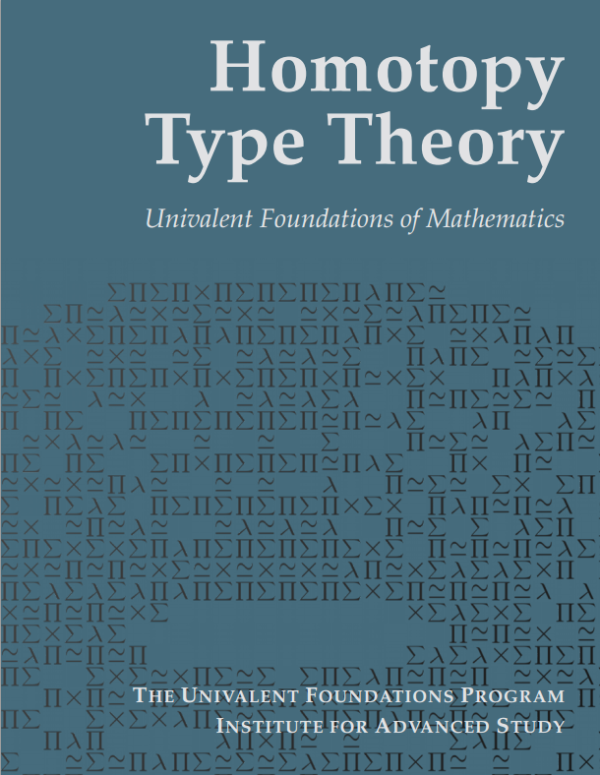
Pretty big book news (in a couple of ways)! The Univalent Foundations Program at the Institute for Advanced Study in Princeton has released a 470-page textbook resetting the foundations of mathematics on homotopy type theory. It’s called Homotopy Type Theory: Univalent Foundations of Mathematics.
Particularly mathematical Birthday Honours 2013
The Birthday Honours 2013 have been announced, and an extensive list has been posted on Wikipedia. The big name is Andrew Dilnot, Chair of the UK Statistics Authority and inaugural presenter of More or Less, who is knighted “for services to Economics and Economic Policy”. Apart from this, the list on Wikipedia contains one other mention of maths or stats that I spotted, John C. Butcher, Emeritus Professor of Mathematics at the University of Auckland, was appointed an Officer of the New Zealand Order of Merit “for services to mathematics”. His website lists his research interests as “numerical methods for the solution of ordinary differential equations”.
That’s all that I can see, which doesn’t compare well with the nine particularly mathematical New Years Honours this year. Does anyone have any to add?
More information
UK Government Birthday Honours lists 2013.