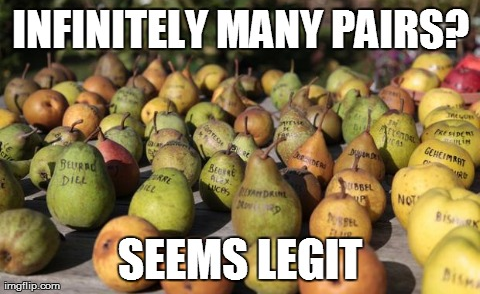
This just in! Important research from mathematicians at the university of Sheffield (in particular, category theorist Eugenia Cheng) has determined the correct proportions of jam and cream to use when creating a jam and cream scone. As the Aperiodical’s cake correspondent, my duty is to report these significant results.
You're reading: News
Elsevier one year on: “essentially nothing has changed”
A new post on Gowers’s Weblog gives, with permission, a letter of resignation from the editorial board of Elsevier’s Journal of Number Theory sent by Greg Martin. Gowers promises that the letter makes “interesting reading”, and he’s right.
Martin points out that it has been over a year since the Elsevier boycott began (covered on this site in the Open Access Update of 25th of May). The boycott currently claims 13,656 researchers have signed up. Martin says that the boycott caused “a flurry of communication back and forth between Elsevier and our editorial board (and those of other journals, I’m sure)”, but, he says “now the dust has settled, and I must conclude that essentially nothing has changed”.
In an interesting letter, Martin reflects on the original Gowers blog post, and on the Elsevier reaction to it, including a proposal to pay a fee to editors for processing articles (Martin says, “we want access to be less expensive; we’re not looking for extra dough in our pockets”).
Read the letter: Elsevier journals: has anything changed?
Geometric Unity: phenomenal advance, or crazy theory?
Marcus du Sautoy has this week presented to the world the physics of Eric Weinstein. ‘Geometric Unity’, apparently, argues “that the seemingly baroque features of the standard model of particle physics are in fact inexorable and geometrically natural when generalizations of the Yang-Mills and Dirac theories are unified with one of general relativity”.
Apparently, du Sautoy and Weinstein were postdocs together in the 1990s. Weinstein is a mathematical physicist turned economist who has been working on his these ideas privately for 20 years. Two years ago, he started to explain his thoughts to Marcus in a bar in New York.
Call for nominations for ICIAM Prizes for 2015
Professor Barbara Keyfitz, President of the International Council for Industrial and Applied Mathematics (ICIAM), has issued a call for nominations for five prizes it will award at its 8th International Congress in Beijing in August 2015.
MathsJam Conference 2013 – registration now open
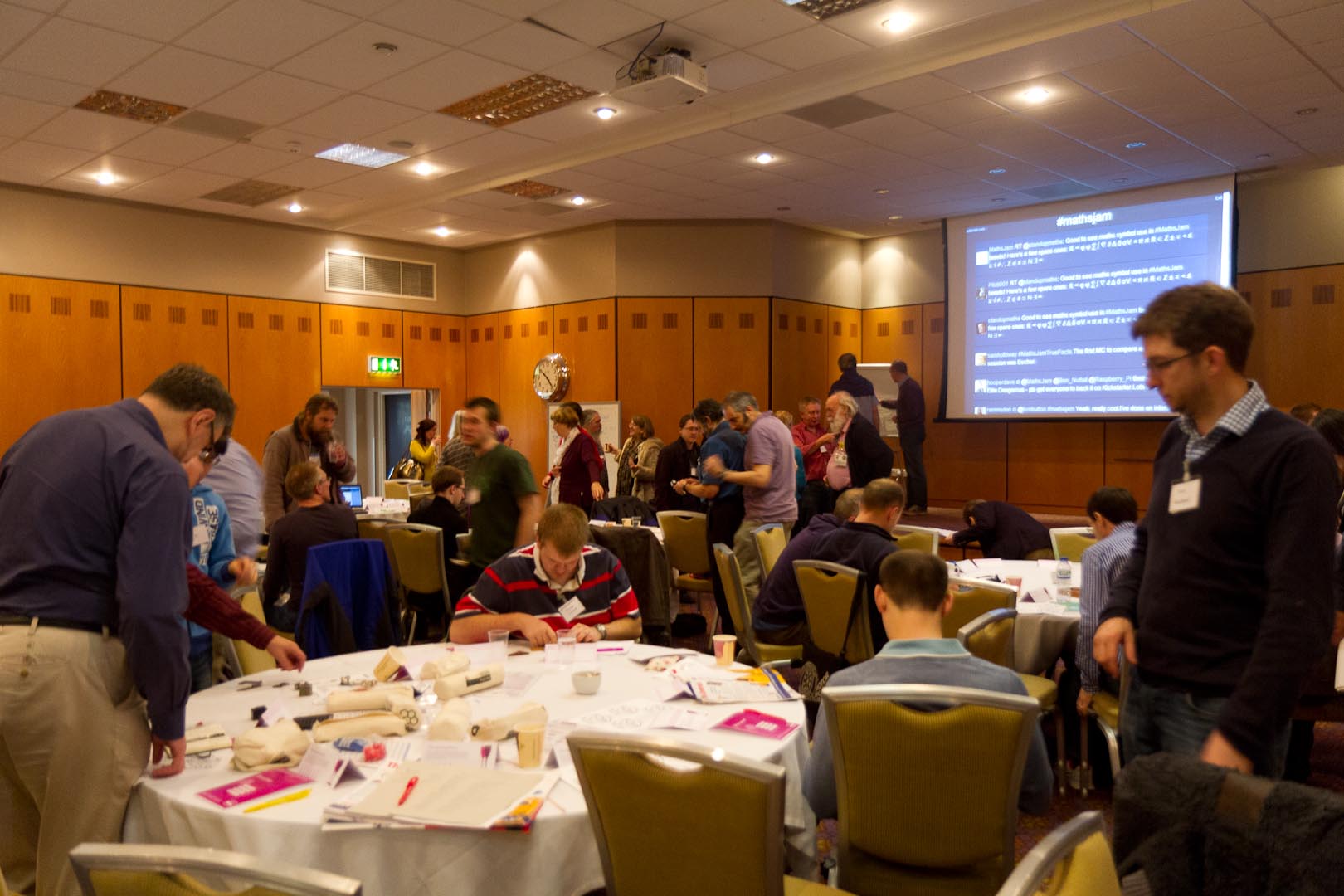
As well as being an excellent monthly pub-based meeting, MathsJam also has an annual conference, which takes place every November. Registration is now open for the 2013 conference, which takes place on 2nd and 3rd November.
MathsJam is an opportunity for like-minded self-confessed maths enthusiasts to get together in a pub and share stuff they like. Puzzles, games, problems, or just anything they think is cool or interesting. The annual conference is a weekend of lightning talks, where you can show or demonstrate something you want to share, followed by lengthy coffee breaks for conversation and socialising. And coffee.
Details about the conference, as well as the chance to register and secure your place, can be found at the MathsJam conference website.
All odd integers greater than 7 are the sum of three odd primes!
It seems that big mathematical advances are like buses – you wait ages for one, and then two come along at once. Also revealed yesterday was a proof of the odd Goldbach conjecture: that all odd numbers greater than 7 can be written as the sum of exactly three odd primes. The proof is contained in Major arcs for Goldbach’s theorem, a paper submitted to the arXiv by Harald Helfgott, who’s a mathematician at the École Normale Supérieure in Paris. This new paper completes the work started in Helfgott’s previous paper, Minor arcs for Golbach’s problem, published last year.
The strong Goldbach conjecture states that every even number can be written as the sum of two primes. This is still unproven, and remains one of the long-standing unproven results in number theory. Sadly, it’s the opinion of Terence Tao, among others, that the method used to prove the weak conjecture probably won’t work on the strong conjecture.
The paper: Major arcs for Goldbach’s theorem by Harald Helfgott
via Terry Tao on Google+
Primes really do stick together

“The author has succeeded to prove a landmark theorem in the distribution of prime numbers. … We are very happy to strongly recommend acceptance of the paper for publication in the Annals.”
According to the Nature News blog, at yesterday’s seminar given by Yitang Zhang it was revealed that his proof that there are infinitely many pairs of primes less than seventy million apart has already been refereed for the Annals of Mathematics; that’s a quote from the referee’s report above.
It seems the proof doesn’t use any unconventional machinery (in contrast to Mochizuki’s Proof from Planet 9 of the abc conjecture) and is fairly uncontroversial. How pleasant! Of course, someone might find a problem with it once it’s publicly available, but that’s the way for all things.
Source: First proof that infinitely many prime numbers come in pairs at Nature News