A recent study commissioned by Nationwide Building Society has revealed that more than one in four girls want to drop maths at 14, that less than half of 12-13 year old students surveyed could correctly calculate their change from £100 when paying for shopping worth £64.23, and that 76% of those who would choose to drop maths at GCSE said they either “couldn’t do maths” (31%) or “found it boring” (45%). They also tested respondents on their ability to identify the best value in a multi-buy situation, thus firmly conflating ‘the ability to do maths’ with ‘the ability to do arithmetic’.
You're reading: Main
The neuroscience of mathematical beauty, or, Equation beauty contest!
Neuroscientists Semir Zeki and John Paul Romaya have put mathematicians in an MRI scanner and shown them equations, in an attempt to discover whether mathematical beauty is comparable to the experience derived from great art.
They’ve detailed the results in a paper titled “The experience of mathematical beauty and its neural correlates”. Here’s a bit of the abstract:
We used functional magnetic resonance imaging (fMRI) to image the activity in the brains of 15 mathematicians when they viewed mathematical formulae which they had individually rated as beautiful, indifferent or ugly. Results showed that the experience of mathematical beauty correlates parametrically with activity in the same part of the emotional brain, namely field A1 of the medial orbito-frontal cortex (mOFC), as the experience of beauty derived from other sources.
BBC News puts it: “the same emotional brain centres used to appreciate art were being activated by ‘beautiful’ maths”. This is interesting, according to the authors, because it investigates the emotional response to beauty derived from “a highly intellectual and abstract source”.
As well as the open access paper, the journal website contains a sheet of the sixty mathematical formulae used in the study. Participants were asked to rate each formula on a scale of “-5 (ugly) to +5 (beautiful)”, and then two weeks later to rate each again as simply ‘ugly’, ‘neutral’ or ‘beautiful’ while in a scanner. The results of these ratings are available in an Excel data sheet.
This free access to research data means we can add to the sum total of human knowledge, namely by presenting a roundup of the most beautiful and most ugly equations!
Tie, tie, tie a tie / Fly, fly, fly as you might
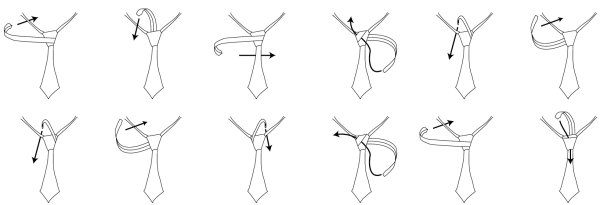
Novel knot news now! You might already be aware that there are 85 ways to tie a tie. Well, cast that preconception aside because there are actually loads.
What kind of mathematics is right for you? Maybe applied sarcasm?
University of Chicago grad student Kathryn Mann spotted this possibly-sexist flyer handed out by the AMS at a recent event:
The beautiful stock photo men are all doing pure maths, and the beautiful stock photo women are all doing applied! Heinous!
How to Teach Maths by Alex Bellos on Radio 4
Media math-man Alex Bellos has made another programme for BBC Radio 4, this time about How to Teach Maths.
Alex Bellos takes you on a mathematical learning journey from the first stages of number recognition through to an understanding of how children solve sums and calculate answers. On the way he will look at the neuroscience of maths and how our mathematical brain develops. He investigates the scientific evidence behind teaching maths and he’ll compare how modern methods of teaching children differ from those taught to their parents, helping kids today go beyond basic numeracy to develop a passion for numbers.
By the way, Radio 4 have also been repeating Marcus du Sautoy’s enjoyable A Brief History of Mathematics at a quarter to two each afternoon. That’s also available to listen to on the Radio 4 website.
Listen: How to Teach Maths on BBC Radio 4.
Martin Gardner Testimonials
21 October 2014 is the centenary of the birth of Martin Gardner, the supreme populariser of mathematics (amongst much else) who sadly passed in 2010. Those behind the Martin Gardner Centennial website and associated Twitter account @MGardner100th are collecting testimonials from people inspired by his work.
What does his extensive written legacy mean to you? Are you one of the many who can say things like “I only read Scientific American for Martin’s column” or “The reason I became a [insert profession/hobby here] is because of Martin”?
We’d love you to submit your comments here please. Feel free to say a little about yourself; if you taught physics for 27 years, tell us. If you are an artist or puzzle maker, or a student of computer science or psychology or linguistics, let us know. If you were lucky enough to correspond with or meet the great man, share your story. If you’ve already written elsewhere about Martin’s influence on you, please don’t be shy about giving details (web links, etc). If you’re a well-known author yourself, who knew Martin, please chime in too. Martin didn’t care if his sources or correspondents were amateurs or professionals, and we’re equally broadminded. We actively seek a good cross-section of comments, but we don’t mind repetition either. So many people have similar stories to tell, and we want them all.
Currently testimonials include Keith Devlin (testimonial #29), Cliff Pickover (#24), George Hart (#9), Max Maven (#3), John Allen Paulos (#30) and Colm Mulcahy (#7).
The website says all submissions will be posted following review. Testimonials can be submitted via the website or by email to gardnercentennial@gmail.com.
More information
For more about Martin Gardner, listen to the All Squared interview with Colm Mulcahy.
Via John Read on Twitter, who submitted testimonial #38.
Open Problems in Mathematics, a new open access journal
Here’s a nice idea: a journal for people to write about open problems, with the aim of inspiring someone to have a go at solving them. Open Problems in Mathematics is a new open-access journal set up by Krzysztof Burdzy and a few others, and it’s online now.