Having gathered a few data points about people’s availability for the recreational maths seminar, and heavily weighted towards my own, it looks like weekend evenings are the most convenient times for everyone to get together for the recreational maths seminar. So, let’s say 7pm GMT on Sunday evening, the 11th of November. That’s 2pm EST (New York), 11am PST (California) and 6am EDT (Eastern Australia, on the 12th of November).
You're reading: Main
Maths Careers Poster Competition 2012/2013
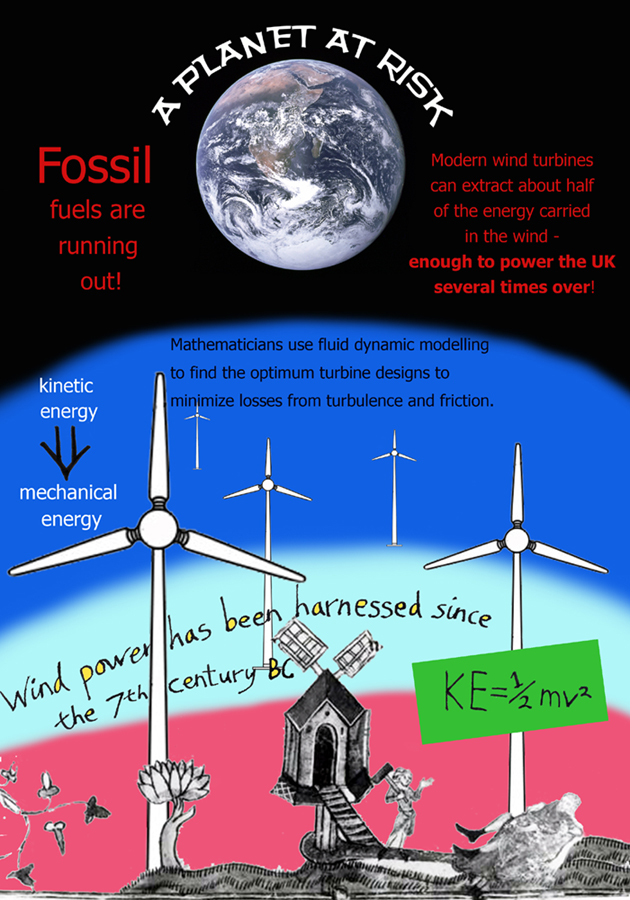 The IMA’s Maths Careers campaign runs a yearly competition for posters illustrating applications of maths. Entry for the 2012/13 competition has opened, and it’s on the theme of the planet Earth, to join in with the Mathematics of Planet Earth year 2013. UK students between the ages of 11 and 19 are invited to submit posters about “A planet to discover“, “A planet supporting life“, “A planet organised by humans” or “A planet at risk“.
The deadline for submissions is my birthday, the 14th of January, and the winners from the three age categories will each receive “an Android tablet”.
Find more info and the entry form on the Maths Careers website.
Walking on π in the NSF Visualization Challenge
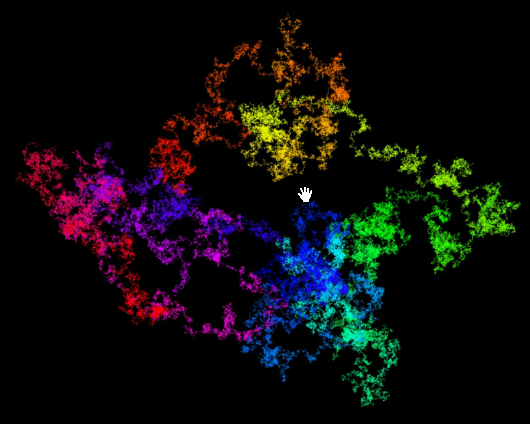
Fran Aragón Artacho has emailed to tell us that he and Jon Borwein have entered their image of a walk on the first 100 billion digits of π in the National Science Foundation (of the USA)’s International Science & Engineering Visualization Challenge. Fran says:
Jon Borwein and I have submitted our picture of a walk based on 100 billion digits of pi to a visualisation contest from the NSF (National Science Foundation). The winners will appear in Science (one will be selected for the front cover!). And we have good news: we are one of the 10 finalists in the Illustration category!
A recreational maths seminar?
Would you be interested in taking part in a sort of online video-chat seminar about recreational maths? Then read on!
Land of the Rising Sums by Alex Bellos on Radio 4
You’ll probably want to listen to this programme presented by Alex Bellos.
Alex Bellos visits Japan, on a quest to discover why Asian cultures seem so much better at maths and numbers than many western countries. He looks at the cultural difference in the Japanese approach to numbers and asks whether there is something fundamental in Japanese culture that keeps them at the upper end of international numeracy league tables. Alex explores the language used to describe numbers themselves, the songs taught in schools to teach children their times tables, and the passion the Japanese still show for the ancient but foolproof abacus, even in the computer age. He visits the national abacus competition in Kyoto to see the incredible mathematical feats achieved by children as young as 5 and discovers why abacus users actually use a different part of the brain to most people doing mathematical problems, and whether this could be the key to their superior number skills.
It’s on iPlayer Radio, so should be available to you no matter where in the world you are.
Math/Maths 118: An 11.5 microhertz Domputer
A new episode of the Math/Maths Podcast has been released.
A conversation about mathematics between the UK and USA from Pulse-Project.org. This week Samuel and Peter couldn’t speak but Peter spoke to Matt Parker and Katie Steckles about the Domputer, an attempt to build a computer from 10,000 dominoes at the Manchester Science Festival.
Get this episode: Math/Maths 118: An 11.5 microhertz Domputer
National Numeracy Challenge for working adults
A new ((Relatively new, they were launched in March.)) charity called National Numeracy has launched a campaign to
produce a positive transformation of public attitudes to numeracy and mathematics in the UK, to create an “I can do maths” approach and to raise the numeracy skills of at least 500,000 adults of working age to Level 1 or Level 2 where appropriate.