The people behind the free and open source computer maths system Sage have opened a new site called interact.sagemath.org, containing interactive demos of things you can do with Sage.
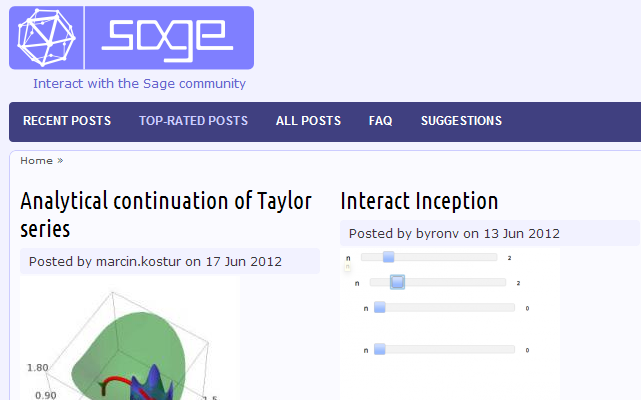
The people behind the free and open source computer maths system Sage have opened a new site called interact.sagemath.org, containing interactive demos of things you can do with Sage.
The march of the righteous towards victory over the rent-seeking publishers continues apace, so here’s another Open Access round up. I’m not even going to bother trying to remain impartial any more, for the following reasons:
Google Code, one of now approximately a million different websites which start with the word Google, is a sharing platform for developers to exchange open-source programs and nifty things they have made.
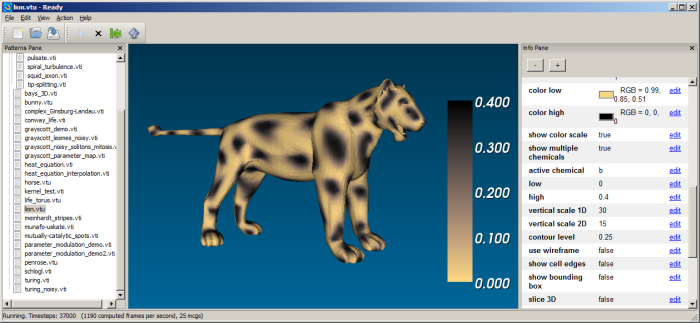
One such nifty thing is this Reaction-Diffusion package, based on our old friend Alan Turing’s famous equation. The reaction-diffusion equation, originally given in Turing’s 1952 paper The Chemical Basis of Morphogenesis, provides a model for how a mixture of chemicals, reacting with each other while moving under the action of diffusion, might result in the kind of patterns we see in animal print and elsewhere in nature.
Have a look at this trailer for a new film about maths:
A new episode of the Math/Maths Podcast has been released.
A conversation about mathematics between the UK and USA from Pulse-Project.org. This week Samuel and Peter spoke about: Make Britain Count open letter to Michael Gove (but do they know their four times table?); Higgs boson-like particle discovery claimed at LHC (or, perhaps, Confirmed: the Higgs boson does exist); Two new open access journals in mathematics, Forum of Mathematics, Pi and Forum of Mathematics, Sigma; World’s Shifting Center of Gravity; Urban World: Cities and the Rise of the Consuming Class; Maths expert creates formula for ‘perfect’ tennis serve; Ready, a program for exploring continuous cellular automata including reaction-diffusion equations; Émilie; Museum of Mathematics Field Trip Reservations; Abel Prize 2013 call for nominations; Help Samuel spot the error in a proof of the exact value of pi; and more.
Get this episode: Math/Maths 104: Never mind Higgs; exact value discovered for pi
The Telegraph have printed an open letter to Michael Gove and Vince Cable summarising its six month numeracy campaign, Make Britain Count. This says that the campaign has “highlighted the crisis we face as a nation in maths education” and call on the Secretaries of State to commit resources, adjust policy and campaign to address the issue.
A wide range of experts and concerned organisations working in education, training and industry have lined up to add their voices to our central contention that underperformance in maths up to 16, and avoidance of it thereafter, have left us with a critical skills gap when it comes to filling the job vacancies that exist right now for the numerate.
The letter gives eight points that the Telegraph feels need to be addressed and promises to return to the issue at the start of the new school year.
Incredibly, the article is presented with a photograph of a blackboard showing incorrect calculations of the four times table ((from $8 \times 4$ onwards. The error, which occurs twice, seems to involve adding $4$ to $28$ and $38$ to get $30$ and $40$, respectively, although the move from $8$ to $12$ is done correctly.)). $10 \times 4 = 38$, does it? Perhaps that only serves to highlight the problem further.
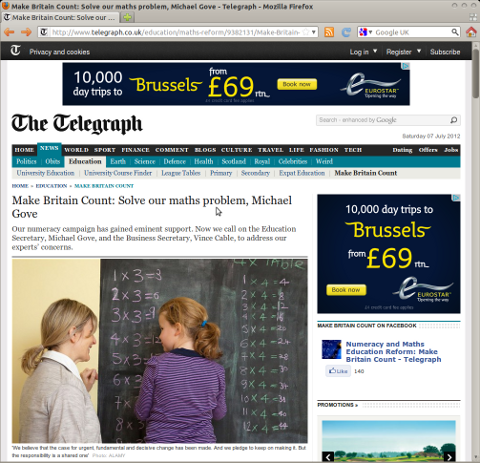
Screenshot of Telegraph webpage showing arithmetic errors on blackboard
Source: Make Britain Count: Solve our maths problem, Michael Gove.
A mathematical model previously used to determine the hunting range of animals in the wild, namely the ‘formal spatial Lotka–Volterra competition model’, apparently holds promise for mapping the territories of street gangs.
Lead author P. Jeffrey Brantingham is quoted in a press release saying: “The way gangs break up their neighborhoods into unique territories is a lot like the way lions or honey bees break up space”.
