The UK Government have announced the latest list of honours, and we’ve taken a look for the particularly mathematical entries. Here is the selection for this year – if you spot any more, let us know in the comments and we’ll add to the list.
Chris Pritchard, Chair, Scottish Mathematical Council, Secretary, James Clerk Maxwell Foundation and lately President of The Mathematical Association. Appointed OBE for services to mathematics education.
We chatted to Chris Dawson – the creator of Jigsy, a shape-based puzzle app which we’ve enjoyed playing – to find out more about where it came from and how it was developed.
A conversation about mathematics inspired by a light pattern in a tea cup. Presented by Katie Steckles and Peter Rowlett, with special guest Dominika Vasilkova.
Here’s a round-up of maths news from October and November 2025 which we didn’t otherwise cover on the site.
Awards and Grants
Applications for participation in the 13th Heidelberg Laureate Forum for Outstanding Young Researchers in Mathematics and Computer Science is now open . If you’re selected, you can join the conference in September in Heidelberg, Germany, and meet laureates of the most prestigious prizes in the fields of mathematics and computer science – including the Abel Prize, the ACM A.M. Turing Award, the ACM Prize in Computing, the Fields Medal, the IMU Abacus Medal and the Nevanlinna Prize – and engage in cross-generational scientific dialogue, including with other young researchers. The 13th HLF will take place from September 13 to 18, 2026.
The application period runs until February 11, 2026, and young researchers at all phases of their careers (undergrad, PhD or postdoc) can apply at application.heidelberg-laureate-forum.org. There are 100 spaces available for researchers from both mathematics and computer science, respectively, and all applicants will be notified by the end of April 2026 about whether or not they have been selected. For questions regarding the requirements and the application process, please see the HLF FAQs or visit heidelberg-laureate-forum.org.
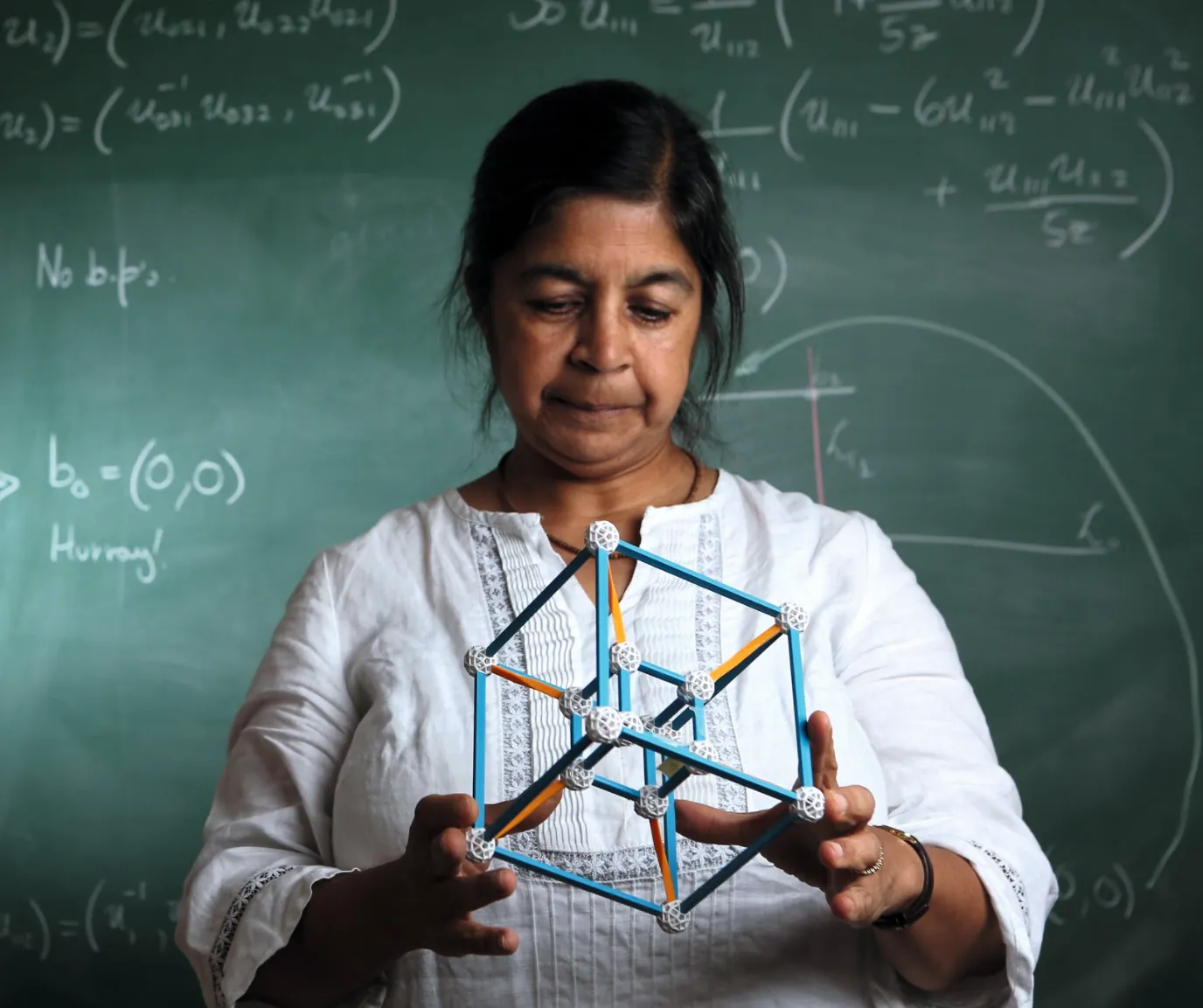
Mathematician Nalini Joshi has been awarded New South Wales Scientist of the Year 2025, for her pioneering work which “has transformed the field of integrable systems. She is internationally recognised for introducing geometric and asymptotic methods to study discrete and continuous nonlinear mathematical models, [and] her results have led to crucial information about singularity structure and to improved tests for the identification of critical models called integrable systems.”
Algorithmic trading firm XTX markets has announced £26m funding for PhD students and postdoctoral researchers in pure maths. According to the press release, “XTX Markets is launching the Early-Career Research Funding programme, designed to increase the number and quality of PhDs and postdocs entering the talent pipeline at top UK universities. The programme aims to create more than 100 new early career research positions, across seven universities, with entry in 2026, 2027 and 2028. The funding will support PhD students and postdoctoral research associates in pure maths.” (via Daniel Colquitt)
Other News
A Paris court has blocked Pascal’s La Pascaline calculator being exported from France – described as “one of the world’s first calculating machines”, the calculator is provisionally blocked from export due to heritage protection arguments. The auction, at which valuations suggested the machine could fetch €2m to 3m (£1.7m to £2.6m), has been postponed.