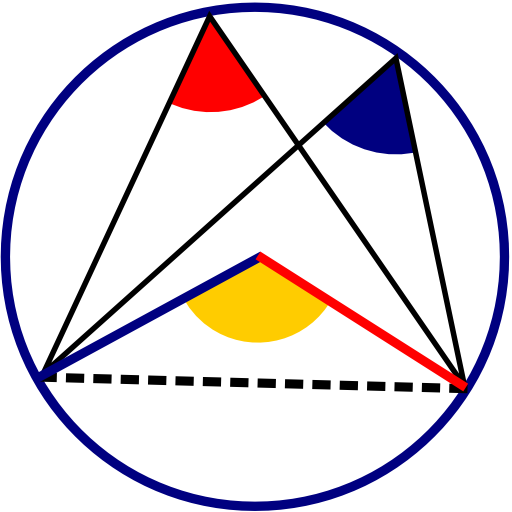
A conversation about mathematics inspired by a t-shirt featuring Pythagoras’ theorem. Presented by Katie Steckles and Peter Rowlett.

Podcast: Play in new window | Download
Subscribe: RSS | List of episodes

A conversation about mathematics inspired by a t-shirt featuring Pythagoras’ theorem. Presented by Katie Steckles and Peter Rowlett.

Podcast: Play in new window | Download
Subscribe: RSS | List of episodes

We spotted award-winning physicist Jess Boland sharing YouTube clips of mathematical terms in sign language on her Twitter account – and instantly wanted to learn more. We asked her about herself, the videos, and her interest in mathematical and scientific sign language.

Stand-up mathematician and friend of the site Matt Parker has produced a set of videos for teacher resource site BBC Teach, aimed at GCSE maths students.
A group of over 800 scientists have signed their names to an article published in Nature, explaining why statistical significance shouldn’t be relied on so heavily as a measure of the success of an experiment. We asked statistics buff Andrew Steele to explain.

The cover text says How to Fall… is “more than a puzzle book”, which is roughly how I was planning to describe it: twenty-six questions that require an element of mathematical or physical thought, followed by solutions in the obvious bijection.
Puzzle books, for me, are hit and miss – I’ve had a steady diet of pop-maths puzzles for the last three decades, and I’m cynical and jaded enough to expect a book of such things to be of little interest: either I’ve seen most of them before, or I’m just not interested in the topics at hand. Nahin’s book is something like an enthusiastic rookie that shakes me out of my cynicism.

A conversation about mathematics inspired by the Towers of Hanoi puzzle. Presented by Katie Steckles and Peter Rowlett.

Update: Here’s a lovely knitted Towers of Hanoi, tweeted in response to this episode by Pat Ashforth.
Podcast: Play in new window | Download
Subscribe: RSS | List of episodes

There are many things I admire about Matt Parker (or, to give him his full title, Friend of the Aperiodical, Mathematician Matt Parker) and his work, but probably top of the list is how he switches, apparently effortlessly, between modes. One minute, he’s showing off a fax machine to a group of hard-core geeks with Festival of the Spoken Nerd; the previous, he’s inspiring a “lively” bottom set of year 9s, after putting together a Numberphile video for people somewhere in between.
While Humble Pi – A Comedy Of Maths Errors is pitched firmly at the last of those groups – for a popular maths book to hit the top of the Sunday Times bestseller list, it really needs to be – there’s plenty in it for the others.