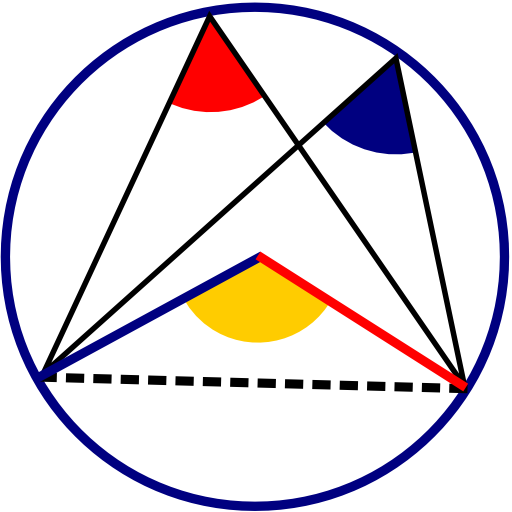
Watch geometer/topologist Caleb Ashley explain the parallel postulate on Numberphile.
You're reading: Main
- Mike Bassett, England Manager
“Pariah Moonshine” Part I: The Happy Family and the Pariah Groups
Being a mathematician, I often get asked if I’m good at calculating tips. I’m not. In fact, mathematicians study lots of other things besides numbers. As most people know, if they stop to think about it, one of the other things mathematicians study is shapes. Some of us are especially interested in the symmetries of those shapes, and a few of us are interested in both numbers and symmetries.
Footballs on road signs: an international overview
I’m an old fashioned manager, I write the team down on the back of a fag packet and I play a simple 4-4-2.
I’m very much like Mike Bassett: I like standing on the terraces, I like full-backs whose main skill is kicking wingers into the ad hoardings, and – most of all – I like geometrically correct footballs.
@standupmaths’ petition has had a response from the government

Friend of the site Matt Parker recently made headlines because of his UK Government Petition to correct the heinous geometrical oddity that is the UK Tourist sign for a football ground. In the standard sign, somehow a sheet of tessellating hexagons is depicted as wrapping around a sphere in a highly improbable (and provably impossible) way.
The petition has achieved a modicum of success, in that it’s passed the 10,000 signatures required to elicit a response from the government. Sadly, the response isn’t quite what you’d like to hear.
Stirling’s numbers in a nutshell
This is a guest post by researcher Audace Dossou-Olory of Stellenbosch University, South Africa.
In assignment problems, one wants to find an optimal and efficient way to assign objects of a given set to objects of another given set. An assignment can be regarded as a bijective map $\pi$ between two finite sets $E$ and $F$ of $n\geq 1$ elements. By identifying the sets $E$ and $F$ with $\{1,2,\ldots, n\}$, we can represent an assignment by a permutation.
A new aspect of mathematics
This is a guest post written by David Nkansah, a mathematics student at the University of Glasgow.
Around the fourth century BC, the term ‘Mathematics’ was defined by Aristotle as the “science of quantity”. It’s my own experience as a young mathematician to say this definition, although correct in its own right, poses a problem for those who do not truly know what mathematics is. It fails to highlight the true creativity of the subject.
Human inspiration and imagination are essential ingredients in mathematics. Regarding creativity, one could say, with merit, that in a sense mathematics is an art. Before proceeding to outline similarities between sketching mathematical proofs and painting on a canvas, it is important to know what fundamental premises mathematical proofs are built on.
Binary, with Anne-Marie Imafidon (video)
Watch mathematician and entrepreneur Anne-Marie Imafidon MBE explain binary numbers. Anne-Marie studied for an MSc in mathematics at Oxford University, and founded the social enterprise Stemettes to encourage more women and girls into STEM careers.