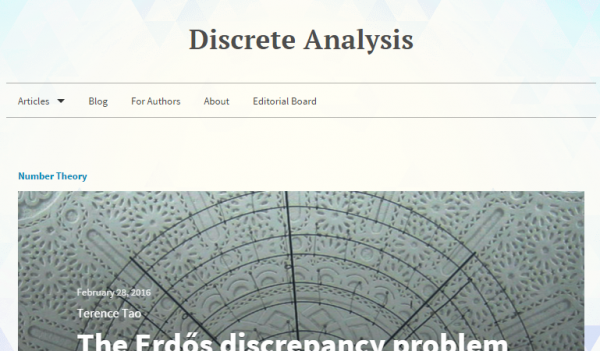
Discrete Analysis, a new open-access journal for articles which are “analytical in flavour but that also have an impact on the study of discrete structures”, launched this week. What’s interesting about it is that it’s an arXiv overlay journal founded by, among others, Timothy Gowers.
You're reading: Main
The Man Who Knew Infinity trailer
Here’s an official trailer for the long-awaited Ramanujan biopic, The Man Who Knew Infinity, starring Dev Patel and Jeremy Irons.
Looks good! IMDB reckons it’ll be out on the 8th of April. It’s taken long enough – we first reported on this film just over two years ago.
Relatively Prime Recap: Season 2, Episode 8: Diegetic Plots, Chapter 2
There really isn’t enough silliness in maths. Samuel has tried to inject some throughout the series, sometimes more successfully than others. This is the episode where he finally nails the silliness.
Diegetic Plots, Chapter 2 is a nice finale to a generally good season of Relatively Prime. Dealing with sketches and haiku from the mathematical domain, we get a glimpse of the daft side of maths.
Relatively Prime Recap: Season 2, Episode 7: $f(\theta) = 1 – \theta$
I’d have written it as $r = 1 – \theta$, myself, but even then it’s not much of a heart. However, that’s pretty much my biggest gripe about this episode, the penultimate in series 2 of Samuel Hansen’s one-of-a-kind mathematics podcast, Relatively Prime.
Episode 7 is subtitled “Dating in the mathematical domain”, and looks at the maths involved in dating and relationships, and begins with some of the comments Sam’s dating profile received from non-mathematicians. Now, denizens of the dating world: Samuel has many flaws and failings; picking on the fact that he’s a mathematician seems a little arbitrary and unfair, like deciding not to vote for Donald Trump because you don’t like his tie. I have this unfamiliar sensation. Could it be… surely not? It appears that I feel a little sorry for Samuel. Don’t tell him, ok?
Christopher Zeeman has died
Sir Christopher at the Warwick Mathematics Institute in December 2009. Photo by Nicholas Jackson.
Last weekend mathematician Sir Erik Christopher Zeeman passed away. A giant of mathematics research, he worked in geometry, topology, knot theory and singularity theory, and was also a great populariser of mathematics. He gave the Royal Institution Christmas Lectures in 1978 – not only was this the first time the lectures had been on the subject of mathematics, it was also the start of the Ri’s Mathematics Masterclass series which still runs all over the UK.
He was the 63rd president of the London Mathematical Society (1986-88) and founded the Mathematics Department and Mathematics Research Centre at the then-new University of Warwick in 1964. Zeeman was elected as a Fellow of the Royal Society in 1975, and was awarded the Society’s Faraday Medal in 1988. Zeeman was a hugely popular lecturer, and supervised nearly 30 doctoral students.
In September 2006, the LMS and IMA awarded him the David Crighton medal for his long and distinguished service to mathematics and the mathematical community. The LMS/IMA’s Christopher Zeeman Medal for Communication of Mathematics is awarded in his honour.
He will be sadly missed.
More information
Sir Christopher Zeeman FRS (1925-2016), on the Warwick Mathematics Institute website
We’ve done a bit of Spring cleaning
It’s daylight outside at the moment, which hasn’t been the case for pretty much any of the past few months up here in the North-East of England. That means Spring is on its way, so my cleaning and tidying instinct has activated.
When I can’t think of anything else to put here, I’ll use a picture of Poppy, the Aperiodical Dog.
We’ve had the same layout here since 2013, I think, so it was high time it was freshened up. I’ve made a bright new header image, and I’ve banished the sidebar to the bottom of the page so there’s nothing to interrupt your reading of our very interesting articles.
Additionally, we’re always finding that we want to add extra bits of information or quips, with nowhere sensible to put them. Parenthetical statements ruin the flow of reading if they’re too long, and footnotes don’t really work on the web. You’ll have noticed there’s quite a bit of space on the right (unless you’re reading this on your phone) – that’s set aside so we can put whatever little notes, links, or images we think would be worthwhile, without getting in the way of the main text.
So, I hope you like it, and please let us know if anything’s broken in the comments.
Carnival of Mathematics #131

Welcome to the 131st edition of the Carnival of Mathematics, a monthly blogging carnival which scoots its way round the internet, rounding up maths-related blog posts from the month of January.