Math Stack is a deck of playing cards with mathematical artwork on the faces. The makers call it “a potent and effective learning tool”. I’m not convinced about that, but they are so pretty!

So pretty!
So pretty!
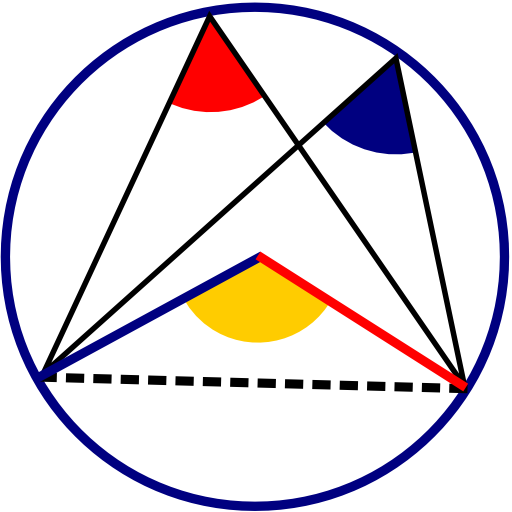
Math Stack is a deck of playing cards with mathematical artwork on the faces. The makers call it “a potent and effective learning tool”. I’m not convinced about that, but they are so pretty!
So pretty!
So pretty!
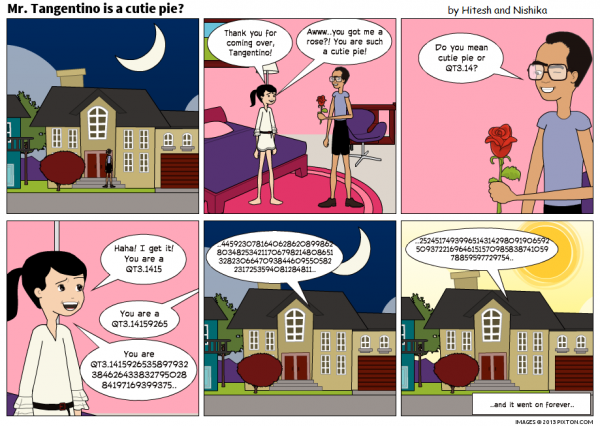
Nishika Bhatia wrote in to tell us about Dr. Isomorpheus, a webcomic about mathematicians. It’s full of weak puns of the “abelian grape” variety. You might like it!
Read: Dr. Isomorpheus
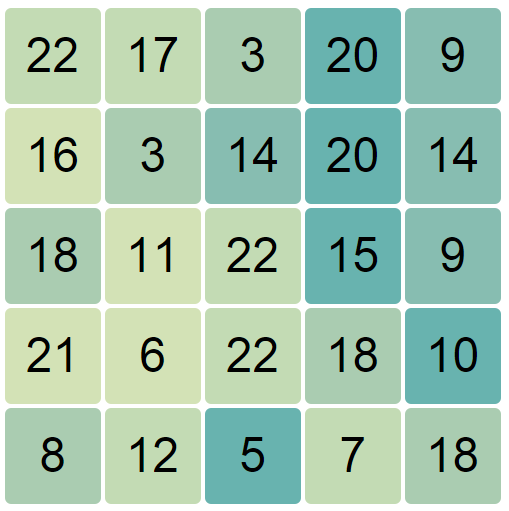
For the past couple of weeks, I’ve been obsessively playing the game Twenty on my phone. The fact that my wife has consistently been ahead of my high scores has nothing to do with it.

The main source of strife in my marriage.
Twenty is another in the current spate of “numbers-in-a-grid” games that also includes Threes, 1024, 2048 (and its $2^{48}$ clones), Just Get 10, and Quento.
The basic idea is that you have a grid of numbered tiles, and you combine them to build up your score. While there are lots of unimaginative derivatives of the bigger games, there’s a surprisingly large range of different games following this template.
With so many different games being created, I thought that a chap like me should be able to come up with a numbers-in-a-grid game of my own. Yet, for a long time, I just couldn’t come up with anything that was any good.
Yesterday I had a really nice shower, and the accompanying feeling that I’d come up with a really good idea – make a game to do with arithmetic progressions.
Next week, Cheltenham takes a break from being the home of horse racing and literary and music festivals, and generally being a regency spa town, to put on their amazing Science Festival. There’s a decent amount of maths in the programme, so here’s a round-up of the maths on offer (leaving aside, of course, the fact that all science is maths, there’s also a bunch of science events you might be interested in too).
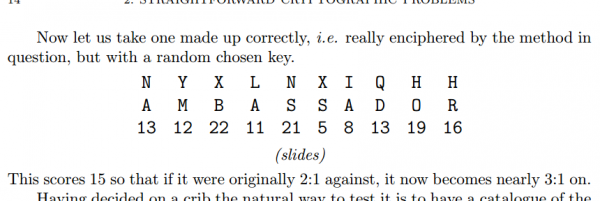
A couple of papers by Alan Turing have appeared on the arXiv.
No, that’s right – The Applications of Probability to Cryptography and The Statistics of Repetitions are two papers Turing wrote during the Second World War, and they’re now available on the arXiv, transcribed into modern LaTeX by Ian Taylor.

John Nash, famous for his work in game theory and as the subject of the film A Beautiful Mind, has died in a car crash, according to the BBC.
As well as winning the (in memory of but not actually a) Nobel Prize for Economics in 1994, Nash was recently awarded the Abel Prize for his work on nonlinear partial differential equations.
‘Beautiful Mind’ mathematician John Nash killed on the BBC.
Famed ‘A Beautiful Mind’ mathematician John Nash, wife killed in taxi crash, police say at nj.com.
John Nash’s unique approach produced huge leaps in economics and maths by Alex Bellos in the Guardian.
Alex Bellos’s short essay about the work which earned Nash and Nirenberg the 105 Abel Prize.
Equilibrium points in N-person games, the 1950 paper in which Nash introduced the concept of the Nash equilibrium.
The bargaining problem, Nash’s 1950 paper which introduced his solution to the classic economics problem.
The Nash-Kuiper embedding theorem was used recently to construct an amazing isometric embedding of the flat torus in Euclidean space.
Nash’s letter to the NSA (PDF) in which he described an encryption-decryption machine, anticipating more recent ideas of computational complexity.
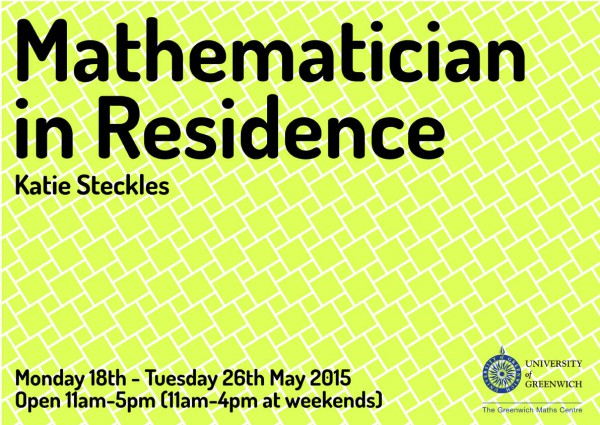
Our very own Katie Steckles is currently residing mathematically in the University of Greenwich’s Stephen Lawrence Gallery. She’s there until Tuesday the 26th, doing a variety of numerical, geometrical and otherwisely logical things for anyone who pops along.