
The IMA turns 50 this year, and is holding two celebration events and publishing a book.

The IMA turns 50 this year, and is holding two celebration events and publishing a book.
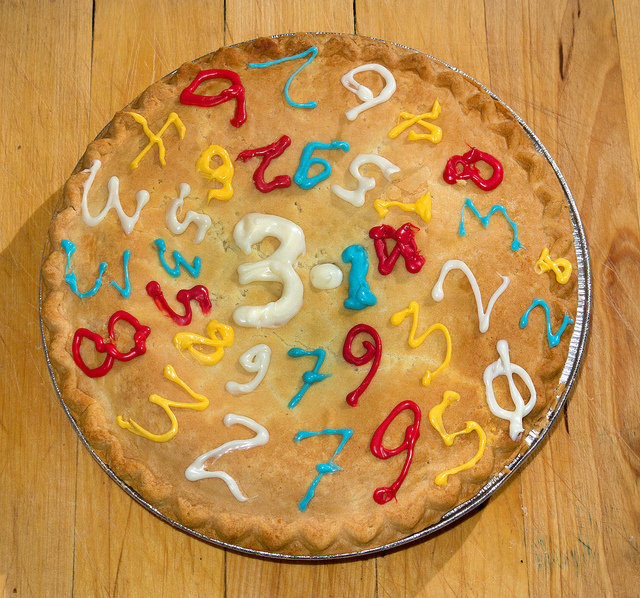
π pie by Robert Couse-Baker. Photo used under the CC-BY 2.0 licence.
‘Tis the season to celebrate the circle constant! ((Pedants would have me revise that to “a circle constant”.)) Yes, that’s right: in some calendar systems using some date notation, the day and month coincide with the first three digits of π, and mathematicians all over the world are celebrating with thematic baked goods and the wearing of irrational t-shirts.
And the internet’s maths cohort isn’t far behind. Here’s a round-up (geddit – round?!) of some of our favourites. In case you were wondering, we at The Aperiodical hadn’t forgotten about π day – we’re just saving ourselves for next year, when we’ll celebrate the magnificent “3.14.15”, which will for once be more accurate to the value of π than π approximation day on 22/7. (Admittedly, for the last few years, 3.14.14 and so on have strictly been closer to π than 22/7. But this will be the first time you can include the year and feel like you’re doing it right.)
Media math-man Alex Bellos has made another programme for BBC Radio 4, this time about How to Teach Maths.
Alex Bellos takes you on a mathematical learning journey from the first stages of number recognition through to an understanding of how children solve sums and calculate answers. On the way he will look at the neuroscience of maths and how our mathematical brain develops. He investigates the scientific evidence behind teaching maths and he’ll compare how modern methods of teaching children differ from those taught to their parents, helping kids today go beyond basic numeracy to develop a passion for numbers.
By the way, Radio 4 have also been repeating Marcus du Sautoy’s enjoyable A Brief History of Mathematics at a quarter to two each afternoon. That’s also available to listen to on the Radio 4 website.
Listen: How to Teach Maths on BBC Radio 4.
Alex Bellos has made another documentary for BBC Radio 4, this time about the number zero. It’s a pleasant bit of numerical tourism, as Alex travels to India to find the source of the number zero in a small shrine, with a diversion to talk about Vedic maths along the way.
You can listen to Nirvana by Numbers on the BBC iPlayer. It looks like it’s available indefinitely. If Alex has whetted your appetite for historical zeroes, the book Zero: The Biography of a Dangerous Idea by Charles Seife is a cracking read.
Listen: Nirvana by Numbers on BBC Radio 4.
Here are three things we noticed this month which didn’t get a proper write-up, due to thesis/Edinburgh fringe/holidays: a big proof, a fun maths book club, and a ridiculous bit of pi-related madhattery.
Here’s a quick round-up of some news stories from the tail end of 2012 that we characteristically failed to write up!
You’ll probably want to listen to this programme presented by Alex Bellos.
Alex Bellos visits Japan, on a quest to discover why Asian cultures seem so much better at maths and numbers than many western countries. He looks at the cultural difference in the Japanese approach to numbers and asks whether there is something fundamental in Japanese culture that keeps them at the upper end of international numeracy league tables. Alex explores the language used to describe numbers themselves, the songs taught in schools to teach children their times tables, and the passion the Japanese still show for the ancient but foolproof abacus, even in the computer age. He visits the national abacus competition in Kyoto to see the incredible mathematical feats achieved by children as young as 5 and discovers why abacus users actually use a different part of the brain to most people doing mathematical problems, and whether this could be the key to their superior number skills.
It’s on iPlayer Radio, so should be available to you no matter where in the world you are.