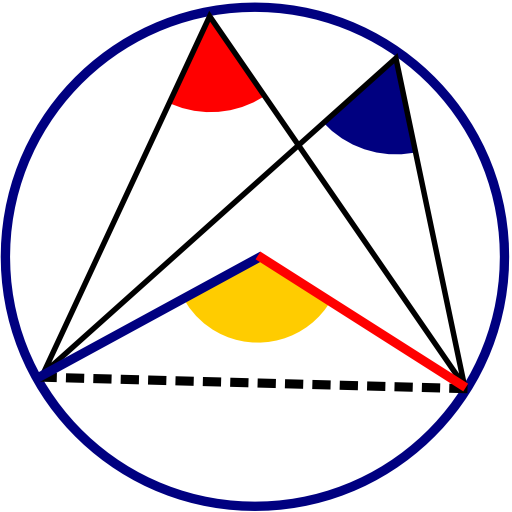
Here’s a round-up of some news from the last couple of months.
You're reading: Posts Tagged: Christopher Zeeman medal
Double Maths First Thing: Issue 1D
Double Maths First Thing just doesn’t know any more
Hello! My name is Colin and I am a mathematician on a mission to spread delight and joy in doing maths for the sake of it.
This week I have mainly been figuring out the mechanics of the Bokeh library so I can make it draw graphs. It’s really neat! (Now drawing graphs is a service I offer at a reasonable consulting rate.)
I’ve also been making progress with blindfold cubing — I managed a successful solve on the bluetooth cube in under 5:30, which is slower than I’d like; however, there’s plenty of time until the competition to get quicker and more reliable. (Talking of cubing, there’s a wealth of data available here.)
Links
Frank Lantz loves SET in a different way to how I do. If you don’t own it, you can get it from MathsGear for a tenner or so (UK).
Here’s an interesting (but ultimately, unsatisfying) article from Quanta via Wired about a new kind of hash table. I think my problem with this kind of article is that I want to know a bit more about the detail and a bit less about how it made people go wow.
Much more in-depth: this one’s about different sorts of means.
Finally, a curiosity: a number’s Zeckendorf decomposition is the unique way it can be written as non-consecutive Fibonacci numbers, so (e.g.) 20 = 13 + 5 + 2. You can use the Zeckendorf decomposition to factorise numbers, although it turns out to be pretty slow.
A geeky aside
I found out this week that Paul Erdős appeared as himself in the documentary N is a Number, as did Tomas Luczak.
Luczak had a minor role in The Mill and the Cross, which also featured Charlotte Rampling.
Rampling and Martin Sheen both had acting credits for Jerusalemki sindrom.
And Martin Sheen was in JFK with Kevin Bacon.
Therefore Paul Erdős has a Bacon number of four — and also an Erdős-Bacon number of four. (Nicholas Metropolis, according to the Wiki, is also a 4.)
My Erdős number is 5+i; the i was bestowed upon me at G4G after I wore Erdős’s coat.
As it happens, today is Erdős’s 112th birthday. Here’s Katie celebrating it a few years ago.
Currently
There is a partial solar eclipse on Saturday coming (March 29th), visible across most of Europe and around the North Atlantic. Don’t look directly at the sun, unless of course you’re the President, in which case feel free to ignore that woke nanny-state nonsense.
Registration is open for the Zeeman Award ceremony on May 7th in London — you don’t get a Zeeman Award without being a legend; this year’s laureate is Brady Haran of Numberphile. (The dates are all over the place on that page, but I’m assured it’s this May.)
And I deliberately missed off Chris Smith’s maths newsletter from “here are good places to get maths content” last week — but only because I needed to check with him about how to sign up. You email aap03102@gmail.com and he’ll be delighted to have you on board.
That’s all I’ve got for this week. If you have friends and/or colleagues who would enjoy Double Maths First Thing, do send them the link to sign up — they’ll be very welcome here.
If you’ve missed the previous issues of DMFT or — somehow — this one, you can find the archive courtesy of my dear friends at the Aperiodical.
Meanwhile, if there’s something I should know about, you can find me on Mathstodon as @icecolbeveridge, or at my personal website. You can also just reply to this email if there’s something you want to tell me.
Until next time,
C
Aperiodical News Roundup – January 2023
Here’s a round-up of news stories from January 2023.
Maths forever news
The British Prime Minister Rishi Sunak has announced that all students will study maths to age 18. The response has been varied, with commentators from both within mathematics and from non-mathematical backgrounds weighing in (with varying degrees of nuance).
However, this isn’t planned to happen soon – only to start the work to introduce this during this Parliament, with actual implementation to happen at an unspecified point in the future.
It’s worth noting that there is a shortage of maths teachers, with nearly half of schools currently using non-specialist maths teachers, according to the TES.
The fact this might make maths a political football is a bit of a problem – the opposition Labour party say “they’ve nothing to offer the country except double maths”. (As much as we love maths, we’ll agree there are more important things to worry about at the moment).
Tech news
The Chrome browser, and eventually other browsers built on it such as Edge and Opera, can now render MathML without any additional libraries as of version 109. Chrome briefly had some support for MathML, which was removed in 2013 due to lack of interest from Google. The developers who were working on it have kept plugging away, funded by the open source software consultancy Igalia.
Until now, the only reliable way to display mathematical notation on the web has been to use a JavaScript library such as MathJax or KaTeX, which do all the work of laying out symbols using generic HTML elements.
Now, you can just put MathML code in a page and expect most browsers to display it, like this:
There’s still a need for MathJax and the like: writing MathML code is no fun, so they’re still useful for translating LaTeX code, and MathJax adds a range of annotations that help with accessibility. But this is a step towards mathematical notation being much easier to work with on the web!
Other news
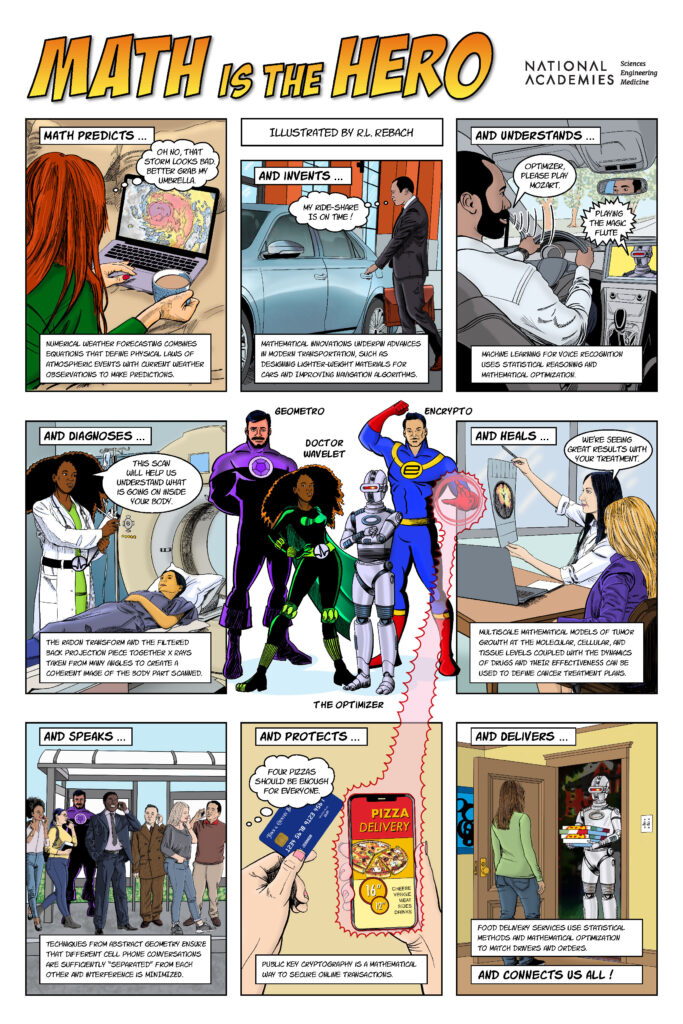
The US National Academies have released a series of posters “Illustrating the impact of the mathematical sciences”.
CLP’s place of work still has some Millennium Maths Project posters clinging on to the walls, older than almost all of the students, so maybe it’s time for a refresh! (via Terence Tao)
Tim Austin is the new Regius professor mathematics at Warwick. (via Warwick Mathematics Institute)
A bit of bureaucracy news: the Council for the Mathematical Sciences, comprising the five learned societies for maths and stats in the UK, is creating a new Academy for the Mathematical Sciences. It looks like the societies for the different sub-disciplines have acknowledged they need to work together, though this gives off a “now you have n+1 standards” smell. They’ve got a nice logo, though.
The Financial Times style guide changed so that ‘data’ is always singular, pragmatically following common usage. FT writer Alan Beattie said it best: “For anyone opposed, I’d like to know what your agendum is.“
Events
The London Mathematical Society will hold a ceremony in London on 22nd March to officially award the Christopher Zeeman medal to the 2020 and 2022 medallists, Matt Parker and Simon Singh.
The ICMS in Edinburhgh has launched a “Maths for Humanity” initiative, which will be “devoted to education, research, and scholarly exchange having direct relevance to the ways in which mathematics, broadly construed, can contribute to the betterment of humanity.” (via Terence Tao)
And finally
Yuri Marin has died. The Max Planck Institute has posted an obituary describing his life’s work. One of his PhD students, Arend Bayer, collected some memories in a Mastodon thread.
William ‘Bill’ Lawvere has died. There is a page on the nLab describing his life’s work.
Aperiodical News Roundup – July 2022
Here’s a roundup of some mathematical news we didn’t yet report from the last month.
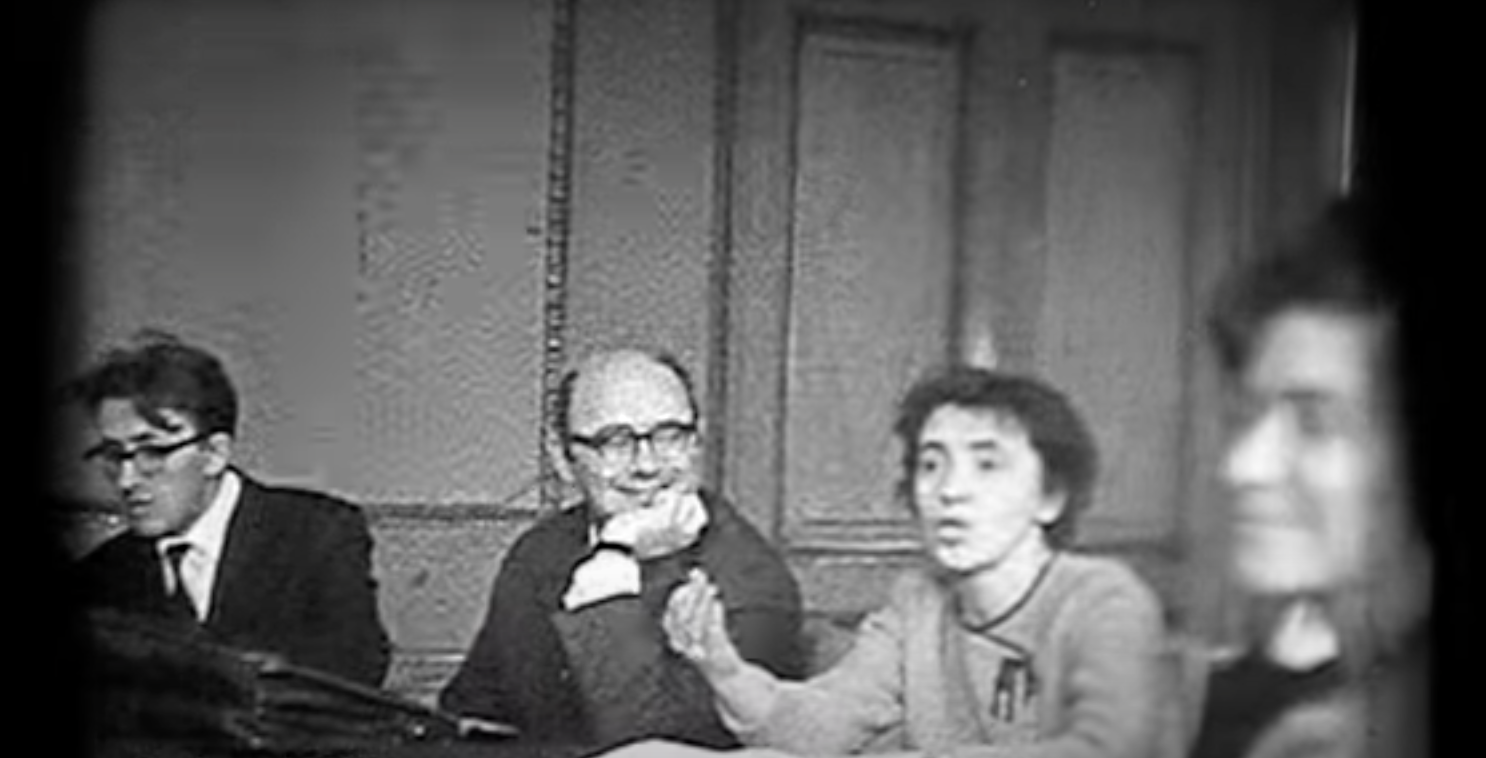
The makers of documentary film ‘Olga Ladyzhenskaya’, detailing the life of the Russian mathematician, have released a five-minute trailer giving a flavour of the film. (via ICM Intelligencer)
Research
According to a new ArXiV paper, the triple bubble conjecture (a result about the shapes taken by surfaces that are attempting to enclose a volume, or in this case three volumes, with minimal surface area) has been solved. (via Ian Agol)
The Lean community, who use and blog about the Lean proof assistant, have announced completion of the liquid tensor experiment – proving the main theorem of liquid vector spaces (me neither) and thereby formalising a big serious proof using the system. (via David Eppstein)
In computer science, a new ArXiV paper takes us a step closer to automating quantitative reasoning – Minerva, a large language model pre-trained on general natural language data and technical content, has correctly solved some college-level questions that “require quantitative reasoning”.
Awards

A big month for prizes, with the announcement of the 2022 Fields medals, awarded to Hugo Duminil-Copin, June Huh, James Maynard and Maryna Viazovska, as well as the 2022 Christopher Zeeman medal, which has been awarded to Simon Singh.
2020 Christopher Zeeman Medal awarded to Matt Parker
Stand-up Mathematician and internet superstar Matt Parker has been awarded the 2020 IMA/LMS Christopher Zeeman Medal, which aims to recognise and acknowledge the contributions of mathematicians involved in promoting mathematics to the public and engaging with the public in mathematics in the UK.
2018 Christopher Zeeman Medal nominations open
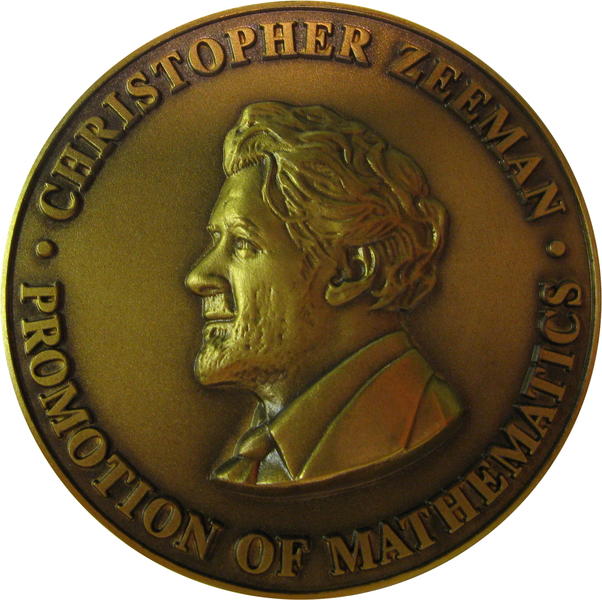
The IMA/LMS Zeeman Medal has been awarded every two years since 2008, to an individual, to “recognise and acknowledge the contributions of mathematicians involved in promoting mathematics to the public and engaging with the public in mathematics in the UK, and demonstrate that such activities are valued by the societies and the mathematical community at large and are a part of a mathematician’s roles and responsibilities”. The nomination process is now open for 2018, and details of eligibility and how to make a nomination are at the link below.
Not Mentioned on the Aperiodical, 10th November 2016
Here’s a round-up of some of the news from this month.
Never-ending Turing centenary, part XLVI
The Alan Turing centenary shows no signs of abating.
First of all, there’s a marvellous new art installation under Paddington Bridge in London, in memory of Turing. There’s also a theatre piece called Breaking the Code, showing at Manchester’s Royal Exchange Theatre until 19th November.
Secondly, work continues to introduce legislation in the UK pardoning all gay men who were convicted of crimes related to homosexuality, in the same way Alan was a few years ago. Ministers said they were ‘committed’ to getting the law passed, but in an emotional session the bill was “talked out” by minister Sam Gyimah, meaning it wasn’t voted on.
LMS wins the first Royal Society Athena prize
The London Mathematical Society (LMS) has been honoured this autumn by receiving the first Royal Society Athena Prize to recognise its advancement of diversity in science, technology, engineering and mathematics (STEM) within the mathematical community. The prize was awarded in a ceremony at the Royal Society’s annual diversity conference on 31 October.
Fourth Christopher Zeeman medal goes to Rob Eastaway
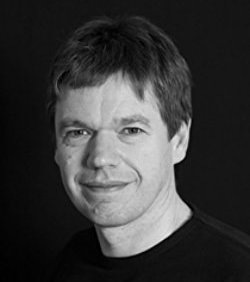 Mathematician, author and friend of the site Rob Eastaway has received the 2016 Christopher Zeeman medal, awarded to recognise and acknowledge the contributions of mathematicians involved in promoting mathematics to the public and engaging with the public in mathematics in the UK.
There will be an award lecture taking place on 22 March 2017, and details will be announced in Mathematics Today and the LMS Newsletter.
IMA website article on the award
Rob Eastaway’s citation (PDF)