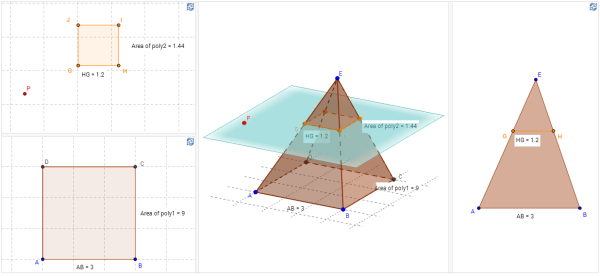
GeoGebra, the Aperiodical’s official Favourite Thing for Messing About With Geometry, has just bumped up to version 5. With that bigger number comes another dimension – GeoGebra now supports three-dimensional geometry!
You're reading: Posts Tagged: Geometry
Euclid’s Kiss: Geometric Sculpture of George Hart
George Hart is putting on a one-man show of his sculptures at Stony Brook University. He’s posted this video of him walking through the exhibition and describing the pieces on display.
[youtube url=https://www.youtube.com/watch?v=DI1612YhMqg]
George also gave a lecture to open the exhibition, which you can watch on the SCGP website.
Euclid’s Kiss: Geometric Sculpture of George Hart is on display at the Simons Center for Geometry and Physics during September and October.
More information: Euclid’s Kiss: Geometric Sculpture of George Hart
Ghost Diagrams
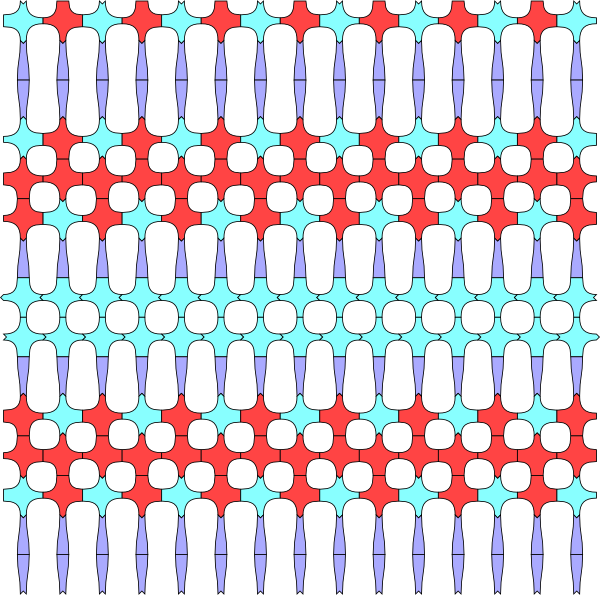
Yet another fun toy for you. Give a computer a set of tiles defined by what their edges look like, can you fit them together? That problem is undecidable, since you can encode Turing machines as sets of tiles, but it turns out it’s fun to watch a computer try.
Ghost Diagrams asks you for a set of tiles (or it’ll make some up if you didn’t bring one) and shows you its attempts to make them fit together. It’s very pretty, and quite mesmerising. Sometimes it looks even better when you turn on the “knotwork” option.
Paul Harrison created Ghost Diagrams while writing his PhD thesis, Image Texture Tools: Texture Synthesis, Texture Transfer, and Plausible Restoration. He’s written a short blog post about the program.
Here are a few patterns I liked: 1, 2, 3, 4, 5.
via John Baez on Google+.
A bit of midweek fun: ANCIENT GREEK GEOMETRY
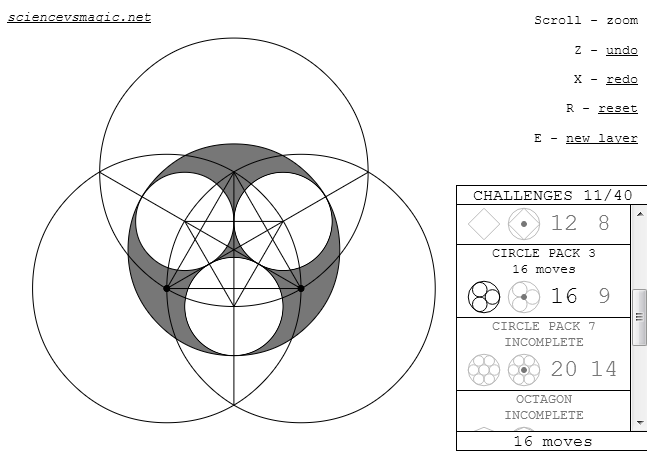
This is a fun game to while away the midweek blues. You’re presented with two dots. You can drag between dots to create lines and circles, as if you had a straightedge and compass. Apart from a few challenges to get you thinking, that’s pretty much it!
The game was created by Nico Disseldorp, who has a few more fun things on his website, Science vs Magic.
Play: ANCIENT GREEK GEOMETRY
Follow Friday, 29/03/13
It’s Friday again! And with a seamless unbroken chain of Follow Friday posts stretching backward through time with no discernible gap, here’s another post with some recommendations of people to follow on Twitter if you’re into maths.
Radii of polyhedra
(At last month’s big MathsJam conference, we asked a few people who gave particularly interesting talks if they’d like to write something for the site. A surprising number said yes. First to arrive in the submissions pile was this piece by Tom Button.)
The formula for the surface area of a sphere, $A=4\pi r^{2}$, is the derivative of the formula for the volume of a sphere: $V=\frac{4}{3}\pi r^{3}$.
This result does not hold for a cube with side length $a$ if the surface area and volume are written in terms of $a$. However, if the surface area and volume are written in terms of half the side length, $r=\frac{a}{2}$, you get the surface area $A=24 r^{2}$, which is the derivative of the volume, $V=8 r^{3}$.
Starburst by Tim Locke
Tim Locke displayed his geometric metalwork at the 2012 Bridges conference.
via Mr Honner