Here’s a short round-up of maths news from this month.
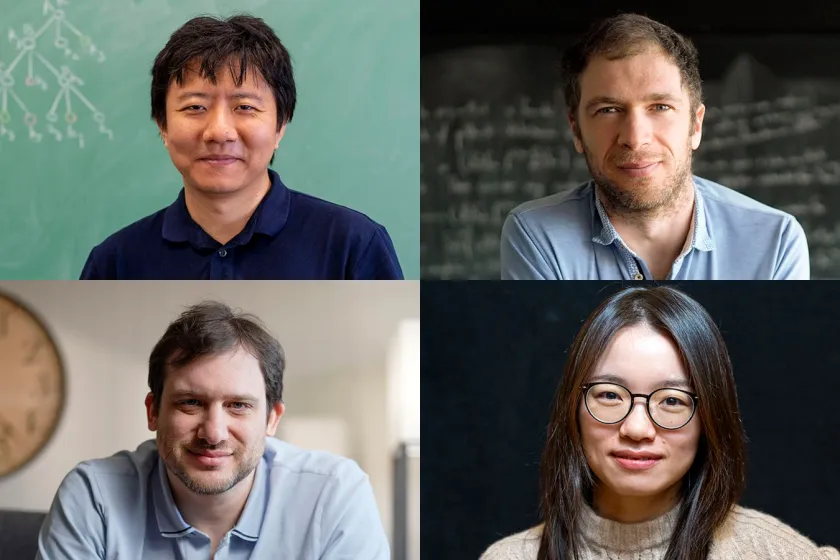
The 2026 Fields medals have been awarded to Yu Deng, John Pardon, Jacob Tsimerman and Hong Wang. The Fields Medal is awarded to recognize outstanding mathematical achievement for existing work and for the promise of future achievement, and this year’s winners work across PDEs, symplectic geometry, algebraic geometry, harmonic analysis and measure theory.
Hannah Fry has been awarded the IMU’s Leelavati prize for increasing public awareness of maths. “She has become a voice for mathematics that resonates far beyond the public audience normally interested in science communication. Through a wide range of media – including books, videos, and television programs – she has used outstanding creativity and originality to translate mathematics into a language of wonder and relevance for the public without diminishing its scope and importance.”
A result in braid theory has been proven by a team including Joan Birman, aged 99. The proof “reveals brand new insights into the geometry of braids” and closes the \(n=4\) case of the long-standing question of whether the Burau representation of the braid group is faithful. (via @gregegansf@mathstodon.xyz)
The theme selected for the 2027 International Day of Mathematics is ‘Mathematics, AI and Our Future’. “The theme explores the role of mathematics as the foundation of artificial intelligence and how mathematical ideas shape one of today’s most transformative technologies.”
Double Maths First Thing is somewhat ready to rock
Hello! My name is Colin and I am a mathematician on a mission to spread the joy and love in mathematics, the pleasure of puzzling things out and getting people to notice the sense of satisfaction that comes from everything clicking into place at once.
I’ve been in Peterborough for the weekend rocking out with the Pseudorandom Ensemble who, as hinted over the last few weeks, will be playing a rare show at MathsWorld on Monday September 21st. Tickets aren’t on sale at the time of writing, but I believe they will be soon – keep an eye on the events page, you (presumably) don’t want to miss out.
Links
Let’s start with another daily puzzle, sent to me by Gabriel Sobrino: a riddle of the day, which I’ve only had a glance at; I’m not a fan of the AI tutor thing, but the puzzle I saw was interesting enough. You might also enjoy Suat Ayöz‘s posting of the AMS Epsilon of Maths calendar.
I sometimes feel like Terry Tao does more things than a single person should be able to, and that I’m going to turn around and find him mowing my lawn with one hand, reading a textbook with another, and giving a cheery wave with another. This second, he’s announced that he’ll be an editor at a journal dedicated to maths research videos, Mathematical Discourse. Full announcement to follow, apparently. Also in superhumans news, Hannah Fry has been awarded the Leelavati prize for increasing public awareness of maths.
At MathsWorld, upcoming lates include June Barrow-Green on August 12th from 6:50pm UK time and – as I mentioned before, the best maths band you’re likely to see at MathsWorld this year.
The next Finite Group livestream is on Thursday August 13th at 6pm UK time, and Scroggs will be coding up solutions to Peter’s historical maths challenges.
That’s all I’ve got for this week. If you have friends and/or colleagues who would enjoy Double Maths First Thing, do send them the link to sign up – they’ll be very welcome here.
Meanwhile, if there’s something I should know about, you can find me on Mathstodon as @icecolbeveridge, or at my personal website. You can also just reply to this email if there’s something you want to tell me.
Hello! My name is Colin and I am a mathematician on a mission to spread joy and delight in playing with patterns, puzzles, figures and logic.
First up, an apology: in last week’s issue, I mistyped the number of solvable nonograms: rather than 25,000, there are 25,000,000. As of Tuesday evening, humanity has solved about 27% of them. Good work, fellow humans!
Links
One fellow human doing good nonogram work is Lucas Cimon, who has developed code to generate nonogram QR codes. He says it will likely be “difficult to solve manually”.
Since we’re looking at puzzles and logic, all-round good egg Tony Mann has pointed me at a remarkable 4-by-4 sudoku and Cracking the Cryptic’s solution video. Meanwhile, there’s a ferocious argument going on in the group chat about Zp-ordle, the daily puzzle game for people who think Wordle needs more p-adic integers. (Which is everyone, right?)
There’s one question on everyone’s lips: “Will Jesus Christ return in an election year?” Eric Neyman explains why the likelihood given on Polymarket is 3%, considerably higher than most analysts would predict.
And in mental arithmetic news, Niklas Oberhuber estimates some logarithms. (I particularly liked that 5^10 is about 9.8 million, which I’ll store in the Useful Approximations drawer of my brain.)
Currently
It’s mid-month, which means that your local MathsJam is coming up soon (Tuesday 17th in many locations, including Weymouth). Find yours here, or email Katie to find out how to start your own.
That’s all I’ve got for this week. If you have friends and/or colleagues who would enjoy Double Maths First Thing, do send them the link to sign up — they’ll be very welcome here.
Meanwhile, if there’s something I should know about, you can find me on Mathstodon as @icecolbeveridge, or at my personal website. You can also just reply to this email if there’s something you want to tell me.
Here’s a round-up of some news stories from the last two months of 2024, (mostly) not otherwise covered here on the Aperiodical.
Maths Research
At the start of December, John Carlos Baez shared on Mathstodon that the moving sofa problem may have been solved – the question of the largest possible shape you can fit around a 2D corner. For many years, a shape called Gerver’s sofa has been thought to be optimal, but an ArXiV paper from 29th November claims to have proved it is. More context in this blog post by Dan Romnik.
And depending on what you consider to be good news, Terry Tao has also announced the creation of Renaissance Philanthropy and XTX Markets’ AI for Math fund, supporting projects that apply AI and machine learning to mathematics, with a focus on automated theorem proving. The deadline for initial expressions of interest is Jan 10, 2025.
The other big news from last December was Hannah Fry’s appointment as Cambridge’s new Professor of the Public Understanding of Mathematics. She joined the Department of Applied Mathematics and Theoretical Physics (DAMTP) on 1st January, and the role will involve communicating to diverse audiences, including with people not previously interested in maths. Fry follows in the footsteps of the late John Barrow, who informally took on the same role for much of his distinguished career.
“Communication is not an optional extra: if you are creating something that is used by, or interacts with members of the public or the world in general, then I think it’s genuinely your moral duty to engage the people affected by it. I’d love to build and grow a community around excellence in mathematical communication at Cambridge – so that we’re really researching the best possible methods to communicate with people.”
– Hannah Fry
Other news
From now until 11th February, Young Researcher applications for the Heidelberg Laureate Forum 2025 are open to any undergraduate/pre-master, PhD or PostDoc researchers who would like to join the highest level of mathematical laureates alongside hundreds of other researchers in maths and computer science for a week of talks, workshops and networking in the beautiful city of Heidelberg in September.
Here’s a roundup of news stories from December 2021 that we didn’t cover at the time.
Maths results
Firstly, some nice news of a proof of a result on the density of unit fractions – a set of integers of positive density must contain distinct $n_1,\dots,n_k$ such that $\frac{1}{n_1}+\ldots+\frac{1}{n_k}=1$. (via Thomas Bloom)
According to this post on Gil Kalai’s blog, Ringel’s circle problem has been solved. The problem states:
Consider a finite family of circles such that every point in the plane is included in at most two circles. What is the minimum number of colors needed to color the circles so that tangent circles are colored with different colors?
Turns out, you might need all the colours – the authors of a new ArXiV paper have found ways to construct families of circles in the plane such that their tangency graphs have arbitrarily large girth and chromatic number.
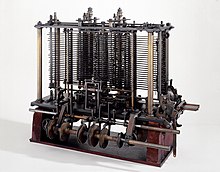
A portion of the analytical engine built by Charles Babbage, at the Science Museum Photo: CC BY-SA Mrjohncummings
We have for the first time both an aerial view that integrates partial and seemingly unrelated developments, as well as the most detailed analysis yet of the specifics of implementation.
The group are hoping to be able to rewrite these notes into a format that can be used to build a physical implementation of the machine, as Babbage’s original notes didn’t include a design for a complete engine, and the work so far has taken five years. This is exactly the kind of unnecessary nerdery I love to see.
Prizes
Per Nalini Joshi on Twitter, Serena Dipierro has been awarded the Australian Mathematics Society medal for 2021, which is given within 15 years of the award of someone’s PhD for distinguished research in the mathematical sciences. According to the AustMS citation,
Professor Serena Dipierro (University of Western Australia) has made outstanding contributions to the area of analysis and PDEs, with a special focus on the theory of nonlocal operators and free boundary problems. She is a prolific researcher with a large international network of collaborators and has become one of the leaders of her field. In the nine years since the award of her PhD, her publications have amassed over 1100 citations in the MathSciNet database; since moving to Australia in 2016 she has averaged one publication per month, including many in journals of the highest quality.
According to a blog post by Gil Kalai, Richard Stanley has won the Leroy P. Steele prize, awarded annually by the AMS for distinguished research work and writing in mathematics. According to the announcement,
Stanley has revolutionized enumerative combinatorics, revealing deep connections with other branches of mathematics, such as commutative algebra, topology, algebraic geometry, probability, convex geometry, and representation theory. In doing so, he solved important longstanding combinatorial problems, often reinvigorating these other fields with new combinatorial methods. Through his outstanding research; excellent expository works; and many PhD students, collaborators and colleagues, he continues to influence the field of combinatorics worldwide.
Jacques Tits was a highly influential group-theorist, proving the celebrated “Tits Alternative” (that every finitely generated linear group either has a solvable subgroup of finite index or contains a free subgroup of rank 2). Probably his most important contribution was the development of group-theoretic “Buildings”, a profound unifying idea which has subsequently had deep applications in diverse mathematical fields.
Following the publication of a fairly painful article in The Times just before Christmas entitled ‘Phwoar! Look at the vital statistics on these lads’ and listing the apparently increasingly attractive, and exclusively male, mathematicians and statisticians responsible for ‘crunching the data’ on the pandemic, the i newspaper published this excellent response pointing out the shocking news that some mathematicians who aren’t men have also been involved, and highlighting some of the top data experts who’ve been looking after us all with maths. The Times article includes a quote from “maths professor and author Hannah Fry — a woman” (that is literally actually what it says) who had correctly expressed on Twitter that mathematicians are hot – but I’m pretty sure she meant all of us and not just men.
Speaking of bad opinion pieces, what better way to sum up the year than this collection of terrible maths takes? Highlights include ‘How does misogyny impede a mathematician of doing a good job?’ [sic] and the wonderful ‘Physics is not math.’
The American Mathematical Society has cancelled this year’s Joint Mathematics Meetings, scheduled to take place in Seattle on 5-8 Jan, and will be refunding tickets and organising an online event instead. Unfortunately, they initially failed to notify attendees of this by email, and many found out via Twitter.
Dynamic geometry powerhouse Geogebra has been bought by an online tutoring company called BYJU’S, run by a group of former maths teachers from India. They’ve stated that all current employees, contracts, agreements and software licenses will remain in place, and the software and online resources will continue to be free to use. (via Geogebra on twitter)
PROMYS Europe is a programme designed to encourage mathematically ambitious secondary school students to explore the creative world of mathematics. Competitively selected pre-university students from around Europe gather at Wadham College, Oxford for six weeks of rigorous mathematical activity. This summer it will run from 10th July – 20th August, and applications open on 11th January.
Gathering 4 Gardner’s 2022 Wall Calendar is now available to download and print, and some print copies are also available. Including important dates of huge mathematical significance (my birthday, among others) and a selection of bios, sketches, photos and puzzles any maths fan would enjoy, it’s the perfect solution if you forgot to get a calendar and like maths.
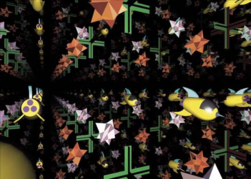
The Geometry Center videos, which brought brought concepts from geometric topology to general audiences through computer-generated visualisation in the early 1990s, have been remastered and are available for free. (via Robin Houston)
If you spot something you think should be in a future Aperiodical News Roundup, send it our way!