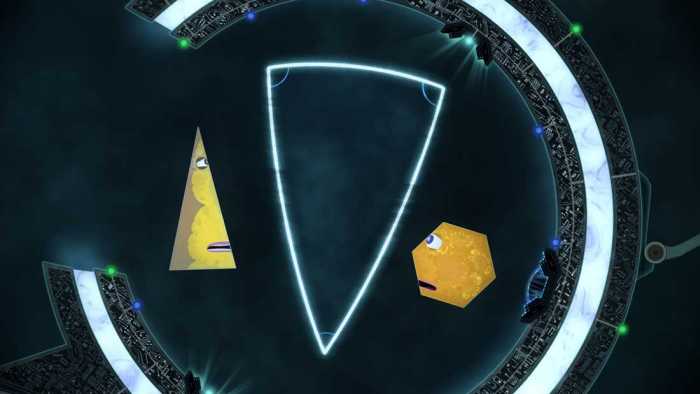
Sphereland, a follow-up to the the animated adaptation of the classic hit-literature-with-a-maths-hammer book Flatland, is to be shown at MAA MathFest in Madison, WI.
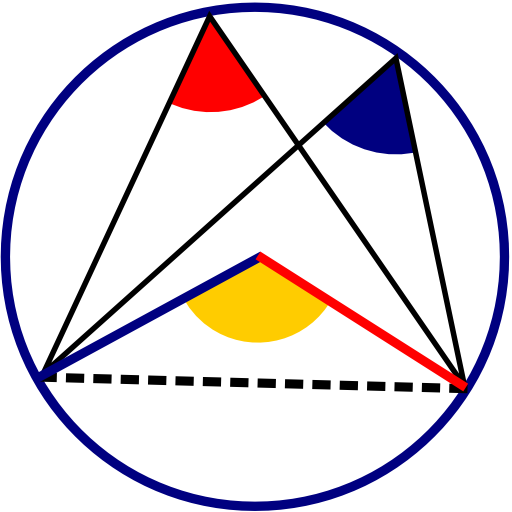
Sphereland, a follow-up to the the animated adaptation of the classic hit-literature-with-a-maths-hammer book Flatland, is to be shown at MAA MathFest in Madison, WI.

A figure 8 knot, a Temari ball with cuboctahedral symmetry and a Klein bottle in the MAA's mathematical petting zoo
The MAA recently displayed a mathematical petting zoo at the USA Science & Engineering Festival, along with a slideshow of pictures from their MAA Found Math collection.
The page about the event doesn’t have any pictures on it but it does have lots of links to the artists and their portfolios. The usual suspects are represented — non-orientable manifolds and polyhedra are in abundance — but there are a couple of unfamiliar objects, and they’re all pleasing to look at and think about.
(via MAA Found Math on Flickr)
Here is a clever display of the prime factorisation of the numbers 1-200 on a sweater, from knitter Sondra Eklund.
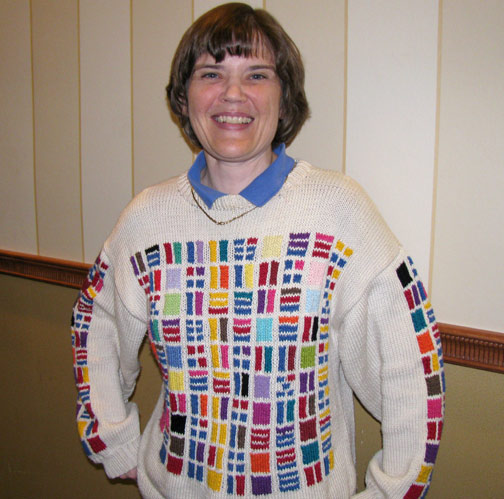
Each prime is represented (as a square) by its own colour, and luckily there’s an infinite number of both. Composites are represented by squares composed of collections of smaller squares or rectangles of appropriate colours.
She has arranged the natural numbers in columns of width ten. Interesting geometric and visual patterns emerge, and on the other side she’s knitted a version with eight to a column, which makes it easier to work in Octal.
As Sondra says, “One of the cool things about this sweater is that it works in any language and on any planet!!!”
Thanks to Ivars Peterson (on Twitter at @mathtourist) for the pointer.
The Telegraph numeracy campaign has a review of Intersections, an exhibition available at The Mathematics Gallery at the Science Museum and at the Royal Society from 5 April to 20 June 2012, which “throws new light on the often overlooked common ground of art and maths”.
The article writes about Henry Moore, who drew inspiration from the Mathematics Gallery at the Science Museum while a student at the Royal College of Art in the 1920s.
What particularly fired Moore’s artistic imagination in this gallery was the collection of 19th-century “ruled surface models” – a rather opaque name for what are arrangements of strings, pulled taut between either wood or metal plates, which can then be adjusted to create complex three-dimensional shapes with exotic names like conoid, ellipsoid and cylindroid. They were built – primarily in a workshop in Munich – in an effort to make real for students of pure mathematics, as well as trainee engineers and architects, geometric forms that could otherwise only be expressed in abstract equations.