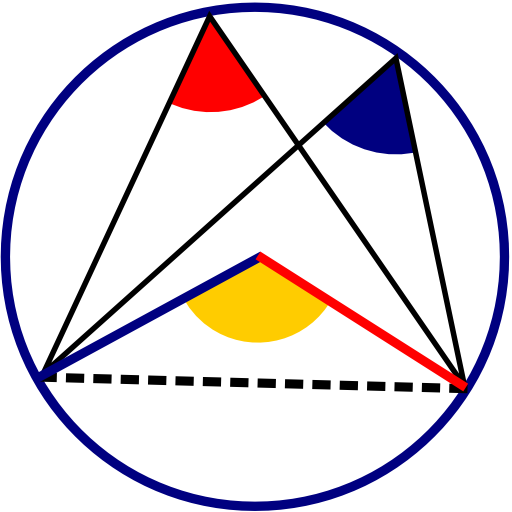
I’d like to cut a rectangle into a 3×4 grid of squares. To minimise the number of cuts, should I cut three long strips first, or four short strips? Does it matter?
You're reading: Posts Tagged: MathsJam
- Miles Gould has pointed me at the Capstan Equation, not to be confused with Captain Caveman. Wrapping a line around a cylinder makes it possible to hold much heavier loads than one would naively expect.
- Devine Lu Linvega has a zine about rewriting rules, which appeals to me.
- The train wifi is unable to allow me to watch Sophie Maclean talk about voting paradoxes on Numberphile, much as I would love to.
- The Finite Group’s birthday livestream included Peter Rowlett talking about Carnelli, a game which involves running film titles together — the canonical example is The Empire Strikes Back To The Future. I’m enjoying subverting it (Run Lola Run Lola Run, or On the Waterfronthe Waterfront, or somehow making Zero Dark Thirty and 300 into a loop). What interesting things can you do with it?
- There is a lot of discussion currently about the number of holes in a straw (which is obviously and unambiguously one). If you join the ends together to make a loop, how many holes are there now? If you sew up the top of a sock, how many holes does that contain?
- Tim Harford’s Cautionary Tales
- Bec Hill and Matt Parker’s A Problem Squared
- Evelyn J Lamb and Kevin Knudson’s My Favorite Theorem
- Katie Steckles and Peter Rowlett’s Mathematical Objects — I understand that series 8 is imminent.
Double Maths First Thing: Issue A
Double Maths First Thing is where there area 10 kinds of people: those who understand hexadecimal, and F others.
Hello! My name is Colin and I am a mathematician on a mission to share joy and delight in maths, beyond and instead of the test. Around here, we count in hexadecimal.
My big news!

This is not remotely maths-related, but we’ve just been adopted by a Patterdale terrier called Slap-Dash Pete. He’s slipped straight into the family as if he’s always been here. You definitely need a picture.
Also not-maths-related, I finished third in my Toastmasters area humorous speaking contest. I spoke about the process of figuring out I’m autistic and how that relates to being a mathematician. I thought it was a good talk, but it wasn’t the best on the day.
Maths events and news!
It is currently Maths Week England, an event aiming to help people realise that maths is for everyone and not only for genius. See what’s going on near you!
Much less joyfully, it seems that Ada Lovelace Day Live will no longer be happening. It’s galling that tech giants can’t (or rather, won’t) find a few quid down the back of a beanbag to help make sure there’s space at the table for everyone. The organisation lives on, and the day celebrating women in science lives on, but it’s sad that the flagship event has to stop.
Dates of local MathsJams are all over the place this month. Some have moved to yesterday in support of MWE, but others — including Weymouth — are sticking to the traditional penultimate Tuesday date. Find your local ‘Jam here — if there isn’t one near you, there are instructions on how to start one; alternatively, you may prefer to join in the Online MathsJam that’s usually on the antepenultimate Tuesday. Because of course it is. You just missed it. Sorry.
Links!
There’s an interesting discussion on Reddit decrying the state of maths games in general.
Some maths games that very much don’t suck are those created by the legendary Simon Tatham, which have stolen about as much of my work time as Tetris and Slay The Spire. Simon posted on Mathstodon about the ZX Spectrum BASIC manual. For geeks my age (and probably a little older), this is one of the 1980s’ most significant works of literature, the book that taught me how to program (and to develop bad habits that would take years to unlearn.)
(Incidentally, Mathstodon is an excellent community of maths people, and far less shouty than the Other Place. I’ve heard good things about Bluesky, also; I gather it’s possible to bridge between the two, but don’t ask me what that means. I’m already in too deep.)
Another legend, Rob Eastaway, is making a rare screen appearance in a Numberphile video about Philip Henslowe’s diary and the shift from Roman numerals to Arabic.
A third and final legend for this week: Tanya Khovanova is making foams out of felt. A foam is a mathematical object rather than something to make safety equipment out of, it transpires.
That’s all for this week! In the meantime, if you have friends and/or colleagues who would enjoy Double Maths First Thing, do send them the link to sign up — they’ll be very welcome here.
If you’ve missed the previous issues of DMFT or — somehow — this one, you can find the archive courtesy of my dear friends at the Aperiodical.
That’s all for this week! If there’s something I should know about, you can find me on Mathstodon as @icecolbeveridge, or at my personal website. You can also just reply to this email if there’s something I should be aware of.
Until next time,
C
Double Maths First Thing: Issue 8
Double Maths First Thing is Colin’s refuge from the kids’ obsession with Odd Squad.
Hello, and welcome to Double Maths First Thing! My name is Colin and I am a mathematician on a mission to spread joy and delight in my subject.
It’s half-term week, so this is necessarily rushed, brief, and poorly formatted — but it’s Big MathsJam at the weekend, so I expect to more than make up for the brevity next week.
On my list of things to contemplate on the long journey northwards:
If you’re going to be at Big MathsJam, I hope I’ll see you there! I’ll be talking about HyperRogue, but you risk accidental spoilers if you click through.
In the meantime, if you have friends and/or colleagues who would enjoy Double Maths First Thing, do send them the link to sign up — they’ll be very welcome here.
If you’ve missed the previous issues of DMFT or — somehow — this one, you can find the archive courtesy of my dear friends at the Aperiodical.
That’s all for this week! If there’s something I should know about, you can find me on Mathstodon as @icecolbeveridge, or at my personal website. You can also just reply to this email if there’s something I should be aware of.
Until next time,
C
Double Maths First Thing: Issue 6
Double Maths First Thing is to maths news what the noticeboard outside the coffee shop is to theorems
Hello! My name is Colin and I am a mathematician on a mission to spread delight and joy while making people think.
More from me!
I almost forgot (so strongly do I dislike the academic publishing process) that I had a paper published recently about Heron’s formula. One of the reasons I dislike it is that T&F want to charge you £45 of those sterling pounds to read a four-page paper, which is patently ridiculous. I can send you a copy if you want one. You definitely shouldn’t paste the DOI reference, 10.1080/0025570X.2024.2376510, into SciHub, or else the whole publishing system might collapse! (In fact, you can read the proof and the story behind it here).
I’ve also done my stint volunteering for Dorset Coding Day at a couple of local schools. The best questions I was asked were “how many pages were in your books?” and “what’s your favourite Netflix movie?”. Not a single more-of-a-comment, ten-year-olds are brilliant.
And in an email that made me grin from ear, a Tudor living historian emailed me to say he’d read my piece about Henslowe’s trick and is now performing it at events. How amazing is that?
Links from everywhere!
Sometimes, people use the word “intuitive” for something that doesn’t line up with my intuition at all — but that’s ok, it’s good to see how other people’s minds work. For example, Gregory Gundersen’s piece on the Black-Scholes equation doesn’t match with how I’d explain it, but it’s still a lovely piece!
I haven’t yet got around to reading this article on the Kelly Criterion, but it’s a topic that always makes me prick up my ears. From my recollection, it turns out that “maximising expected returns” means roughly “small chance of an enormous jackpot, otherwise ruin”, but it’s a fascinating thing to play with.
Another item on my to-read list is this guide to transforming colours with matrices. This feels all sorts of wrong, but at first glance, it seems to work nicely!
Lastly, from memory lane, one of my favourite pieces of mathematical writing: Tim Gowers on deducing the cubic formula. A Fields Medallist explaining how to think about something? Clearly and lucidly? Sign me right up.
I’m also midway through Grant Sanderson explaining Manim to Ben Sparks and now I want to make videos just so I have an excuse to play with it.
Community!
In a move closely aligned with my key themes, the Finite Group have opened up their Discord to free-tier members. Among other things, it’s a great source of memes and somewhere you can suffer an endless stream of bad jokes, not all of which are from me. (The amazing live-streams — the next of which is on Wednesday 23rd October at 2pm UK time — are paid content, and worth every penny.)
Gathering4Gardner, best-known for their biennial gatherings that inspired Big MathsJam, but who do all sorts of amazing work, have a fundraising auction starting next week. I refuse to look at it because I have to dispose my income on fixing my laptop, but there might be something there that tickles your fancy!
Speaking of Big MathsJam, Tuesday coming is Little MathsJam Day — find your local Jam here or, failing that, start your own! It’s simple enough that I can do it. Instructions are on that page.
In the meantime, if you have friends and/or colleagues who would enjoy Double Maths First Thing, do send them the link to sign up — they’ll be very welcome here.
If you’ve missed the previous issues of DMFT or — somehow — this one, you can find the archive courtesy of my dear friends at the Aperiodical.
That’s all for this week! If there’s something I should know about, you can find me on Mathstodon as @icecolbeveridge, or at my personal website. You can also just reply to this email if there’s something I should be aware of.
Until next time,
C
Double Maths First Thing: Issue 4
Double Maths First Thing is Colin’s weekly news bulletin. Although it’s more like a nerfpelletin, honestly.
Hello! My name is Colin and I am a mathematician on a mission to help everyone find the joy and delight in figuring things out.
Art!
Up in that London they have these days, the Piccadilly Circus ad boards are being taken over by Olafur Eliasson. While this doesn’t look especially mathematical, a lot of Eliasson’s work is gorgeously so.
I took the kids to a science fair recently, and they tried their hand at marbling with actual paint… and wet paper, which ripped before we’d left the venue. Fortunately, I was reminded that it’s possible to do marbling mathematically. And it’s invertible, so you can recover your original image!
Speaking of inverses, that’s today’s Mathober prompt! FractalKitty is running it again; it’s a prompt-a-day, make-what-you-like challenge. (Personally, I’m trying to write a song verse every day; I know Katie is trying to write a daily crossword clue. The possibilities are endless.)
Computing!
Following on from the “computers are magic” thing last week, I’ve stumbled on, but not checked out, Arithmazium, which seems to be an explanation of how computers deal with numbers. Or, from a brief glance, doughnuts.
Shapes!
Once upon a time, I wrote about Ailles’ Rectangle — if you inexplicably prefer Wikipedia to my blog, here’s your link. It’s a really neat way to figure out the trig values for 15-75-90 degree triangles, and — if you play about with it a bit, to prove all sorts of identities.
Dave Richeson spotted a naughty cartoon in the New Yorker — not seaside-postcard naughty, more British road-sign naughty.
Obsessions!
The Mathematical Objects podcast is off to a flier in Season 8, chatting with Adam Townsend about possibly the greatest MathsJam talk ever.
There is one that rivals it for commitment to the bit: Ben Ashforth’s calendar odyssey.
I’ll be speaking at this year’s Big MathsJam, but I promise I will not be visiting every cell on the border of Camelot. It’s barely a month away. Eek!
In the meantime, if you have friends and/or colleagues who would enjoy Double Maths First Thing, do send them the link to sign up — they’ll be very welcome here.
If you’ve missed the previous issues of DMFT or — somehow — this one, you can find the archive right here at the Aperiodical.
That’s all for this week! If there’s something I should know about, you can find me on Mathstodon as @icecolbeveridge, or at my personal website. You can also just reply to this email if there’s something I should be aware of.
Until next time,
C
Double Maths First Thing: Issue 1
Double Maths First Thing is Colin’s weekly news summary. Or autumnal, if you’re reading this after the equinox. You can sign up to receive it in your inbox on a Wednesday morning here.
Hello! My name is Colin and I am a mathematician. It’s Wednesday morning, and it’s Double Maths First Thing.
Shape-ology
Over on the Talking Maths In Public WhatsApp group, we’ve been looking at collapsible polyhedra, which Barney Maunder-Taylor calls Flatonic Solids. He’s not the only one, though: here’s a satisfying Instagram reel and an article by Liz Meenan in case you want to make your own.
It also reminded me that you can do cool things with pop-ups, whether or not you have the book.
Speaking of books
Tom Briggs has been compiling suggestions of maths books that aren’t about teaching. I’m given to believe he might be making his own addition to the list in due course.
Peter Rowlett and his son have been reading Gulliver’s Travels, and found an interesting early description of something computery. A biased generator of randomness that produces plausible English? I bet the venture capitalists would be all over that.
Sudoku
I recently had cause to revisit the Miracle Sudoku video — memorably described at the time by Ben Orlin:
You’re about to spend the next 25 minutes watching a guy solve a sudoku.
Not only that, but it’s going to be the highlight of your day.
The highlight of my day recently was coming across Phistomephel’s ring, which is a neat consequence of standard sudoku rules.
Tony Mann pointed me at another Cracking the Cryptic video with the same energy — the frustrations and feelings of stupidity that come with not having the answer yet, followed by the sheer joy of having worked out something clever.
Another (and significantly shorter) video plausibly worth your time is Alyssa Williams and Christian Scott at G4G discussing how to set variant sudoku.
Joy in maths
Back to taking pleasure in maths, here’s a short interview with Talithia Williams, PhD: I loved the bit about maths appreciation, and trying to change the mindset that maths is about doing calculations to pass a test.
Another article that caught my eye this week was about climbing. Or rather, spotting an error on the climbing wall and getting it fixed. It’s interesting for several reasons, but what grabbed my attention was what I think of as x-ray vision: the power to see that something looks off, and the insistence that it be put right. That strikes me as a very mathematical thing. (And, speaking for myself, possibly an autistic thing. Drives me MAD when people don’t care about breaking the rules, I tell you.)
For your listening pleasure
This week, I have mostly been listening to:
I’ve not yet picked up the TMiP podcast, but we all should. And Sam Hansen would give me endless, deserved grief if I didn’t mention Relatively Prime.
The week ahead
Thanks to September ending on a Monday, the monthly MathsJam meet-up is coming around distressingly quickly — those that meet on the traditional penultimate Tuesday will do so on September 17th. You can find your local MathsJam here — I’ll be at the Weymouth one.
Also, if you’re planning to go to Big MathsJam in November, early-bird pricing ends on Sunday.
There’s a Finite Group livestream on Friday, September 13th at 9pm BST — Katie and Ayliean are putting the ‘fun’ into ‘fundamental theorems’, it says here.
That’s all for this week! If there’s something I should know about, you can find me on Mathstodon as @icecolbeveridge, or at my personal website.
Until next time,
C
The Double Back puzzle is a nice mix of Towers of Hanoi and Solitaire
This post is both a video and text. The content is largely the same in both versions, so you can pick one to look at.
I’d like to show you a puzzle, or game for one person, that Ed Kirkby came up with. Ed showed this to me at the Big MathsJam gathering last year.
I was walking around MathsJam and people were doing all sorts of stuff and Ed was quietly sat at a table with some cards in front of them, and a couple of people were gathered around with thoughtful faces, so I thought “oh that looks interesting” and I walked over and Ed explained the rules of this game to me.
And like most things at MathsJam, I didn’t immediately know the solution but it really got to me, so I went away and tried to find a solution myself. It was really fun and it was one of those pure experiences of mathematical discovery that you really remember.
I kept grabbing other people and saying, “have you seen Ed’s puzzle? Come over here. Ed, explain this puzzle to this person!” I did that for the duration of the weekend, and for a little while after I got back home.
I’ll show you what the puzzle is.
Take two sets of cards numbered 1 to 4, and lay them out in two rows. The game is to get them the other way round, so each row goes 4, 3, 2, 1.
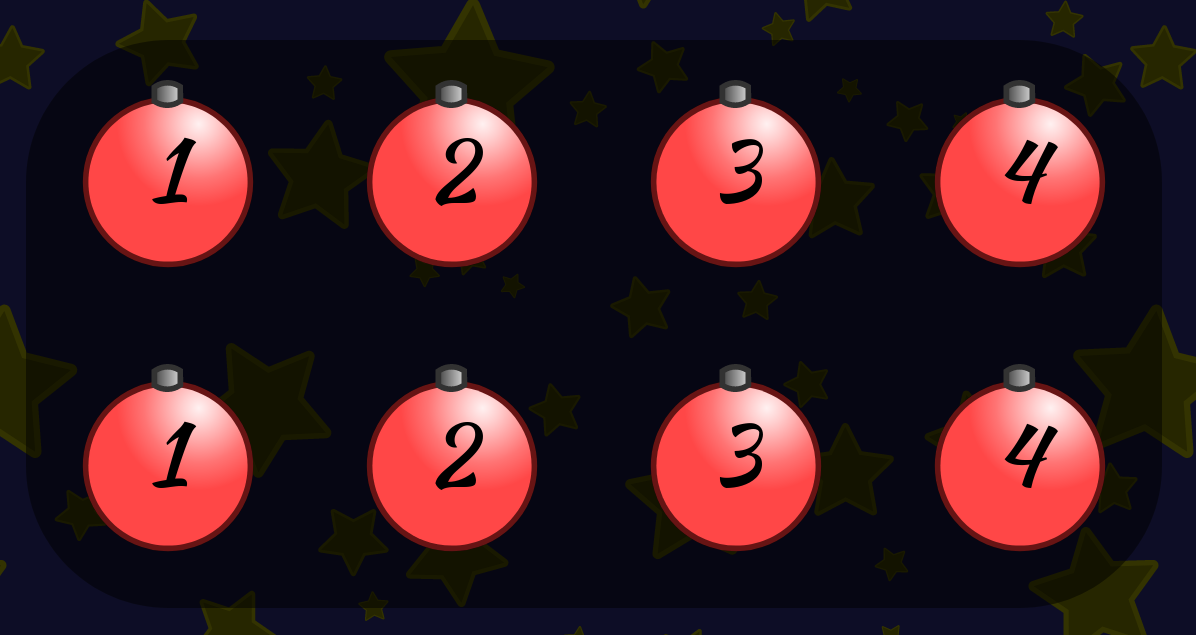
The things you are allowed to do are to swap two cards that are adjacent numbers and in adjacent columns.
So you can swap the four and three here:
You can also swap to the other row.
You can’t swap the four and the two here because they’re not adjacent numbers.
It’s a permutations puzzle. And with a bit of thinking, a lot of just making random moves, eventually I worked out how to do it for four cards (or two lots of four cards, to be precise).
It took me a few more goes to be sure that I’d found the shortest solution — the fewest moves — but then five really stumped me.
When I tried six cards, I wasn’t sure it was possible at all: there was a point where I kept getting stuck.
So I was really unsure, and Ed was unsure as well – they didn’t know if there was a solution for every number of cards. They’d written some code that very slowly churned out solutions for small $n$, but didn’t have a general solution.
So I did my usual problem solving technique which was, if I couldn’t do it with four cards, do it with three cards, and very briefly with two cards. Then after a while I sort of started seeing a pattern.
I came away from Big MathsJam not knowing how to solve this puzzle.
I kept playing with it when I should have been working, and eventually I think I’ve sort of got the vibe of how it works and I’m pretty sure now I can solve it for any number of cards. I haven’t written down a really rigorous algorithm for doing it but I’ve got a general idea.
Interactive version
Something that often happened when I was playing with cards was that I’d forget which way I was going, because when you don’t have a strategy you’re sort of making lots of moves to see where they’ll go, and then maybe you want to backtrack a bit, and you go like wait wait — which end did the aces start at? You’re continually picking up cards and moving them, and if you’re as clumsy as I am they scatter all over the place and you end up unsure if you’re in a valid state.
So it won’t surprise you to learn that I made an online version of this.
Big MathsJam happens in November, and by the time I’d got this online version working it was getting close to Christmas and I thought, “we need something that’s not playing cards to be the pieces – why shouldn’t it be baubles? They’re circles, they’re easy to draw.”
So I spent some time drawing a bauble image and making it look Christmassy. I didn’t quite get it ready for last Christmas, so I spent some more time improving the interface and I made it fully keyboard accessible.
And then I made a note to write a post about it in December 2023. And here we are!
I think this is a nice Christmas puzzle: I think the set-up and the rules are easy to remember, and it only needs a pack of cards, which you’ll probably have lying around.
So over Christmas, if there’s a quiet moment, if you get some playing cards in your Christmas cracker or just some pieces that you can put in an easy to identify order, try showing this to someone.
So there you go, that’s the Double Back puzzle, invented by Ed Kirkby, online version made by me.