Here’s a round-up of all the mathematical news from the last couple of months we didn’t otherwise cover here.
You're reading: Posts Tagged: Pi Day
- Maths learning organisation (and Carnival of Mathematics stalwarts) Ganit Charcha are running a competition for schools in India, challenging them to ‘Doodle for π‘ – students should take inspiration from a mathematical concept, and create a doodle/image to submit. The competition invites creativity and imagination, and runs until 12th March.
- If you’re not in India, you can still use π as inspiration for artworks – Think Maths speaker and Aperiodical Math-off contestant Zoe Griffiths has put together a set of ideas for how to use π to create beautiful pictures, to decorate your home, school or office.
Double Maths First Thing: Issue 1B
Double Maths First Thing thinks ISO8601’s great
Hello! My name is Colin and I am a mathematician on a mission to spread mathematical joy — I almost misspelt “mathematical” as “mayhem”, so let’s have a bit of that, too.
I spent much of the weekend with a secret cabal of mathematical musicians at an undisclosed location. I’m not authorised to say whether we were rehearsing original maths songs and I certainly couldn’t comment on rumours of a future gig on the roof of the RI. By which I mean, you’ll likely hear more details in the future.
Links
What’s been on my radar this week? Well, r/math has been surprisingly interesting, with a dissection of a square into 32 similar triangles and a nice pandigital approximation for e.
It was pointed out to me that I didn’t say what I was trying to solve blindfold last week. To clarify, I’ve been learning the M2 method for solving the Rubik’s Cube. If you were a computer, you might prefer a more brute force method.
When I was about 8, I got into trouble at school for saying “DAMN!” when my Polydron dodecahedron collapsed. If you want to have the same experience of frustration, you can get a 10% discount over the next few months. (That’s not an affiliate link, we don’t roll that way around here.)
A way we do roll is to stand up and say “oi! no!” to bullies. I’m conscious that I have pretty close to a full bingo card of privilege, and that a lot of the toxic behaviour in academia flies beyond my radar. Dr Rachel Los’s Anti-Acknowledgements (p113), (or more conveniently, in a toot) in her thesis (brilliantly titled “Play Nice or Pay the Price”) make me sigh in despair; men need to stop behaving like this, and the “not all men” men need to call out this sort of behaviour.
Currently
Less upsettingly, there’s a lot going on at the moment! This week has Pi Day, about which I am largely curmudgeonly, but some people erroneously believe it’s more Geek Christmas than Big MathsJam is. Whatever, you do you!
Tuesday coming (March 18th, 2025) is the traditional time for your local MathsJam — find your nearest one here, along with instructions on how to start your own if the nearest one is inconvenient. There’s also an online (UK) one if that’s better for you.
And on Monday coming (March 17th), there’s a Finite Group livestream. The FG Discord is a great hangout for mathematicians, and I always enjoy watching the livestreams with my 11yo.
Last week, I neglected to mention that TMiP is organising an Animation Generation Collaboration — a challenge to see what people come up with, and to share techniques.
That’s all I’ve got for this week. If you have friends and/or colleagues who would enjoy Double Maths First Thing, do send them the link to sign up — they’ll be very welcome here.
If you’ve missed the previous issues of DMFT or — somehow — this one, you can find the archive courtesy of my dear friends at the Aperiodical.
Meanwhile, if there’s something I should know about, you can find me on Mathstodon as @icecolbeveridge, or at my personal website. You can also just reply to this email if there’s something you want to tell me.
Until next time,
C
Aperiodical News Roundup – July 2023
Here’s some mathematical news that didn’t make it on to the site otherwise this month.
Maths News
There’s been more abc conjecture drama: Peter Scholze and Jakob Stix are in line for a ¥140m (around £766k) prize for their paper pointing out the flaw in Mochizuki’s claimed abc proof – if they publish it in a journal.
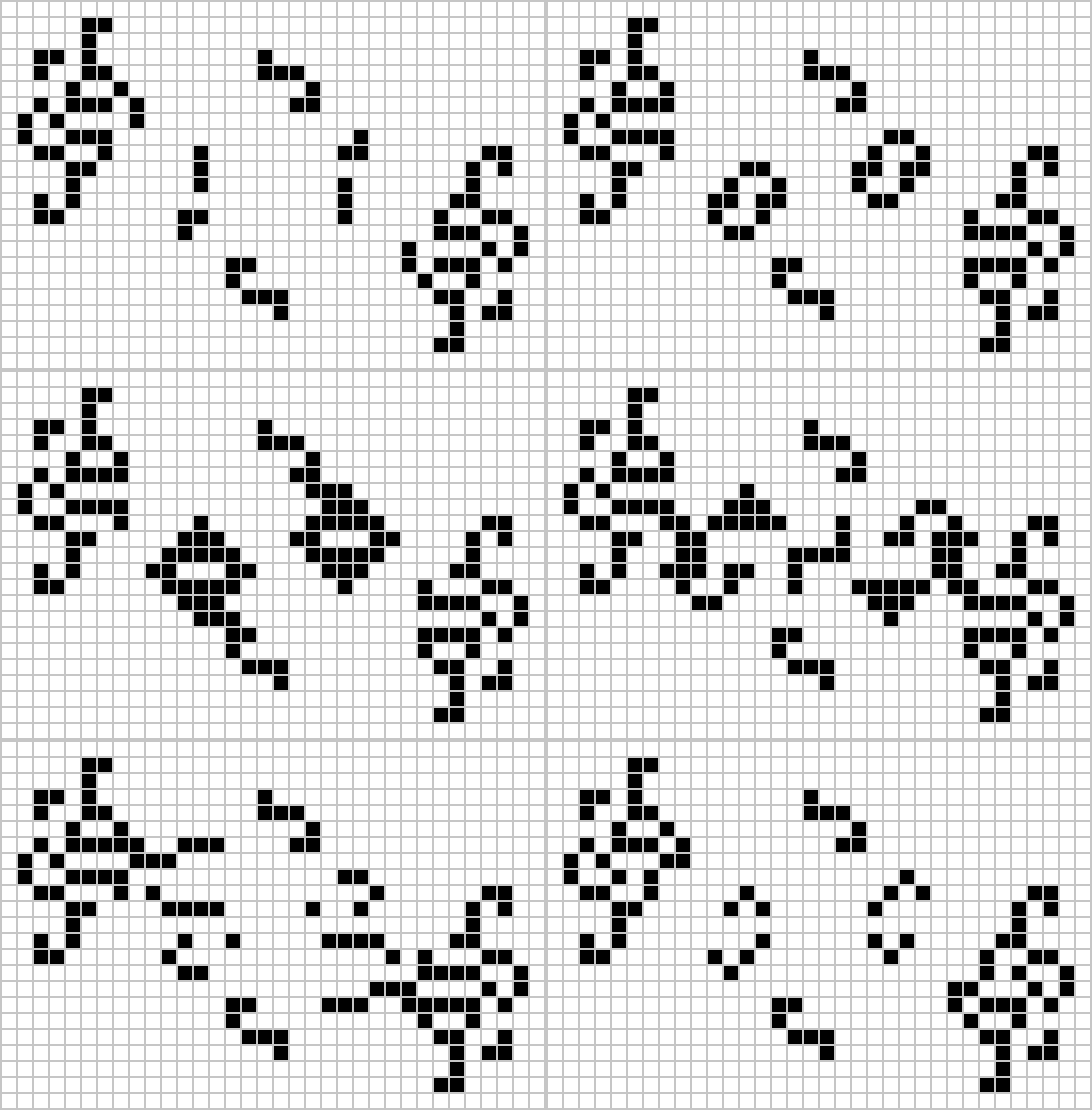
A period 19 oscillator has been found in Conway’s game of life – the discussion thread on ConwayLife just gives it as a series of coordinates, but it already has an entry on LifeWiki, where it’s called ‘Cribbage’. (via Isaac Grosof)
Then, a week later, the first ever period 41 oscillator was also found! Excitingly named 204P41 (consisting of 204 cells) it’s led to another discovery – it looks like we now know how to make oscillators with any period, meaning Game of Life is omniperiodic. Since 2013 we’ve known all periods above 43 were possible, and this fills a gap in this excellent table.
Lean’s mathlib has been completely ported to Lean4 – if you’re familiar with proof assistants, you may find this news exciting or significant. Here’s a video showing off what that looks like. Meanwhile, the Lean Focused Research Organization has been set up to “advance the formal mathematics revolution”. (via @leanprover@functional.cafe)
Events and Organisations
Inclusion/Exclusion, a justice and maths blog, has posted an open letter to the MAA about holding MathFest in Florida, requesting an option for online participation due to the state’s recent draconian law changes. It pulls ε punches:
Regardless of any in-person safeguards that MAA may put in place, this year’s MathFest will not be a safe event for trans people, for undocumented immigrants, or for many other members of our community, including disabled people. Therefore, our most urgent request is that you provide an online participation option.
Excerpt from the open letter
If π approximation day on 22/7 got you thinking about your plans for the next actual π day, you might find it useful to know that the International Day of Mathematics 2024 theme is Playing With Math. From their website, “In 2024 we want to celebrate mathematical games, puzzles and other entertaining activities, but also “playing” with mathematics itself, exploring, experimenting, and discovering.”
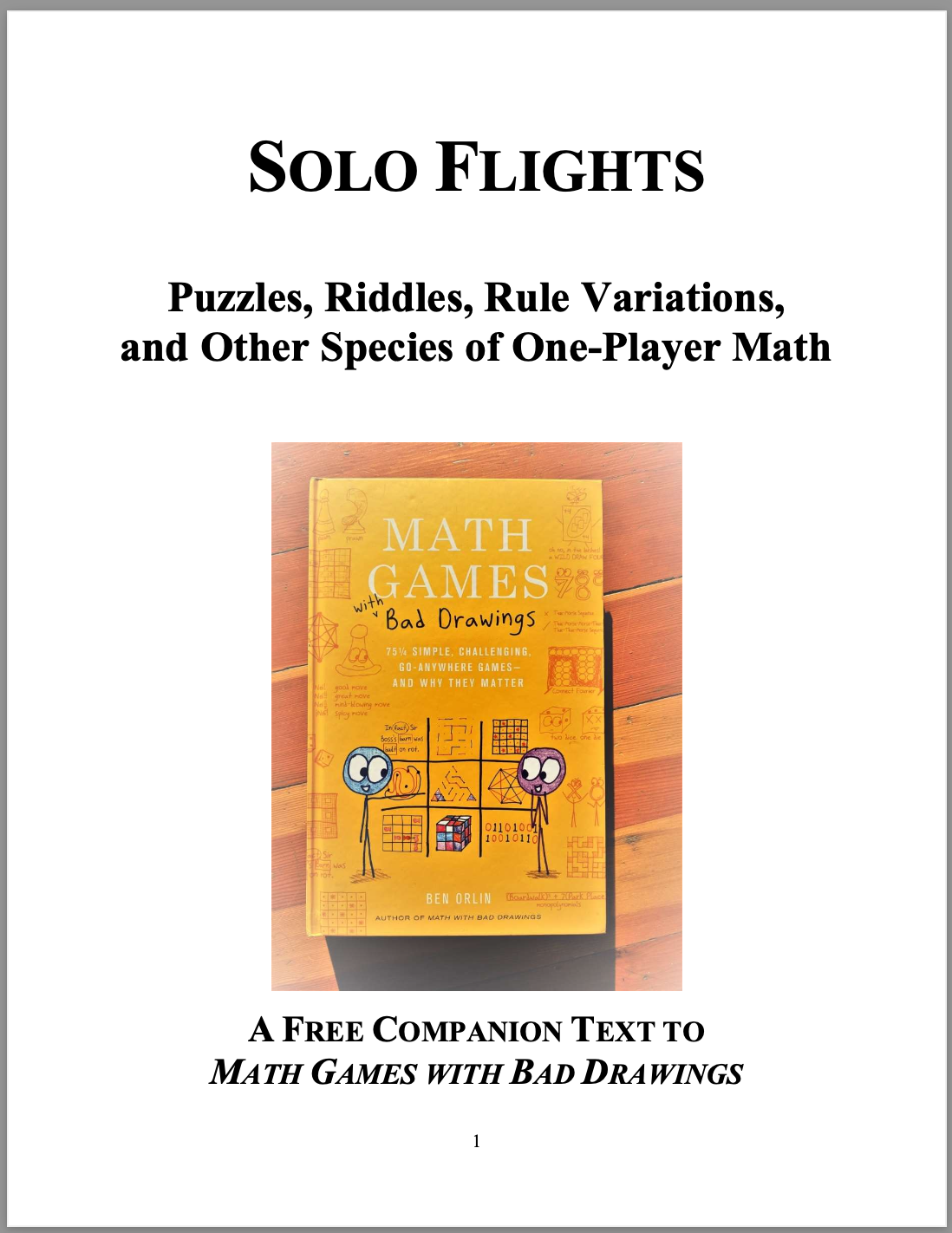
Speaking of mathematical games, Ben Orlin has released a book of solitaire games as a follow-up to his “Math Games with Bad Drawings”. It’s available for free on his website as a PDF, and therefore weighs infinity less than the actual book it’s a follow-up to, which is so huge it’s collapsed into a black hole under its own mass. (via Patrick Honner)

And finally: Tim Wall, the Australian group theorist, has died. According to his profile on the Australian Academy of Science website, Wall “has made highly significant and original contributions to the development of Algebra, in particular to the Theory of Groups. […] He has always instinctingly given of his ideas to his collaborators and younger colleagues.” Thanks Tim!
Mathematics is Everywhere worldwide video – call for contributions
The International Day of Mathematics (a new national day from UNESCO) will take place on 14th March 2020. This includes a collective video, to which you are invited to contribute – if you’re quick:
We are putting together a collective video for the first official International Day of Mathematics centered on this year’s topic Mathematics is Everywhere. Clips from all over the world (including yours!) will illustrate the various places where math can be found.
The idea is you record a video of 15 seconds or less showing something that people might not realise is interesting mathematically, and send it in before 21st February 2020.
For more details of what and how to submit, including technical tips, check out the Mathematics is Everywhere Worldwide Video webpage.
International Day of Mathematics
The UNESCO Executive Board decided in October 2018 to endorse a recommendation, coordinated by the International Mathematical Union, to proclaim an International Day of Mathematics on 14th March each year. This recommendation is on the agenda for the UNESCO General Conference in November 2019 an, if adopted, will have its first official celebration on 14th March 2020, where the proposed theme is ‘Mathematics is Everywhere‘.
Preparations in anticipation for the adoption seem to be heating up, with a publicity drive underway. The IDM website says it will share free materials, projects, ideas and software, as well as a map of worldwide events and gatherings, all in multiple languages and under open licenses. You can sign up for a “one or two emails per month at most” mailing list to keep informed.
More information: The IMU wants to make π Day the International Day of Mathematics (October 2018).
I’m streaming digits of π for π day
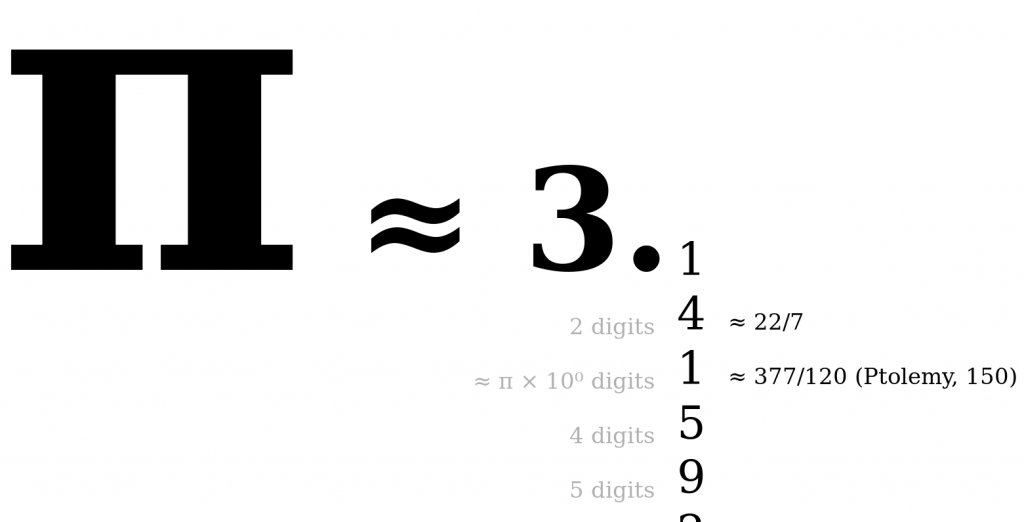
It’s π eve, and I’ve had a silly idea: I’m going to take the ridiculous website I made to show all the digits of π, and stream it scrolling indefinitely through them over the internet.
Starting at midnight GMT on 2019-03-14, the stream below will start scrolling down through the digits of π:
I had this idea this morning, and it’s running on my desktop PC which I’ll be away from until 8am tomorrow, so I won’t be surprised if something goes wrong.
But if it doesn’t: hooray!
Doodling for π day
It’s that time of year again – 3.14 (March 14th), a.k.a π day, is just around the corner, and if you want to do something fun on the day, now’s the time to plan it. One nice way to celebrate this brilliant infinite string of digits is by creating π-inspired art, and we’ve spotted a couple of relevant links if that’s your jam.