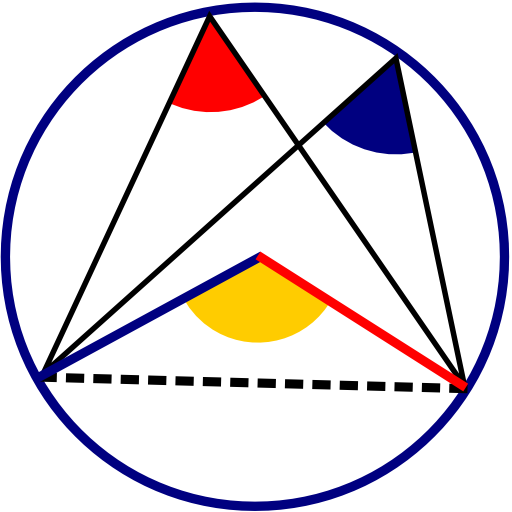
In a classic example of the intersection between maths and news, there’s been a new Mersenne prime discovered! Mersenne primes are numbers of the form $2^p – 1$, where $p$ is a prime number. They’re highly valued as a source of large prime numbers, since testing the primality of a (suspected) prime of this form is much easier than for general prime numbers.
You're reading: Posts Tagged: prime numbers
Factor Conga
Quite a few designery visualisations of the prime numbers have been put out on the web recently, to varying degrees of success. Most of the time they look pretty but don’t tell you very much; the most recent example I can think of is El Patrón de los Números Primos by Jason Davies.
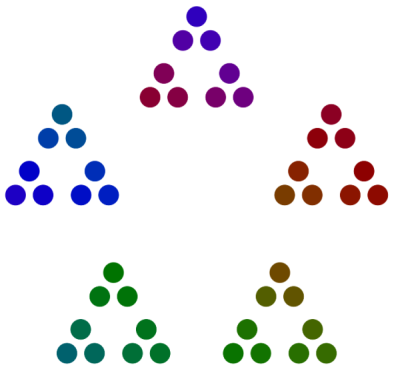
A few weeks ago Brent Yorgey posted on his excellent blog The Math Less Traveled some really nice “factorization diagrams“, along with the code to produce them. Straight away, anyone with a text editor and a knack for fancy web coding set to work making the animated version that was so clearly required.
Stephen von Worley has made, I think, the nicest one. He calls it the Factor Conga. Sit back and enjoy the mysteries of the natural numbers as they dance their beguiling dance!
Interesting Esoterica Summation, volume 4
Dust off your thinking hat and do some mind-stretches because here’s another course of Interesting Maths Esoterica! It’s been several months since the last volume so this is quite a big post. I won’t mind if you skim it.
In case you’re new to this: every now and then I encounter a paper or a book or an article that grabs my interest but isn’t directly useful for anything. It might be about some niche sub-sub-subtopic I’ve never heard of, or it might talk about something old from a new angle, or it might just have a funny title. I put these things in my Interesting Esoterica collection on Mendeley. And then when I’ve gathered up enough, I collect them here.
Knit your mother’s sweater
Here is a clever display of the prime factorisation of the numbers 1-200 on a sweater, from knitter Sondra Eklund.
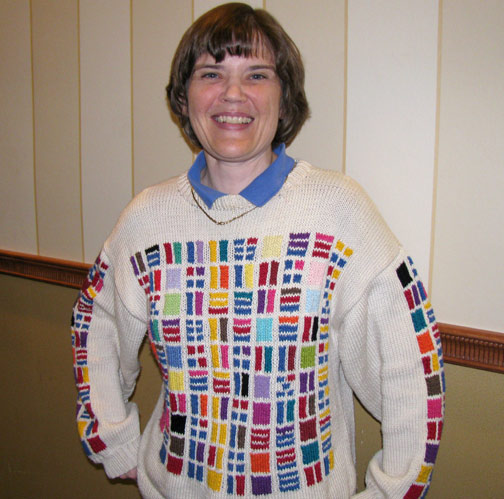
Each prime is represented (as a square) by its own colour, and luckily there’s an infinite number of both. Composites are represented by squares composed of collections of smaller squares or rectangles of appropriate colours.
She has arranged the natural numbers in columns of width ten. Interesting geometric and visual patterns emerge, and on the other side she’s knitted a version with eight to a column, which makes it easier to work in Octal.
As Sondra says, “One of the cool things about this sweater is that it works in any language and on any planet!!!”
Thanks to Ivars Peterson (on Twitter at @mathtourist) for the pointer.
Prime number puzzles from Matt Parker
As part of the Telegraph numeracy campaign “Making Britain Count”, Matt Parker’s second set of puzzles are online. This time they are themed around prime numbers.
Telegraph: Numeracy campaign: More maths puzzles by Matt Parker.