I was recently asked for some recommendations of resources for learning about probability and statistics, for someone without a strong mathematical background. I did a little digging, and have collated what I found here in case it’s useful to anyone else. Add your own suggestions in the comments!
You're reading: Posts Tagged: probability
My cat isn’t psychic – but your pet could be!
Do you remember Paul the Octopus? During the 2010 World Cup, in what his Wikipedia page calls “divinations”, Paul was offered boxes of food labelled with different competitors. Whichever box he ate from first was considered his prediction for the match, with some success.
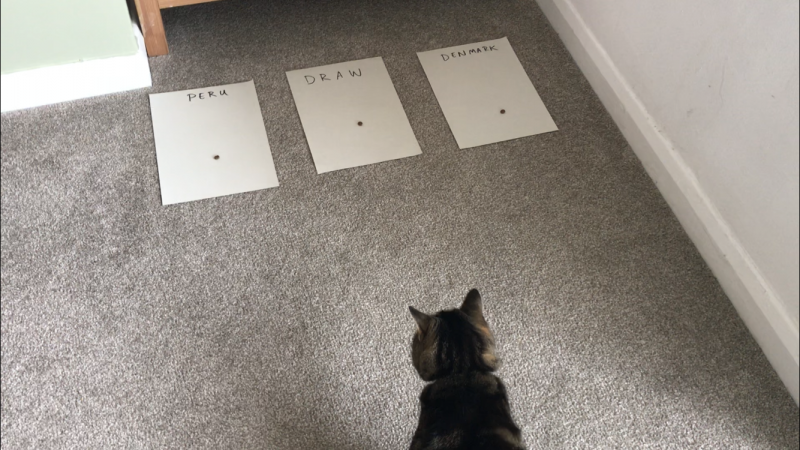
Yesterday morning, my son and I did something similar with our cat, Tabby. This is in response to Matt Parker’s latest initiative, Psychic Pets. Matt is hoping to get thousands of pet owners to make predictions, in order that the odds are good a pet can be found which predicted all prior results for both teams in the final. The good news is it’s fairly straightforward to take part.
Are you more likely to be killed by a meteor or to win the lottery?
This tweet from the QI Elves popped up on my Twitter timeline:
The odds of being crushed by a meteor are considerably lower (i.e. more likely) than those of winning the jackpot on the National Lottery.
— Quite Interesting (@qikipedia) January 11, 2018
In the account’s usual citationless factoid style, the Elves state that you’re more likely to be crushed by a meteor than to win the jackpot on the lottery.
The replies to this tweet were mainly along the lines of this one from my internet acquaintance Chris Mingay:
Should we not be getting almost weekly stories of people being crushed by a meteor then ?
— Chris Mingay (@GhostMutt) January 11, 2018
Yeah, why don’t we hear about people being squished by interplanetary rocks all the time? I’d tune in to that!
UK National Lottery: now 21% more balls (rounded up)
This week, it was announced that from October the UK’s National Lottery, currently operated by Camelot and already providing a veritable Merlin’s cave of probability lessons for maths teachers, will be changing the rules for its main ‘Lotto’ draw. The main changes are that a new £1m prize will be added to the raffle element you didn’t know already happens, and that matching two balls will win a free ‘lucky dip’ ticket in the subsequent draw. The fixed £25 prize for matching three balls remains on the round table (even though it sometimes causes hilarious number gaffes).
But the Sword of Damocles hanging over Camelot’s changes is that there will be an extra ten balls to choose six from (59 instead of 49), dramatically lengthening the odds of winning all of the pre-existing prizes. This is our round-up of the media’s coverage of this mathematical “news”.
Probability of dealing four perfect hands of cards in a world of random shufflers
A couple of months ago (really? Two years?! Man!) I posted about an extraordinary coincidence: in a game of whist at a village hall in Kineton, Warwickshire, each of four players had been dealt an entire suit each. My post ‘Four perfect hands: An event never seen before (right?)‘ discussed this story. What really interested me was that the quoted mathematical analysis — and figure of 2,235,197,406,895,366,368,301,559,999 to 1 — appears to be correct; what lets down the piece is poor modelling. The probability calculated relies on the assumption that the deck is completely randomly ordered. Apart from the fact that new decks of cards come sorted into suits, whist is a game of collecting like cards together, so a coincidental ordering must be made more likely. Still unlikely enough to be worthy of mention in a local paper, maybe, but not “this is the first time this hand has ever been dealt in the history of the game”-unlikely.
Anyway, last week I was asked where the quoted figure 2,235,197,406,895,366,368,301,559,999 to 1 actually comes from. Here’s my shot at it.
The Chris Tarrant Problem
This is a puzzle I presented at the MathsJam conference. It’s a problem that gave me a headache for a week or so, and I thought others might enjoy it, too. I do know the answer, but I’m not going to give it away — you can tweet me @icecolbeveridge if you want to discuss your theories! (As Colin Wright says: don’t tell people the answer).
You’ve heard of the Monty Hall Problem, right?
Cushing your luck: properties of randomly chosen numbers
Long-time Aperiodical muse David Cushing has made a bet with us that he can give us an interesting post every Friday for the next ten weeks. Every week that he sends a post, we buy him a bar of chocolate. Every week that he doesn’t send us a post, he buys us a bar of chocolate. For his first trick, David is going to do some unnatural things with the natural numbers.
The greatest common divisor (gcd) of two or more integers is the greatest integer that evenly divides those integers. For example, the gcd of $8$ and $12$ is $4$ (usually written as $\gcd(8,12)=4$). Two integers are called coprime (or “relatively prime”) if their gcd is equal to $1$.
A reasonable question to ask is,
Given two randomly chosen integers $a$ and $b$, what is the probability that $\gcd(a,b)=1$?